SmallSlanders
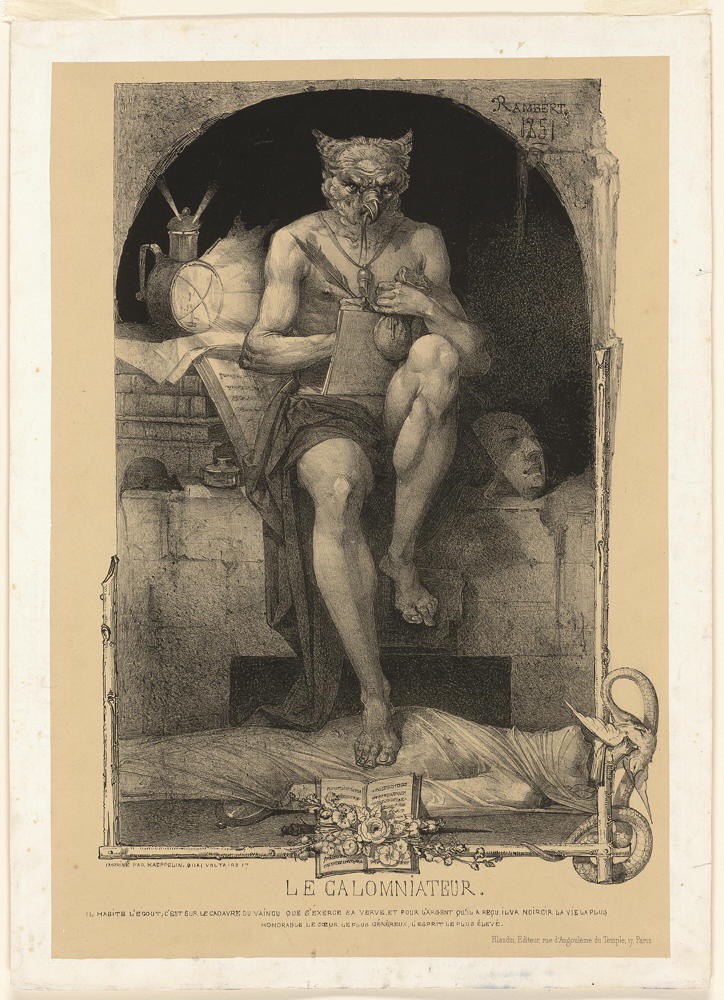
Charles Rambert: The Slanderer (1851)
"…therein lies its rub."
Early American newspapers were filled with slanders great and small, though their limited distribution rendered them relatively benign. Thomas Jefferson famously railed on about the destructive nature of the popular press, yet still concluded, “Were it left to me to decide whether we should have a government without newspapers, or newspapers without a government, I should not hesitate a moment to prefer the latter.” The press never suggested it was anything more than the first draft of history, anyway, rather than anybody’s final word. That history continues unfolding today in all of its original contention and more. Social Media easily amplifies SmallSlanders into much broader coverage. Even a half-baked lie can today even more quickly circumnavigate the globe before truth puts on his shoes. Some days, it seems as though truth cannot find its shoes and so simply slumps back into snoozing. I worry about the SmallSlanders and find them continually unsettling.
The Muse has finally managed to get sideways with some portion of her constituency. As a proudly elected commissioner of the local Port Commission, she enjoyed just over two years in that position without much in the way of controversy. We both acknowledged that some issue would eventually prove capable of cauterizing that universal support into factions. We watched it arriving in the form of a decision to sell some industrial property to a data center development company. Torches and pitchforks turned out for that fateful session, where the commission agreed to perfect the letter of intent by agreeing to terms. Only two testified in support of the motion; the rest seemingly deeply disturbed about some aspect of the imagined transaction. The commissioners didn’t yet have a specific list of particulars, let alone anything resembling final specifications, but the anticipation proved more than sufficient to fuel heated accusations. The local Social Media featured scandalous assertions, mostly falsehoods or prejudices rather than facts or questions. Portraits of the accusers more than of the accused Muse.
I reflected later that our Social Media experience seems to have encouraged a kind of Napoleonic ethic in our public rhetoric. We suddenly seem to be guilty until somehow proven innocent, with any odd accusation capable of smearing even the better original intentions. There’s no defence in advance of such attacks because the accuser stands in as the sole judge, jury, and gleeful executioner. The initial assertion rarely questions a premise or even an intention. It rather insists that the worst possible interpretation serves as the basis for resolving even the more misguided question. Often, these lines of questioning double-bind everyone involved, leaving little latitude for one who never had to stop beating their dog because they never owned one. Accusers perceive attempts to clarify in such situations as clear evidence of further deception, cleverly unmasked, as if they were successfully avoiding a fast one. It might, in theory, prove possible to be found innocent by a jury of peers, but a jury comprised of dedicated detractors and conspiracy theorists deals exclusively in SmallSlanders, leaving any accused guilty as charged, guilty as original sin.
The effortlessly invisible amplification Social Media enables seems to encourage vicious assaults. It’s literally no sweat to take a swipe that might even decide the controversy without eliciting even a sufficiently cowed response. There is no effective defense against such insidious assertions, however justified any accuser might feel. Often, the accused seems more powerful, and Social Media serves as the relatively powerless accuser’s force multiplier, providing genuine dog-piling power. If all was never fair in such contentions, all sure seems fair when facing some imagined faceless bureaucrat. The notion of asking clarifying questions or engaging in co-equal inquiry rarely seems justified in the light of an imagined sleight. Any attempt to explain or, heaven forbid, justify a position only further solidifies the opposition’s opinion. They seem to demand an immediate acceptance they refuse to accept themselves for their perspective, for they seem to feel that they’re not merely dealing in perspective, but something much more absolute, like truth, justice, or something akin to an all-American Way. They might be right.
Social Media remains indifferent, incapable of caring one way or any other. It seems venial and innocent, mere medium. Those who employ it often seem to underestimate its subtly underlying authority, though. The casual poster rarely suspects when they inadvertently start an avalanche. It behooves every user to at least try to be circumspect and avoid attempting to wreak vengeance there where nobody can look their counterpoint in the eye to judge the quality of their testimony. Social Media serves as more echo chamber than recording studio, the resonance more accidental than purposeful. What might sound sweet to the singer’s ear often proves annoying to those waiting in line for their turn. We do not always converse via Social Media, but scream across impenetrable voids. We cannot reliably intuit intention or interpret anybody’s underlying purpose there. We should probably question more than we assert, but we don’t. We seem to almost exclusively use Social Media to assert, and therein lies its rub.
©2026 by David A. Schmaltz - all rights reserved
Good For A Goose

Decency (90)
Decency Unscrolling (1)
EndDays (92)
Exiled (90)
Fambly (93)
FollowingChapters (93)
Grace (92)
Humor (2)
iAlogue (1)
Letters to the Editor (1)
NextWorld (91)
Personal (18)
Prosperity (23)
Steam Festival (4)
Unscrolling (89)
Vaporized (6)
Work (16)
June 2026
May 2026
April 2026
March 2026
February 2026
January 2026
December 2025
November 2025
October 2025
September 2025
August 2025
July 2025
June 2025
May 2025
April 2025
March 2025
February 2025
January 2025
December 2024
November 2024
October 2024
September 2024
August 2024
July 2024
June 2024
May 2024
April 2024
March 2024
November 2006
October 2006
September 2006
August 2006
July 2006
June 2006
May 2006
April 2006
March 2006
February 2006
January 2006