Amsperity
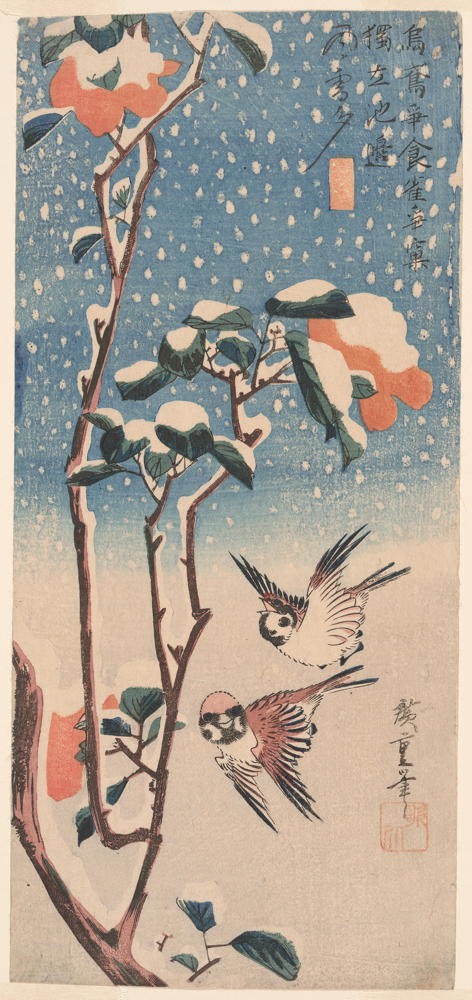
Utagawa Hiroshige 歌川 広重
Sparrows and Camellia in Snow
(c. 1831-33)
"Who, besides such conglomerates, benefits?"
We believe ourselves to be much more skilled at producing and retaining Prosperity than we have generally proven to be in practice. In practice, we have a long history of back-and-forth vacillations. We label these “business cycles” and consider them evidence of nothing more worrisome than The Normals, but these downturns do real damage. Were we more skilled or even professionals at producing and maintaining Prosperity, we might well have eliminated by now the disparities between haves and have-nots. It seems that some subgroup of haves always tries to nudge above their station to take a monopolist’s position in something that might thrive only through egalitarianism. Oh, the nudgers tend to equate egalitarianism with something dreadfully dangerous like communism or socialism, while committing what might be recognized as acts of antisocialism. These purposefully cruel and awfully unusual acts reliably undermine the general welfare and thereby Prosperity, for the myopic purpose of lining their own pockets. Our Prosperity frequently fails us, but usually only because we fail ourselves first.
We seem to be rank amateurs when it comes to producing and preserving our Prosperity. We produce Amsperity instead, balancing what might have become a more permanent Prosperity on essentially the head of some popular ideological pin. We seem to hold enough myths about Prosperity’s origin that we undermine what it might have become in practice. We lack some of the patience required to nurture anything worthwhile into a more permanent existence. We make all the expected mistakes, then make the rookiest of all mistakes by taking those innocent mistakes more seriously than any mere mistake ever warrants. We tend to panic in the face of even fuzzy potential dangers, just as if panicking could ever sustain or recover anything of such inestimable value. We blink and lose focus just when we should be paying even closer attention.
I doubt that filling up the curricula of our leading universities could do much more than further damage our collective ability to nurture our Prosperities. A huge part of the problem we face can be traced back to the certainties taught in those very universities. Economics may never have enjoyed the rigor that the physical sciences do. Their study has often centered on some attractive personality. The Lauffer Curve and shareholder value each took the spotlight for a spell. Depending upon which “school” a scholar followed, they might prescribe the opposite of what might pass for common sense or even decency. People get really funny whenever money enters any conversation. Voices grow quieter as if in humbled acknowledgment that some invisible hand might be listening in and could be offended. We tend to play Blind Man’s Bluff with our money, trusting in invisible appendages or some academic’s depiction of a God to guide our superstitious hands. The professionals might well be worse than the amateurs at preserving the Prosperity we each depend upon.
We are an impatient people, serially disappointed in ourselves. We firmly believe that we should be further along toward our goals than we ever seem to be. We are more likely to shift our investments based on some unsubstantiated rumor than to shift them as part of any well-considered strategy. Depending upon which party holds the Presidency, fiscal policy might be reasonably sane or batshit crazy. We are presently lip-deep in one of our periodic batshit crazy periods. It might be practically impossible to retain Prosperity during any truly batshit crazy period, regardless of anyone’s underlying expertise. We have an improbability generator behind the wheel, and we’re expected to pay HIS bills. I set my compass on eroding my Prosperity at least until this clown finally enters infamy. Maybe, I reason, we’ll see reason after this period of absolute insanity undermines our economy again. Probably not. We’ll likely settle on even more Amsperity instead.
Not one of us could possibly qualify as an island. We’re perhaps not equally vulnerable, though we’re all clearly vulnerable to the unreasonable forces around us. When tempted with cryptocurrency, it’s incumbent upon me, and no other, to see through the fantasy and somehow retain my sense of sanity. Panic has always been my enemy, even when it has motivated me to move when I really needed to move. It most often left me further disadvantaged on this great chessboard on which my Prosperities conflict. Acknowledging my amateur status seems to help a bit. There might be no true experts in the Prosperity field. If it’s true that everyone’s Prosperity molds around their personality and preferences, all expertise where personal Prosperity’s concerned has to be local.
A friend owns a family farm in a region where most of the family farms were bought up by a conglomerate during the Great Depression. He reports that his grandfather wouldn’t buy a pair of boots on credit even if he was broke and really needed them. That frugalness translated directly into how he managed his spread. When his neighbors discovered leverage during the WWI economic boom, he declined the invitation. When the grain markets went to shit after the Armistice, they were up Shit Creek with only that conglomerate offering paddles. They and their Prosperity no longer exist. Who, besides such conglomerates, benefits?
©2026 by David A. Schmaltz - all rights reserved

Good For A Goose

Comeuppance (30)
Decency (90)
Decency Unscrolling (1)
EndDays (92)
Exiled (90)
Fambly (93)
FollowingChapters (93)
Grace (92)
Humor (2)
iAlogue (1)
Letters to the Editor (1)
NextWorld (91)
Personal (18)
Prosperity (94)
Steam Festival (4)
Unscrolling (89)
Vaporized (6)
Work (16)
September 2026
August 2026
July 2026
June 2026
May 2026
April 2026
March 2026
February 2026
January 2026
December 2025
November 2025
October 2025
September 2025
August 2025
July 2025
June 2025
May 2025
April 2025
March 2025
February 2025
January 2025
December 2024
November 2024
October 2024
September 2024
August 2024
July 2024
June 2024
May 2024
April 2024
March 2024
November 2006
October 2006
September 2006
August 2006
July 2006
June 2006
May 2006
April 2006
March 2006
February 2006
January 2006