Classifying
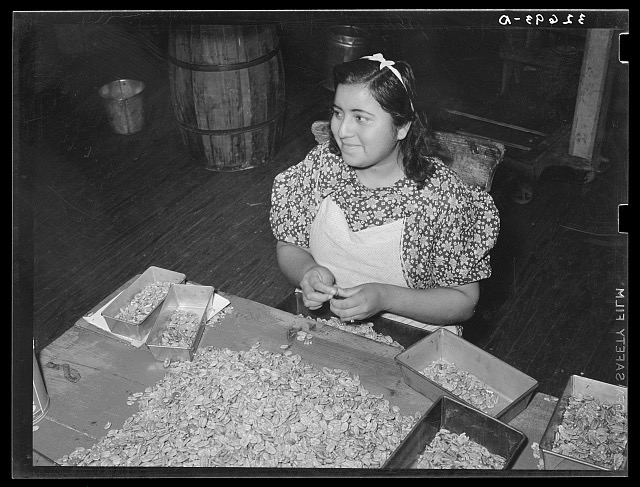
Russell Lee,
United States. Farm Security Administration
Classifying pecan meats. Pecan shelling plant. San Antonio, Texas
(1939)
"…I must be the source of all the Prosperities inevitably surrounding me."
This is not just a game. I have been considering Prosperity, mine as well as ours, for just over forty days and nights now, a suitably Biblical time span, and I am drawing two tentative conclusions, since I can’t seem to decide anything conclusively, nor should I. The first, which I have previously already heavily hinted at, must be that Prosperity only exists as a plural rather than a singular entity. Sanity insists that it always be understood as a multitude rather than as a singular state. It exists only in array. This translates into an understanding that no Prosperity ever stands alone. When I spot a Prosperity, this means that more must be lurking nearby. Prosperity seems to exclusively travels in flocks, herds, schools, or pairs, never “batch.”
The second tentative conclusion I simply must draw from my inquiry so far might seem as if I’m somehow cheating, and truth told, I might be cheating if Hoyle is judging.
Weekly Writing Summary For The Week Ending 07/30/2026
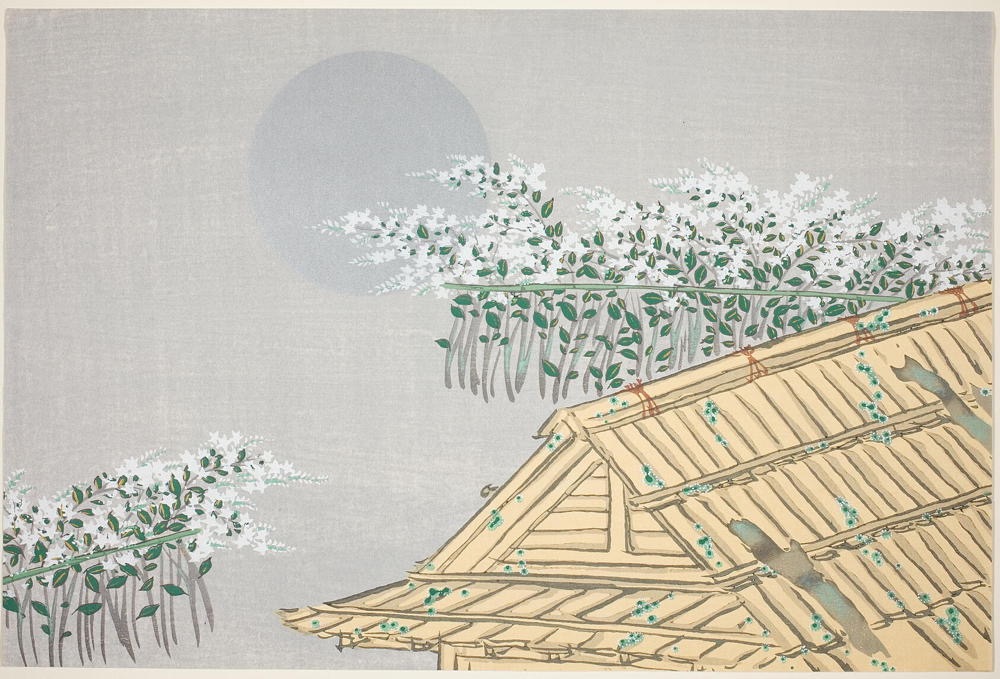
Kamisaka Sekka
Moonlit Scene with Hut and Flowers,
from the series “Worlds of Things (Momoyogusa)”
(1909/10)
This week's Prosperity dispatches arrived as The Muse settled into her dining room recovery center, and I slipped into the familiar role of Nurse Jane Fuzzy Wuzzy. The writing ranged from the slow cruise of InPassing to the firmware-induced disaster of PitchingCodes, from the radical egalitarianism of H-e-a-l-i-n-g to the civic act of Choosers, from the miraculous appearance of Angeli to the philosophical reframe of PreProsperous. The series discovered this week that broken ankles attract angels, that H-e-a-l-i-n-g keeps its own counsel, and that the billionaire class remains stubbornly PreProsperous. The Muse is already removing her own boot unaided. The Angeli are settling in for a productive engagement.
Thank you for following along!
PreProsperous
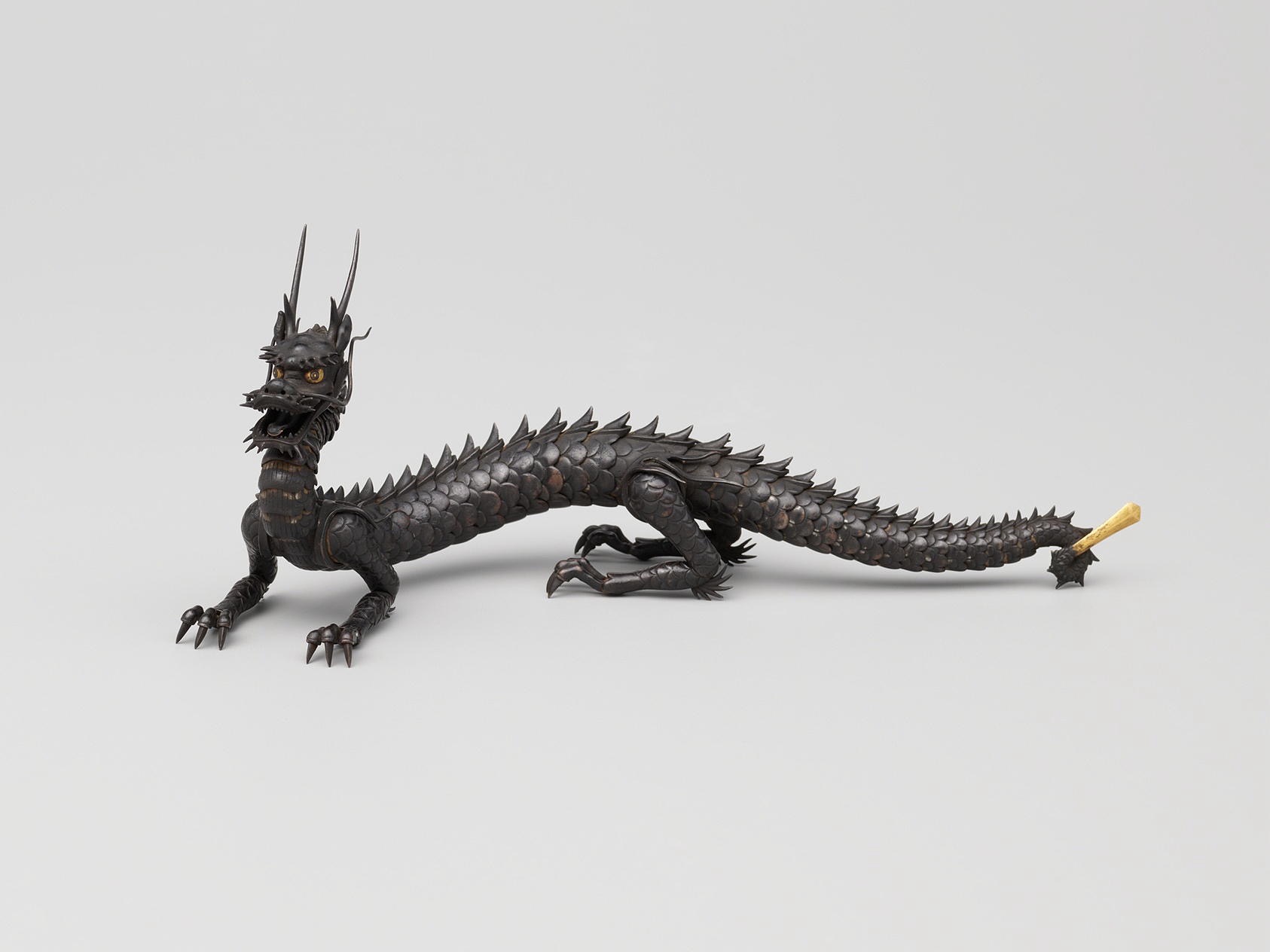
Myochin School
Japanese, active late 19th century
Articulated Dragon
(c. 1880)
"With successes like that, who really requires failure?"
You might have noticed the very wealthy, the billionaire class, reliably behaving preposterously. This behavior highlights a key dichotomy between wealth and Prosperity. While wealth requires control of vast financial resources, Prosperity doesn’t, or doesn’t necessarily require great wealth. It might be easier, stealing this metaphor from the Bible, for any run-of-the-mill camel to pass through a needle’s eye than for the extremely wealthy to ever experience Prosperity, or so their public behavior suggests. Prosperity seems to be mostly mindset, and only partly contingent on possessing anything resembling excess wealth.
Just look at what the very wealthy tend to do when encountering a budget, for instance.
Angeli
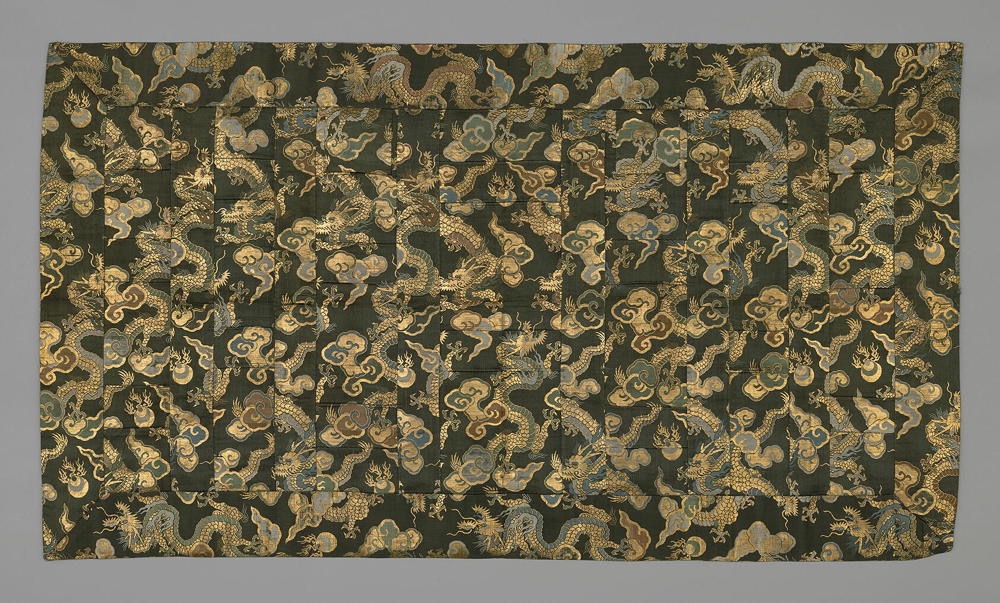
Kamisaka Sekka
Kesa
(late Edo period (1789–1868), early 19th century)
"I ascribe that recovery to the presence of Angeli…"
As for angels, they seem the most mysterious presences. They are said to exist without much in the way of physical evidence. They’ve received ample literary mention over the centuries without leaving foot or fingerprints. They might most often appear when really needed, bringing with them some form of salvation. Their biggest gig was the night Jesus was said to have been born, rousing shepherds and encouraging otherwise skeptical wisemen. They managed a physical presence in that mythical manger, and glory really shone around, according to eyewitness testimony. Otherwise, they regularly appear in statuary and classical paintings, inevitably wearing halos. Popes and potentates have traditionally insisted that their decorators employ Angeli to lend a sense of divine association. Generally speaking, the more terrible the king, the more they relied upon Angeli images to sanctify their tyranny.
An early twenty-first-century person might never encounter an angel, even in passing.
Choosers
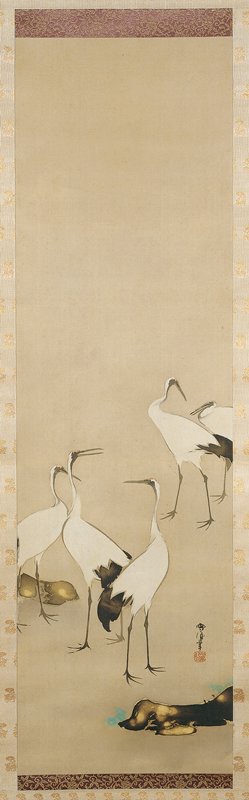
Kamisaka Sekka
Cranes
(Late 19th, Early 20th Century)
“Autocracy only ever works after The People have convinced themselves they’re beggars rather than Choosers.”
Beggars can’t be Choosers, or so my mother insisted. She implied that if you’re not Prosperous, you’re relegated to having to take whatever’s left over after the Choosers have satisfied themselves. This notion seems the opposite of self-determination, that bedrock principle this Democracy was founded upon. This seems the belief of the dedicated second-class citizen, who, all E Pluribus Unum aside, understands the position they inhabit in polite society and won’t raise a fuss at a little inequity between friends or fellow citizens. It defines complacency to know the rules were set up against your own best interests and to support them anyway as a self-sacrificial civic responsibility. Beggars can’t be choosers. That’s just the way life is.
The Prosperous, though, do get to choose.
H-e-a-l-i-n-g
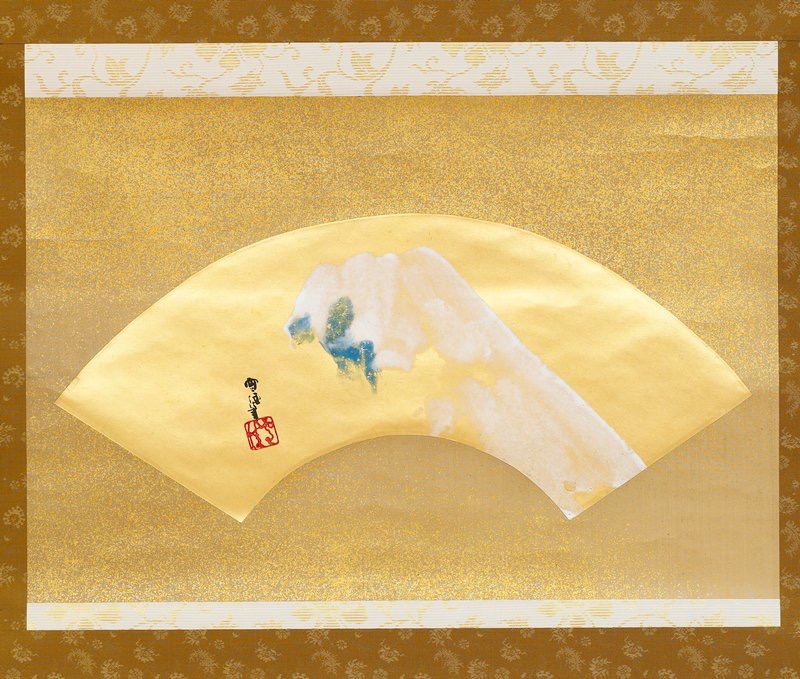
Kamisaka Sekka
Mt. Fuji
(1920s-30s)
"Out of many, one: Pluribus Unum, dammit!"
Healing might be the most egalitarian activity humans ever engage in. It knows no privilege or favor. It moves exclusively at one seemingly inexorable pace regardless of anybody’s relative Prosperity. It keeps its own counsel that everyone must accept and that they just get to guess at. The doctors and therapists predicted six to eight weeks before The Muse’s broken ankles might be fit for use again, but that projection was tempered with a terribly deliberate ‘more or less’ neither of us missed. Someone suggested that acupuncture might shorten that time by a week or more, but, honestly, why bother? Healing wasn’t supposed to be either a race or a competition. There’s nothing to be won if one heals faster or slower than the average, which trends toward the inexorable. There might be something worth learning either way, though.
Healing belongs in that class of human activities of which no human can ever become the master.
PitchingCodes
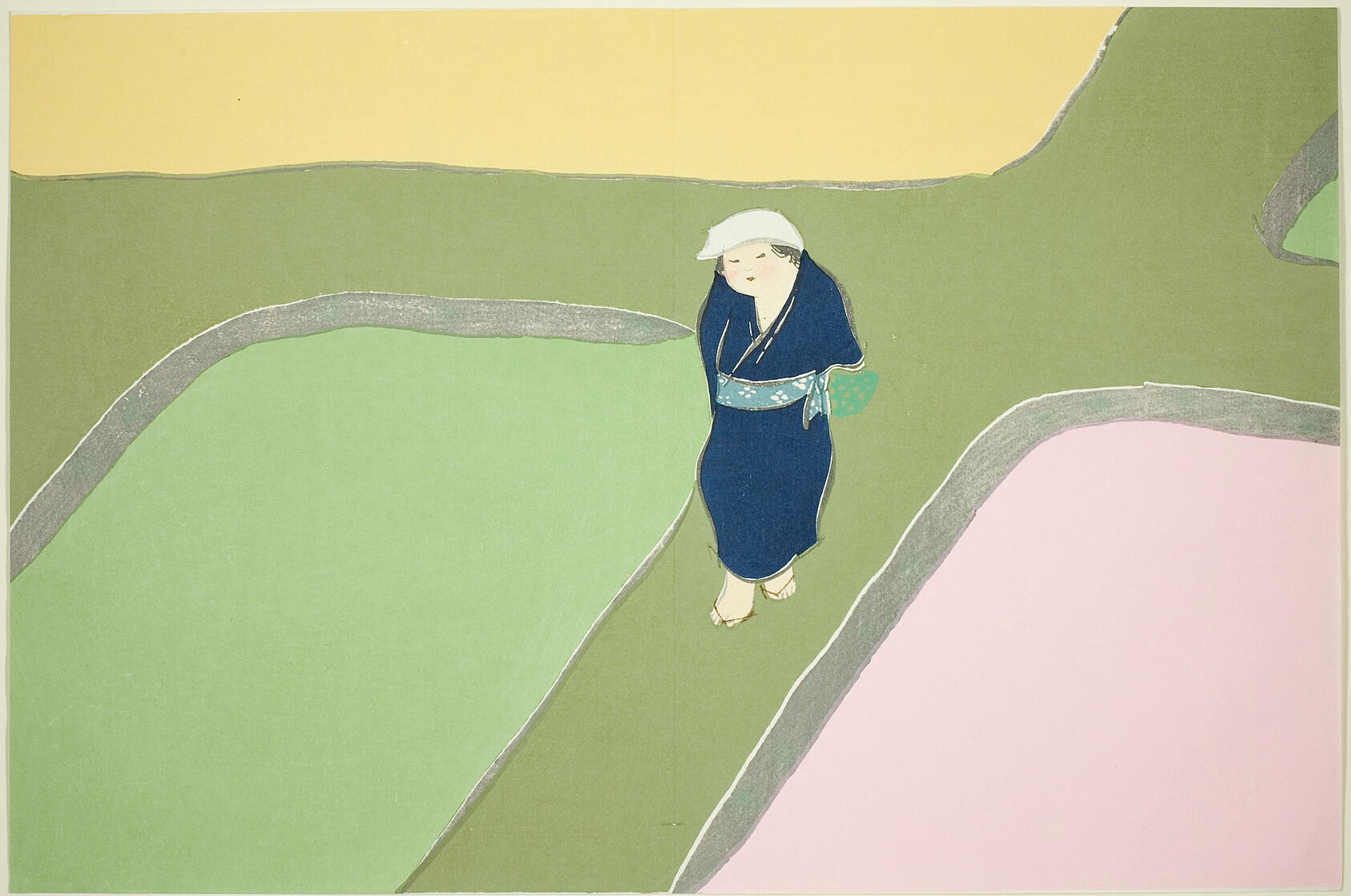
Kamisaka Sekka
A Walk Around the Paddy Fields,
from the series “A World of Things (Momoyogusa)”
(1909/10)
"…another snake satisfyingly gnawing on its own tail."
Prosperity attracts an ever-increasing number of so-called smart stuff. Smart® being a designation rather than a definition. So-called Smart® stuff sure seems stupid sometimes, in the same way that Artificial Intelligence intends to be interpreted with the emphasis on the Artificial part. What passes for Artificial Intelligence® barely registers as clever in practice, but the shady art of branding demands that capabilities always be inflated. Smart® cars were just tiny. Smart® phones weren’t really phones at all. Smart (no ®) people just seem self-aggrandizing, for they sure seem just as stupid as the rest of us put together in practice. So it always was and, as near as I can tell, so it will probably always be.
Our new Smart® irrigation system controller, trademarked “Irrigreen”, failed us during our recent absence.
InPassing
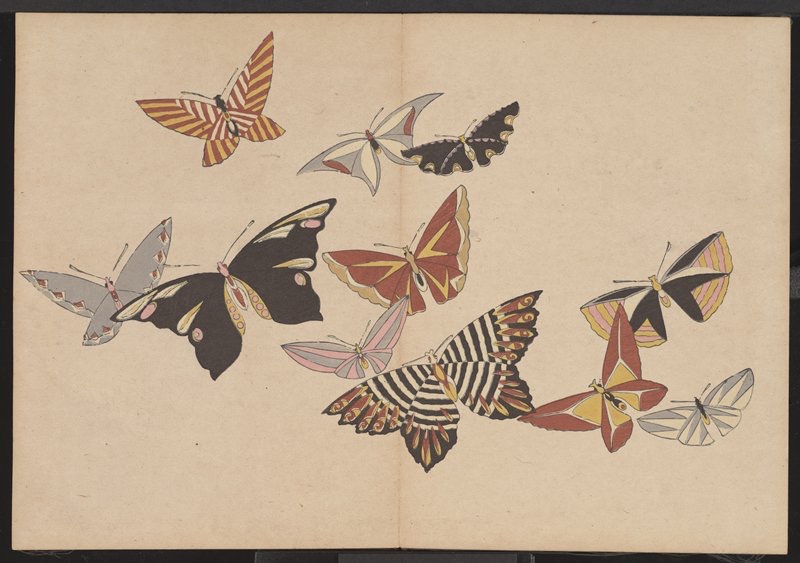
Kamisaka Sekka
All Kinds of Butterflies, Vol. 1
Publisher: Unsōdō
(February 1908)
"… might it just slip by unaware that it was ever anywhere special?"
Washington Highway 28 up and out of East Wenatchee, Washington, in the direction of Quincy, terrifies me. It’s a standard sixty-per-hour two-lane that climbs up through orchards and precipitous views, with a few passing lanes to drain off the race car drivers’ frustrations when they find themselves behind drivers like me, freely exercising their Prosperities. I feel the sensation of the highway tilting at odd angles, as if trying to shake me off one of those impressive cliffs overlooking Crescent Bar or The Gorge Amphitheater and into the Columbia River far below. I drive this road slow, continually feeling as if I’m oversteering. I accumulate a line of Speed Racers behind me who seem dissatisfied with my frantic-feeling forty-five.
I understand that for many, even vacation driving amounts to just another segment in a never-ending race car race.
Weekly Writing Summary For The Week Ending 07/23/2026
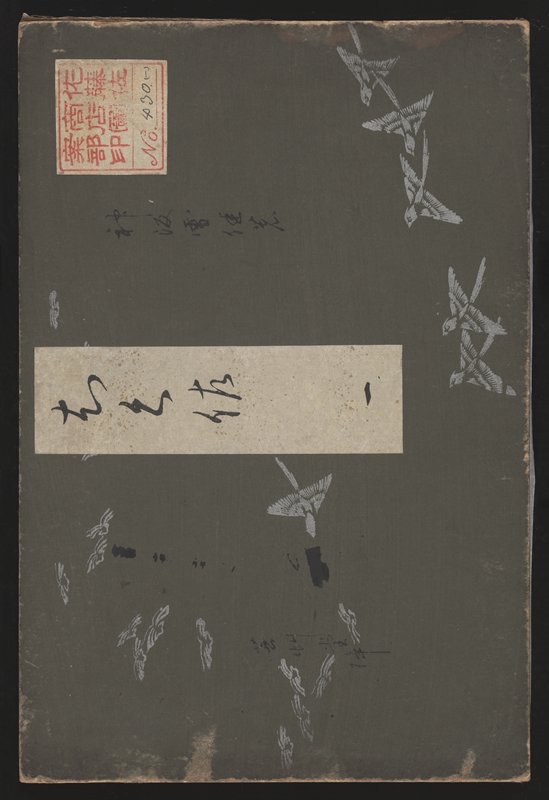
Kamisaka Sekka
All Kinds of Things, Vol. 1
(April 1903)
This week’s Prosperity dispatches arrived through the most consequential week of the series so far. The writing ranged from the self-knowledge of Stingy to the book signing revelation of Discovering, from the fragility of Damnocles to The Muse’s literal BreakPoint on an uneven Wenatchee curb, from the WrestlingAngels who populated an impossibly long afternoon of hospital logistics to the Ghostlies haunting a smoky, uncertain present. The sword of Damnocles fell this week — not as metaphor but as fact. The series has been preparing for exactly this moment for thirty-three installments.
Thank you for following along!
Ghostlies
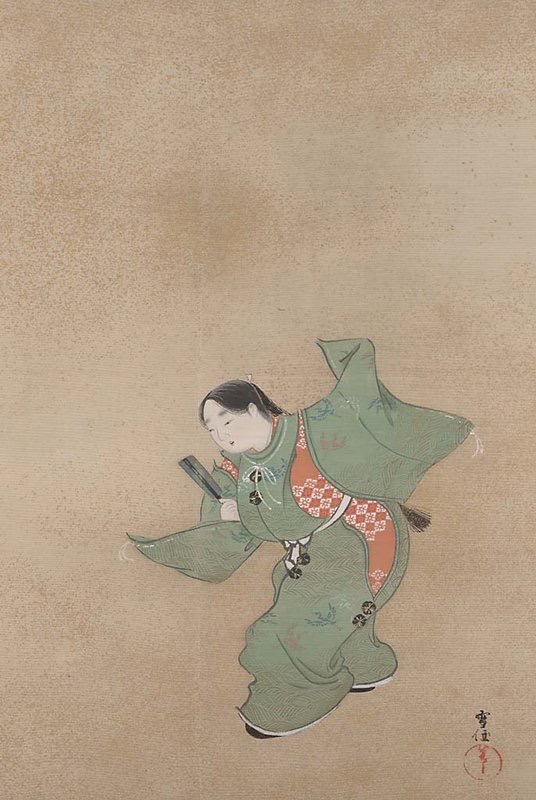
Kamisaka Sekka
Longevity Dance
(1910s-20s)
"…after a period of swirling smoke obscuring past along with potential."
Wenatchee, Washington, the self-proclaimed Apple Capitol of the World, turned out to provide the perfect backdrop for The Muse’s fell swoop and resulting Prosperity transformation. It was ungodly hot there that week, with forest and range fires encircling and intermittent strong winds relentlessly pumping obscuring smoke. The surrounding foothills, brutal barren mountains to my eye, faded in and out of focus, in and out of apparent presence, appearing mostly ghostly rather than in any way substantial. I had previously spent no time in the area, so it served as a near-perfect blank canvas upon which to represent whatever I might imagine about our future and present. Following The Muse’s BreakPoint, I imagined plenty but of little substance. Our accustomed Prosperities had abandoned us there in this curiously welcoming wasteland, opening us to suggestions of replacements.
Our imaginations were encumbered by all we had experienced before.
WrestlingAngels
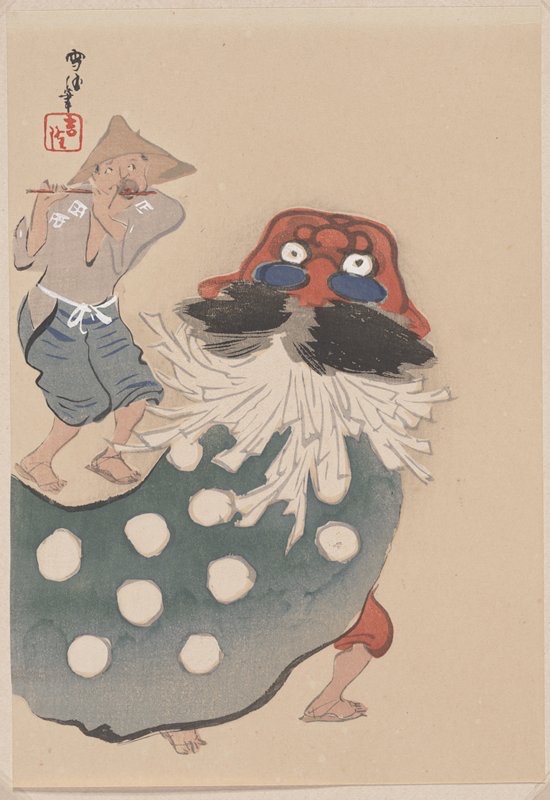
Kamisaka Sekka
Lion dancer
(1920s)
"…an inevitable side effect of switching out former Prosperities for some cranky new fresh ones, of WrestlingAngels."
Fresh Prosperities do not necessarily quietly surrender themselves into existence. The process more closely resembles WrestlingAngels, for while they might eventually surrender, they rarely do so quietly. Fresh Prosperities might be said to be inherently noisy, fussy, as if equal parts impatient and impertinent, aching more to be conquered than accepted. Perhaps they are chartered under a variant of the No Free Lunches Rule, which seems to insist upon satisfying some twisted notion of worthiness before acquiescing into any acceptances. Those who insist that they somehow deserve any Prosperity seem ready and waiting for some form of rude awakening, for, like angels themselves, Prosperities are nobody’s pushovers, and might well insist upon disturbing conditions, not the least of which includes accepting the budding realization that Prosperities get to choose who wins and who loses them. Since not a single beneficiary in the history of this universe so far, ever once deserved their eventual Prosperity, every angel’s insistence upon deciding for can prove to feel at least alarming, often worse.
When The Muse managed to break both ankles in one literal fell swoop, the resulting BreakPoint left a formerly stable Prosperity gasping.
BreakPoint
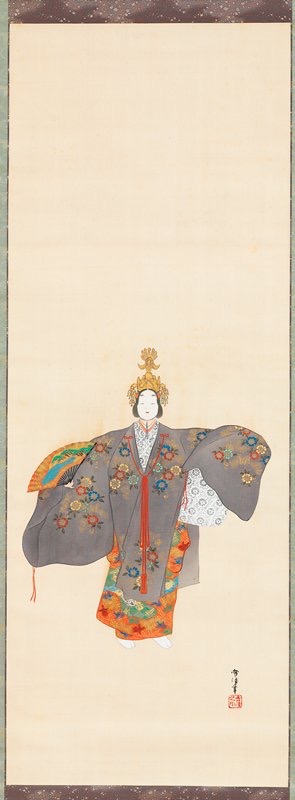
Kamisaka Sekka
Noh Scene: Hagoromo
(1920s-30s)
"…might some surprising Prosperity settle in for the duration of even this?"
That Sword of Damnocles works in seemingly inexorable ways. Each Prosperity, as I’ve already proposed, stretches only into finite if indefinite space. Each inevitably ends. This nature encourages the convection that inspires fresh Prosperities to emerge from within an often deep sense of catastrophe or loss. The most important things happen at the least convenient times. This homily has been an article of faith underlying all of my many Prosperities over at least the last three decades, and, upon more careful reflection, most probably for much longer. I believe that at any moment, an event could occur that could utterly upend every expected trajectory, opening previously unimaginable possibilities. Yesterday, The Muse quite literally stumbled into one.
She was exiting a bus after taking a tour of another Port’s properties as a part of a scheduled Port Commissioner gathering.
Damnocles
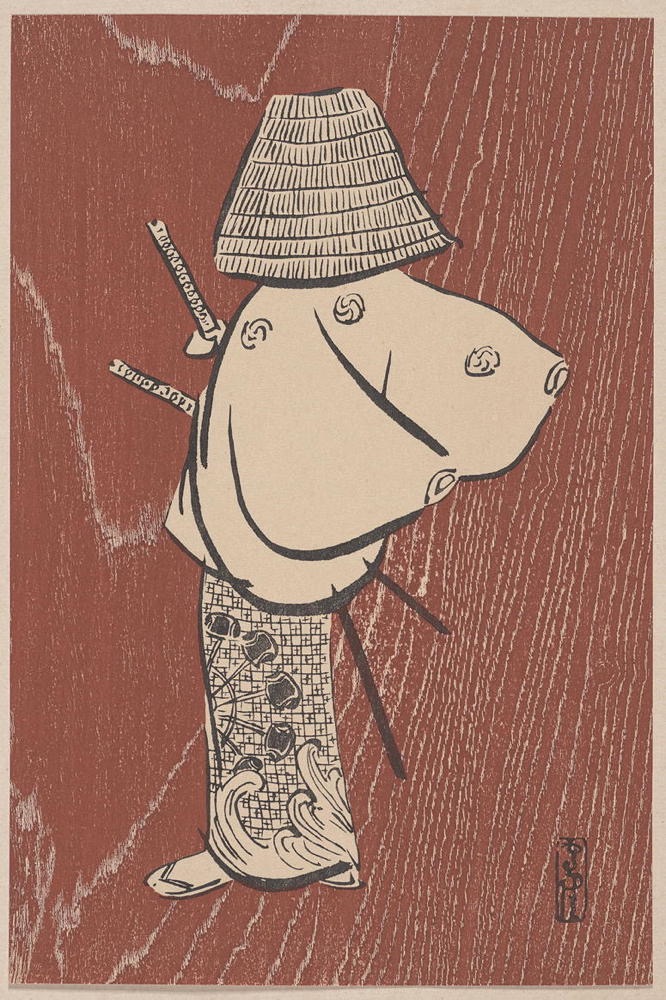
Kamisaka Sekka
Samurai
(1920s)
"Most of them must be lost in use."
We, natives of the Inland Pacific Northwest, were blessed with some of the most beautiful wild country in the world. Since we were the last part of this continent settled, we have also been the last despoiled, though our scenery’s eventual demise seems certain. Through recent summers, wildfires have become more common, and each burn turns its victim into a generational eyesore. Indeed, its virginity will never be restored. Burn woodland covered in many-centuries-old forest, and you’re left with a ghost. No one now alive will see that parcel recovered. Neither will their grandchildren.
In our valley, wheat fires seem by far the most common, and while they destroy, the crop was likely insured, and the land will be returned to productive use the following year with fresh potash fertilizing whatever’s planted.
Discovering
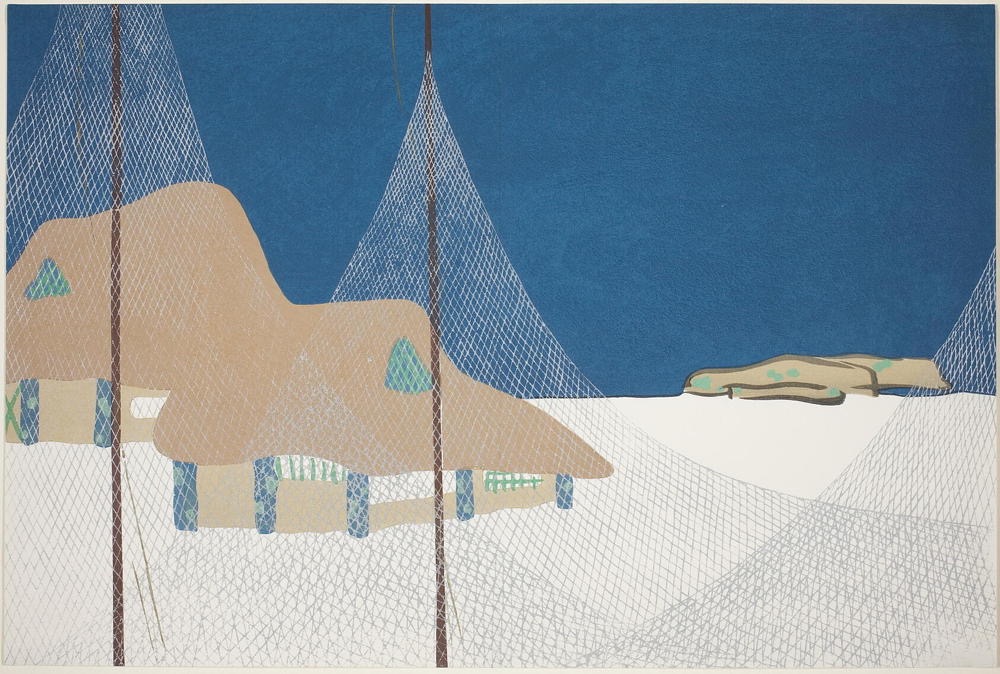
Kamisaka Sekka
Fishing Village,
from the series “A World of Things (Momoyogusa)”
(1909/10)
"I suspect the Quantum plane recognized my presence, as did I."
Once I started Discovering my Prosperities, my discoveries began to expand in earnest. The exercise was apparently not merely a matter of Discovering another Prosperity, but of stumbling upon others, many others. Having only started Discovering these additional Prosperities, I lack sufficient sample size to declare the potential I might have plugged into, but this series appears limitless from here. An unknown number of undiscovered Prosperities seems to stand before me now. I cannot see into any future, but this unknown certainly feels as if it’s infinite from here. Infinite could mean the equivalent of unknown. I need not necessarily interpret it as being an unimaginably large number. A single unknowable will do, but the potential seems much greater than any finite number, even though I could not possibly know how many additional Prosperities might be necessary to maintain this sense of infinite potential. I might estimate as many as an odd billion or so.
My point in even mentioning this phenomenon might be to merely highlight the accompanying feeling.
Stingy
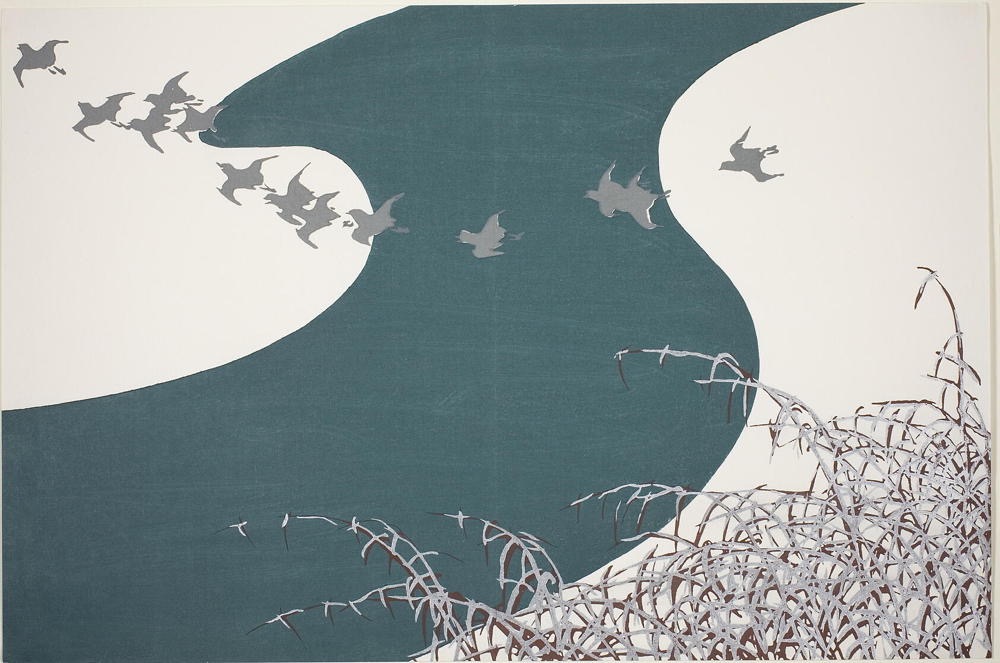
Kamisaka Sekka
Plovers Flying Across a River above Snow-Laden Reeds (Fuyu no Kawa),
from the series “Worlds of Things (Momoyogusa)”
(1878)
"…especially when in the presence of behaviors that just irk the crap out of us."
Prosperity might encourage generosity, but not automatically, never inexorably. Some seem to respond to it by suddenly turning inexplicably Stingy, as if the very presence of plenty prefaced a threatening shortage. This response does not seem at all uncommon and almost seems expected sometimes. I learned to respect others’ apparent Prosperity, to tiptoe around its perimeter with extreme care without assuming an overflowing cup inside. Those in the finest houses seemed more likely to stiff me when I went collecting for their newspaper subscription, often short of “change,” and expecting me to return to get paid. Those who lived in more ramshackle houses tended to be more generous. I was never really moved to wonder why, if only because I didn’t really want to understand. I figured I was witnessing some psychological syndrome manifesting, and that I might be better off not knowing the details behind it, lest it be contagious and spread by sharing poisoning knowledge of it.
Stingy might be an extreme form of self-protection, and, as with many of the more common forms of self-protection, it seems, at root, self-destructive.
Weekly Writing Summary For The Week Ending 07/16/2026
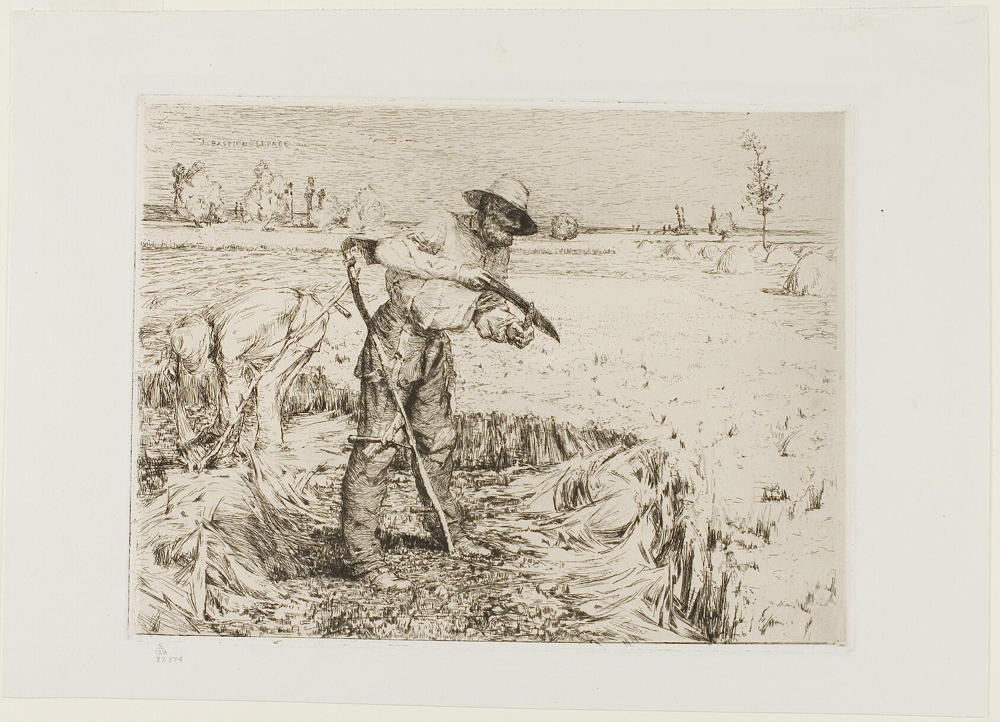
Jules Bastien-Lepage
Mower Honing a Scythe
(1878)
This week's Prosperity dispatches arrived in a week that ranged from the moral architecture of ResponsibleFor to the liberating grace of Freely, from the Fleeting Prosperity of Portland's lost most recent golden years to the non-Mammon discovery of an ancestor's homestead patent, from the faith-based initiative of MakingSpace to the fish tacos and wildfire of Bounty. The road trip that found Evan and Sara Parker Wallace's eighty acres in Umatilla County — and nearly stranded us inside an evacuation zone — produced this week's essential installment. Prosperity simultaneously means Bounty and danger. Lightning doesn't need to strike in the same place twice to leave an indelible mark.
Thank you for following along!
Bounty
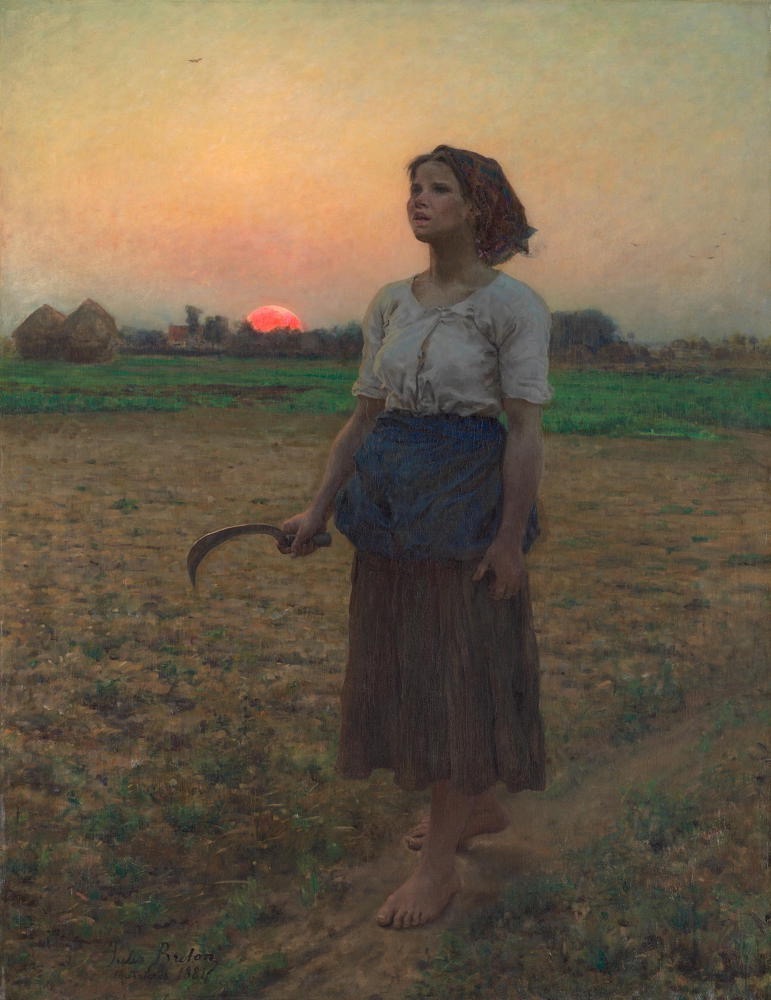
Jules Breton
The Song of the Lark
(1884)
"Lightning doesn't need to strike in the same place twice to leave an indelible mark."
By Mid-July, the Sweet Onion harvest is about over. My own modest patch needs pulling. We eat fresh this time of year, with Sockeye Salmon and the ever-present Steelhead readily available. The Muse’s cucumber crop seems happier than we’ve ever seen one, thanks to her new drip irrigation system. The fig bush has almost become a tree, continually splashed by the backyard pond fountain. It groans under the presence of an unprecedented number of rapidly ripening fruits. These are a reassuring green with the most alluring pink flesh inside. I decide that we’ll have fish tacos for supper and buy a bag of small, freshly made Masa tortillas for the purpose. A grilled eggplant, slices thoroughly saturated with olive oil before I set them on the top grill rack, completes the menu.
The salsa seems similar to what I’ve concocted before, with only the precise contents different.
MakingSpace
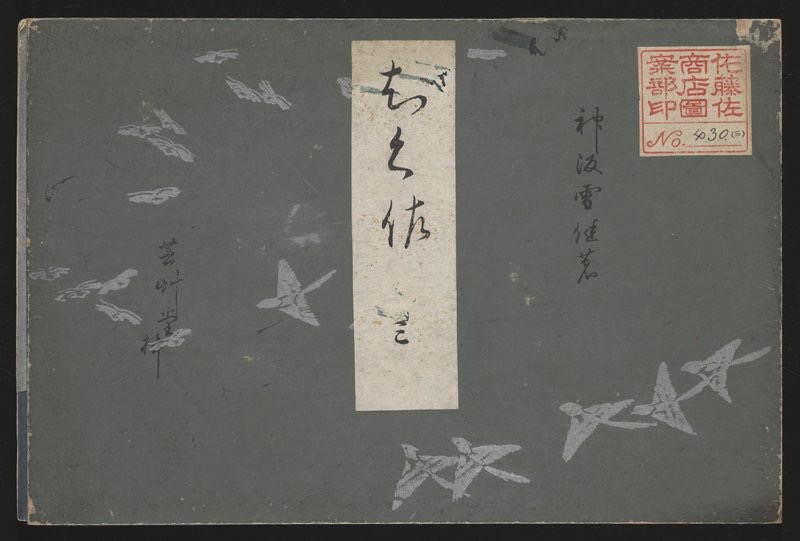
Kamisaka Sekka
All Kinds of Things
Color woodblock printed book
Publisher: Unsōdōexpand_less
(Vol. 3, April 1903)
"…I will need to make some space for a miracle to occur."
Aging must be the process by which I successively outgrow stuff. Yesterday, I finally culled three pairs of jeans I once believed that I might one day fit into again. Yesterday, inexplicably, I finally acceded to the should-have-been-easier truth that I wouldn’t be fitting into them again. I set them aside. Suddenly, my pants drawer had more than enough space for my remaining wardrobe. The Muse mentioned that she probably had a few things to add to my collection destined for the Goodwill, and all was just a little better with our world, or at least, finally threatened to be better. I had retained some prior Prosperity which had been steadfastly preventing fresh Prosperities from entering. Even if I wasn’t itching to acquire any Prosperity, those remnants had rendered my present more cluttered than Prosperous feeling. I had probably been demonstrating some principle to myself then.
Often, I finally figure out something I had been trying for ages to get myself to understand.
Mammon
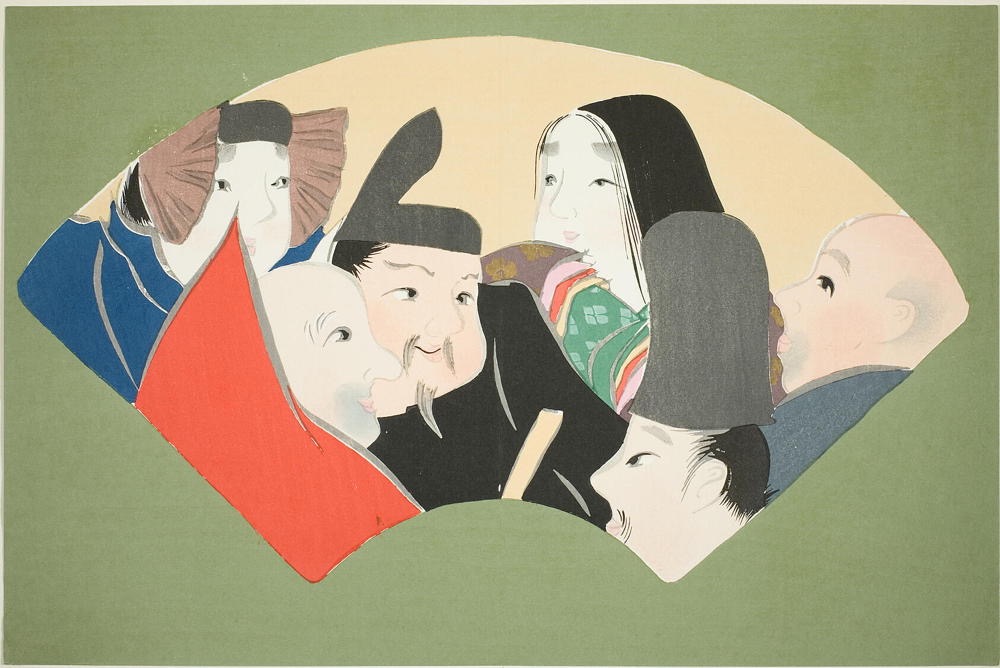
Kamisaka Sekka
The Six Immortal Poets,
from the series “Worlds of Things (Momoyogusa)”
(1909/10)
"Might this realization have been my purpose in beginning this inquiry in the first place?"
The word Prosperity immediately conjures up visions of money wealth, often, by logical extension, also images of stuff that requires money wealth to acquire. The Prosperous do, often, possess lots of stuff, more than what the struggling seem to acquire. Indeed, the lust for stuff that can only be acquired with money often proves to be the undoing of those who struggle to achieve Prosperity, as if they necessarily need money to achieve what might pass for it. Such convictions might be common to members of any acquisitive society such as ours, for aren’t we hammered with messages designed to convince us that we must acquire or suffer horrible consequences? Heaven forbid that we ever find ourselves falling ever further behind Those Damned Joneses!
But the array of stuff that might be acquired by money, and, indeed, money itself, including credit, covers perhaps the most infinitesimal part of what Prosperity might fully entail.
Fleeting
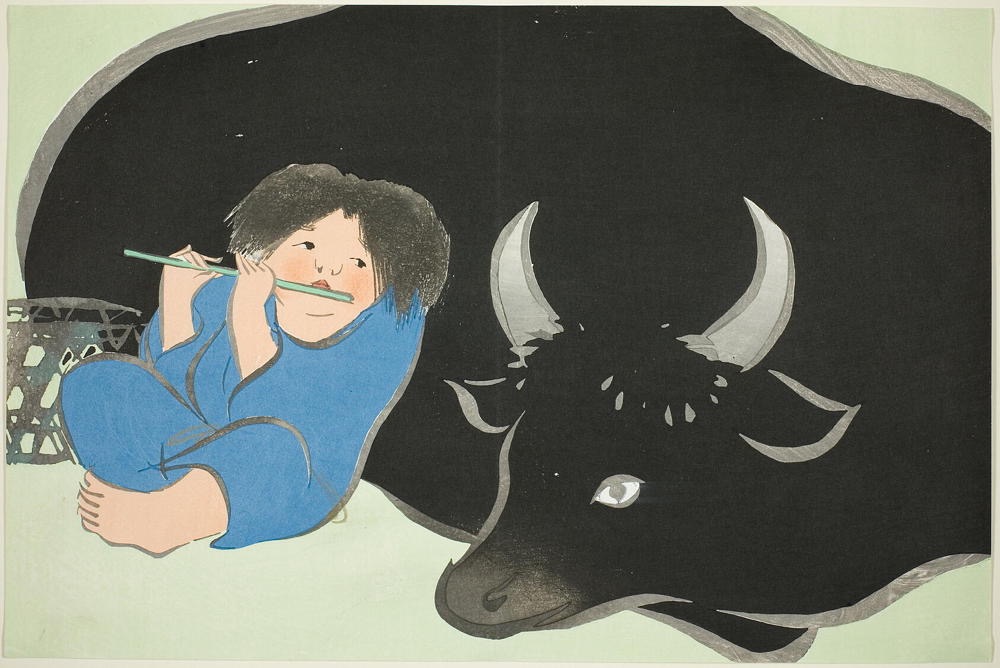
Kamisaka Sekka
Oxherd Flutist,
from the series “Worlds of Things (Momoyogusa)”
(1909/10)
"Prosperity seemed to come so easily then. Now, it seems Fleeting. "
A quick trip over to Portland never fails to remind me just how Fleeting Prosperity can seem. Indeed, all history seems like a mere flash of memory along that more-than-familiar route. We pass places I fondly remember from my own pre-history, forever transformed by what came and went alongside me. It seems that much of my life occurred along that two-hundred-forty-five-mile route: good, bad, and even a little of the ugly, for those, like me, who were raised in the Inland Northwest were never quite able to completely separate ourselves from the sea. We more or less routinely traversed the barren Columbia Plateau to enter the Cascade fairy land and on into country that seemed endlessly green. Everything seemed so clean there, the brown, barren Earth replaced by cooling rains and a soothing rainforest. It seemed downright British over there.
I later lived in Portland, moving there in the year this country turned 200.
Freely
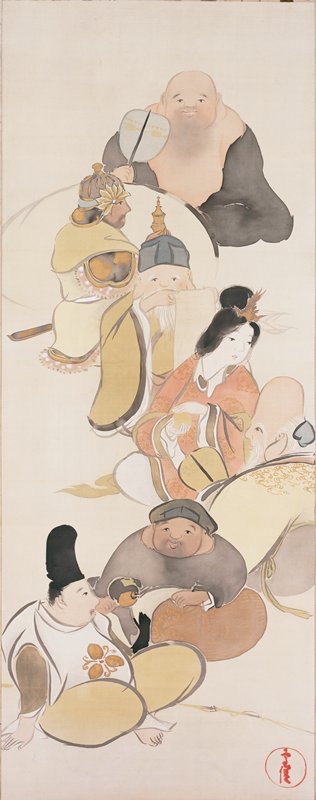
Kamisaka Sekka
Seven Gods of Good Fortune
(1920s)
"… liberating everyone involved."
Prosperity increases the possibility of simply giving stuff away. Once I’d accumulated plenty, I occasionally exceeded my ability to properly appreciate and maintain some of my previously precious possessions. What I had seen as essentials sometimes became more like burdens. An occasional yard sale balanced this scale, where my Prosperity translated into an ability to make somebody a really great deal on something they needed much more than I did. The Muse and I eventually abandoned the usual pretext for conducting such sales and dispensed with putting price tags on anything, explaining to anyone who stopped to browse that everything was going for the same low price: Free! Not even that price guaranteed that everything found a new home, but we completely eliminated the commercial hassle usually associated with such undertakings. When we relocated from Maryland to Colorado, we gave away the larder refrigerator and the hide-a-bed in the basement mother-in-law rooms. We felt instantly lighter when we passed those burdens into somebody else’s delighted care.
Yesterday, I finally managed to give away a patio table that had been gathering grime in what was originally intended as a flowerbed beneath the sideyard's enormous Snowball hedge.
ResponsibleFor
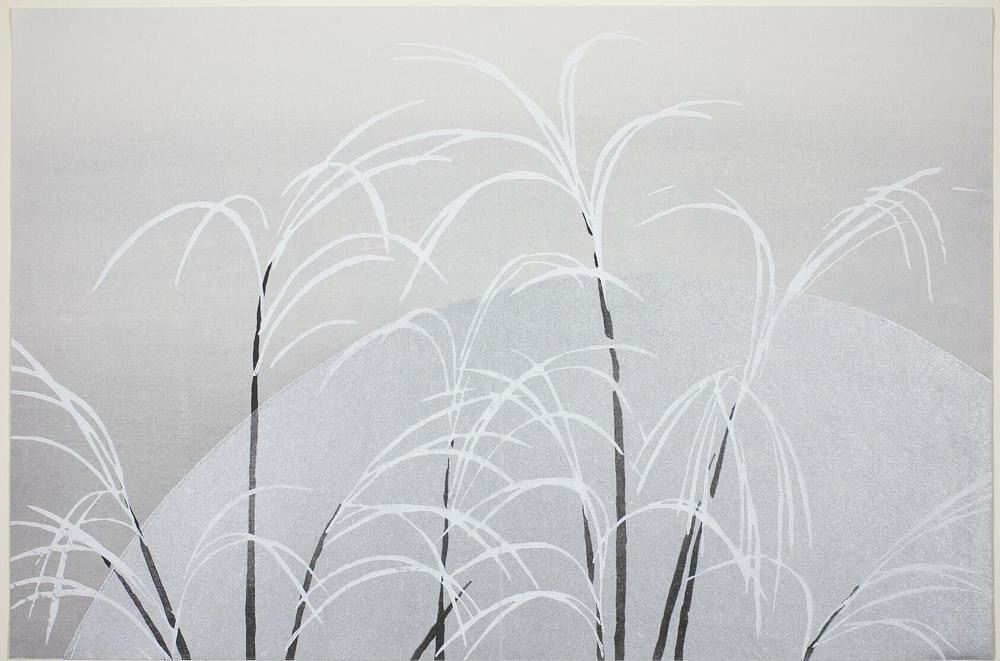
Kamisaka Sekka
Moon over Musashino,
from the series “Worlds of Things (Momoyogusa)”
(1909/10)
"…vulnerable to every odd pebble inadvertantly flying around."
Responsibilities shift when Prosperity appears. Before, the arc of responsibility might have extended no further than one’s self, if even that far. Afterward, it inevitably becomes ever more expansive and more inclusive, often extending far beyond personal home and hearth. Those unprepared for this shift might feel put upon when it happens. When did they suddenly become responsible for everybody else? The worst might even curse their new dependents, wondering why they can’t stand on their own damned hind legs and fully support themselves for a change. These are useless questions bordering on deflections, for if successfully deployed, they might lead the newly prosperous into preposterous positions, undefendable under any condition. This has absolutely nothing to do with religious conviction, but plays into principles included even in the decidedly feral Laws of the Jungle. One need not embrace communism to comprehend to whom and to what one must be ResponsibleFor.
At root, it’s simply self-preservation to help support one’s civilization, each of which inexorably includes both owners and renters, along with a few apparent deadbeats incapable of even supporting themselves.
Weekly Writing Summary For The Week Ending 07/09/2026
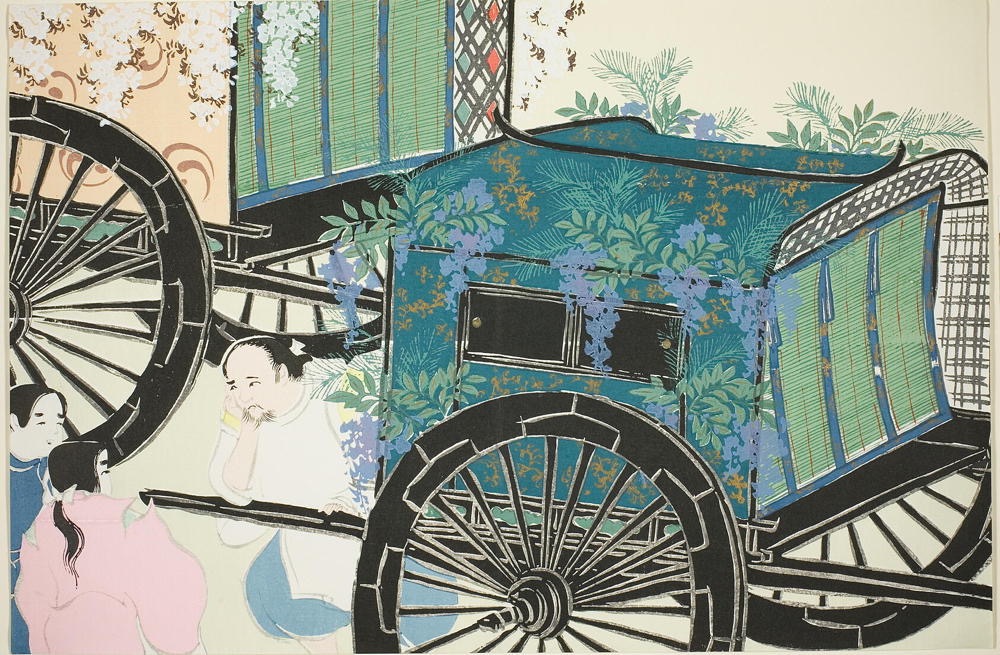
Kamisaka Sekka
Courtiers’ Carriages,
from the series “Worlds of Things (Momoyogusa)”
(1909/10)
This week’s Prosperity dispatches arrived on the Fourth of July and kept arriving through a week that ranged from political fury to philosophical depth to barefoot mourning. The writing moved from the Phreedom of the incumbent’s Mount Rushmore performance to the elusive nature of the Promising, from the composter’s quiet testimony in TheHeap to the expanding universe of Affording, from the NoThings that populate our lives to the SymbolicProsperity found on bookshelves and in the soles of absent barefoot shoes. The series found its most intimate register this week. The foundation holds.
Thank you for following along!
SymbolicProsperity
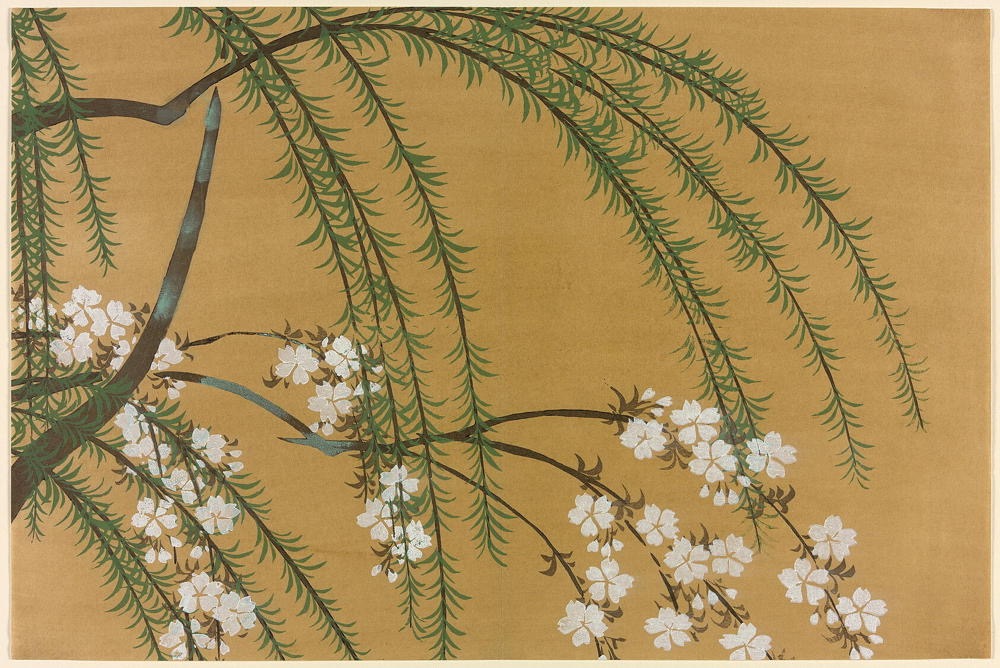
Kamisaka Sekka
Willow and Cherry Branches,
from the series “Worlds of Things (Momoyogusa)”
(1909/10)
"…they bear the weight of my very identity, my Prosperity."
Prosperity seems to depend upon some symbolism to properly manifest. It can’t exist without this. Neither island nor isthmus, it must carry some close association with a seemingly unrelated entity, as if inextricably married to it. For me, the symbol that fully embodied my growing Prosperity was found on my bookshelves. Once upon a time, in my penniless youth, I owned few books. I seemed to accumulate them, though, each a treasure in its own way. I considered each a keepsake. Nothing seemed to better symbolize my standing in my own eyes and in my community than that line of books, later that line of bookshelves I proudly maintained. I separated fiction from the others and sorted each by author, with a shelf or two in the basement, more or less randomly, holding gardening and travel books. Those were not for show. The others most decidedly were.
No better gauge of my Prosperity ever existed, or, indeed, still exists today.
NoThings
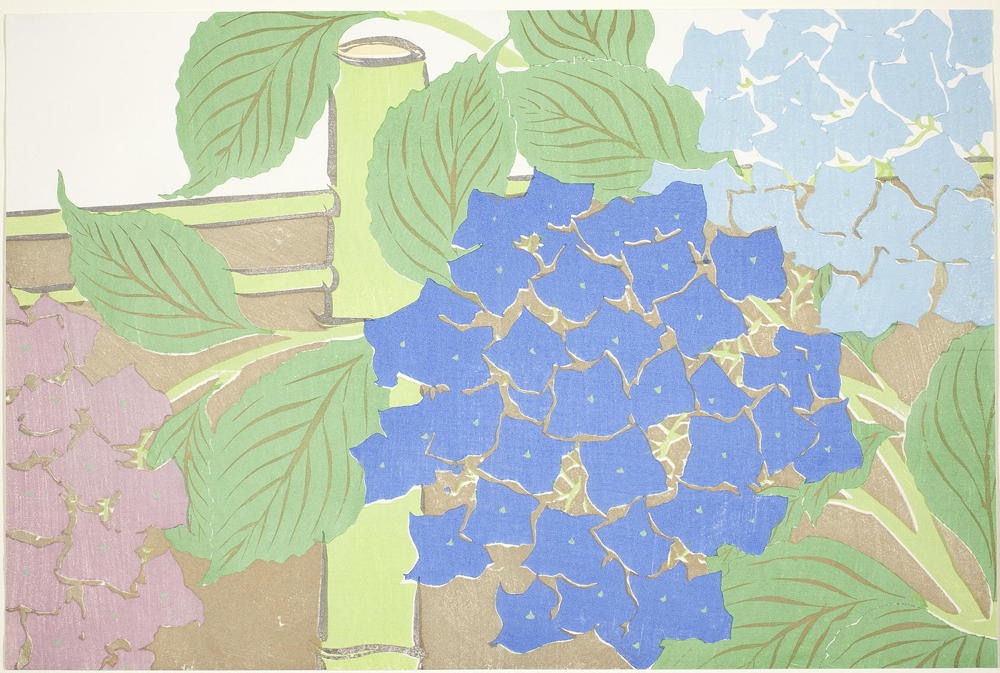
Kamisaka Sekka
Hydrangeas, from the series “Worlds of Things (Momoyogusa)”
(1909/10)
"Later, it becomes the imperative."
Many who seek Prosperity find themselves frustrated by its apparent elusiveness. One might start such a search with some clear notion of what they’ll find, but then their clarity of intention seems to somehow prevent discovery, as what seemed straightforward when planning became decidedly crooked in execution. Some abandon the effort, convinced that the game was somehow rigged against their favor. Others redouble their effort and quickly redouble their frustration. Some eventually stumble into something perhaps only distantly resembling whatever it was that they’d previously so clearly envisioned, and call that good enough, if only because it isn’t a complete disappointment. Success in this context has often proved difficult, if not impossible. Some seem fortunate enough to stumble into something more or less acceptable as their Prosperity without expending their entire youth in the effort. Others conclude that Prosperity wasn’t really made for somebody like them. However the search resolves, the indifferent world seems unimpressed with either failure or success.
The chief difficulty might be that Prosperity belongs to a curious class of things that do not really qualify as things.
Affording
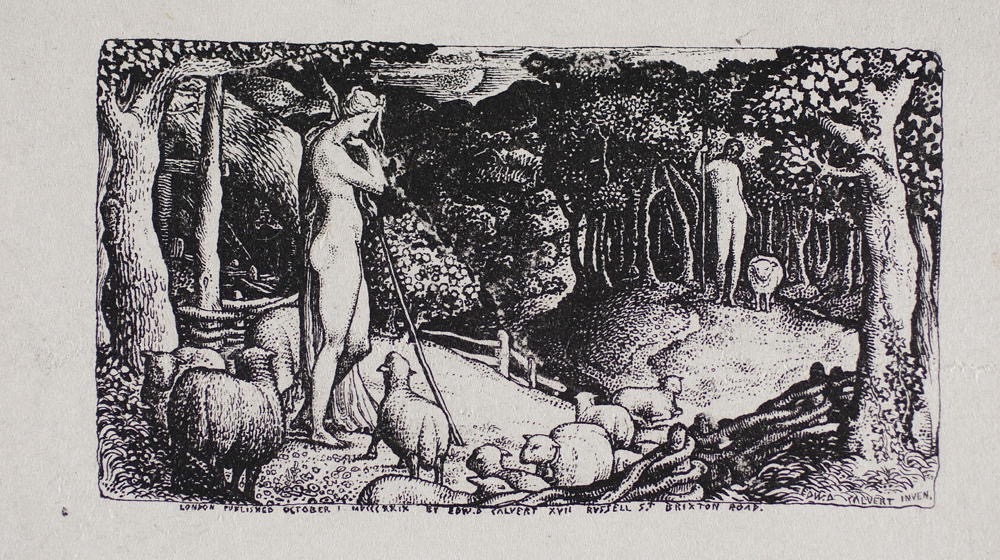
Edward Calvert
Ideal Pastoral Life
(1845)
"It threatens the notion that anyone might be an island unto themselves…"
Having grown up in a family with five kids, I learned early and often what we could not afford. I developed a mindset, a sort of radar capable of discerning whether or not I could afford something by coming into proximity with it, or by just imagining it. I could mostly tell by looking. I constructed a partitioned world, one composed of stuff I could afford and one with stuff I couldn’t. The world I could not afford initially seemed alluring and vast. The one I believed I could afford seemed dank and narrow in comparison. Over time, I learned how to want what I could afford, and, over even more time, grew snobbish about what I felt I could not afford. I first felt excluded before I came to feel somehow special because of my limitations. I experienced few disappointments or discouragements because I came to not want what I so obviously couldn’t have, anyway. Rather than grow up with anything like a vast sense of possibility, I inherited more of a certainty. I never really wanted whatever my circumstances denied me, or whatever my mindset denied myself.
Prosperity never seemed achievable, so it fell well within the territory denied me.
TheHeap
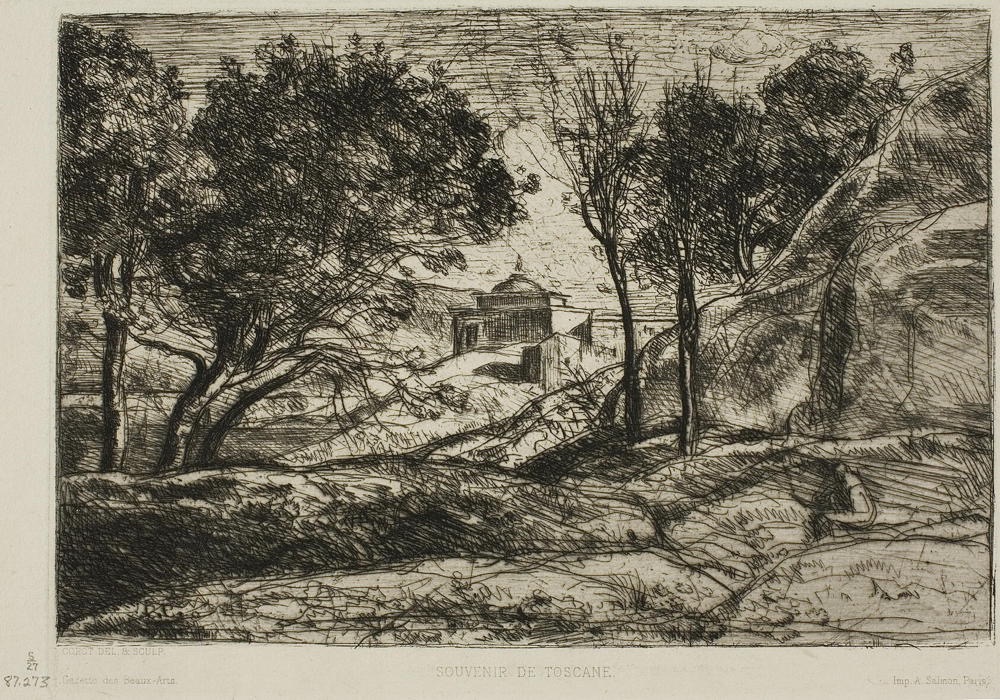
Jean-Baptiste-Camille Corot
Souvenir of Tuscany
(1845)
"If that's not an accurate portrait of Prosperity, I suppose nothing is, or could be, either."
When I look for external evidence of my Prosperity, I migrate toward what might appear to be a remote and under-appreciated corner of the yard. I do not dwell on the fine front porch we so recently remodeled or the lawn and gardens, though these certainly do seem to exude Prosperity’s usual and expected context markers. No, I head back behind the garage, beneath where the ornamental Elderberry bush is busily out-growing its assigned space, where my compost heap stands. Of all the improvements The Muse and I have made in the quarter century since we bought this place, my composter stands as the one of which I’m proudest. I swell with appreciation and, yes, pride every time my eye drifts across its now slightly deteriorating frame. I cut those boards. I fastened them together. The chicken wire that originally separated its compartments long ago corroded away, replaced by jute coffee bags until the Red Wiggler composting worms had their way with them. Now, the three sections get by with nothing more than seasonal boards separating them when I’m introducing autumn’s chopped leaves or summer’s apricot culls.
The rest of the yard holds clear evidence of that composter’s existence.
Promising
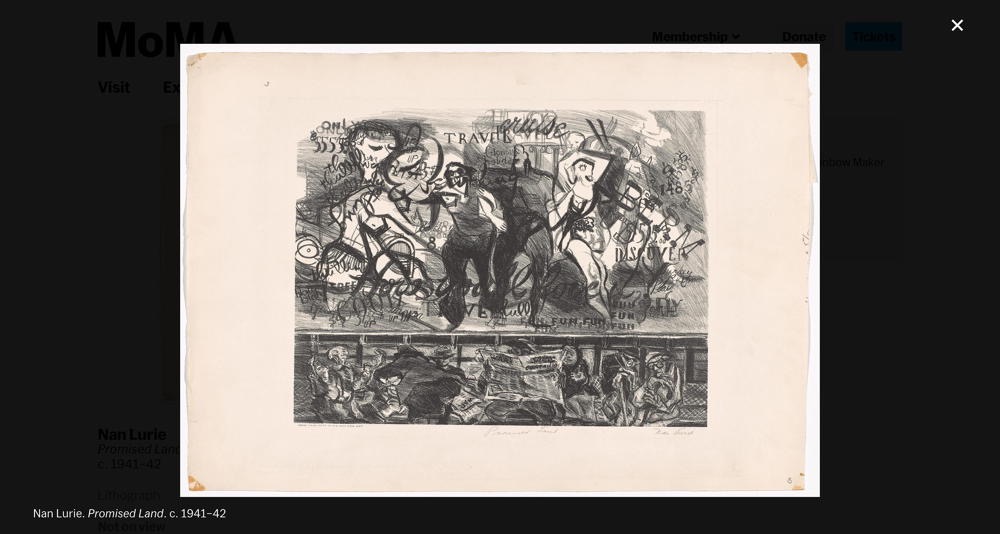
Nan Lurie
Promised land
(1941 - 1942)
Works Progress Administration (WPA), Federal Art Project, New York
"Who knows where such mustard seeds come from, anyway?"
Some significant portion of Prosperity never exists in any present. The future might prove to be the most significant element of it. Certainly, some Prosperity usually exists in a prosperous present, and much of it might remain as fond memories of some past Prosperity, but neither warm recollections nor present relations with it thrive without warm anticipation of upcoming Prosperity. Prosperity seems to require some sense of continuity. The disparity between a strong, felt present sense of Prosperity and its actual existence probably lies largely in that sensed future, for a sensation that the future will not contain adequate Prosperity seems plenty and enough to smother any present sense of possessing it. Prosperity was never actually an asset, but usually more an anticipation, anyway.
No contract seems capable of providing this sense of impending, either.
Phreedom
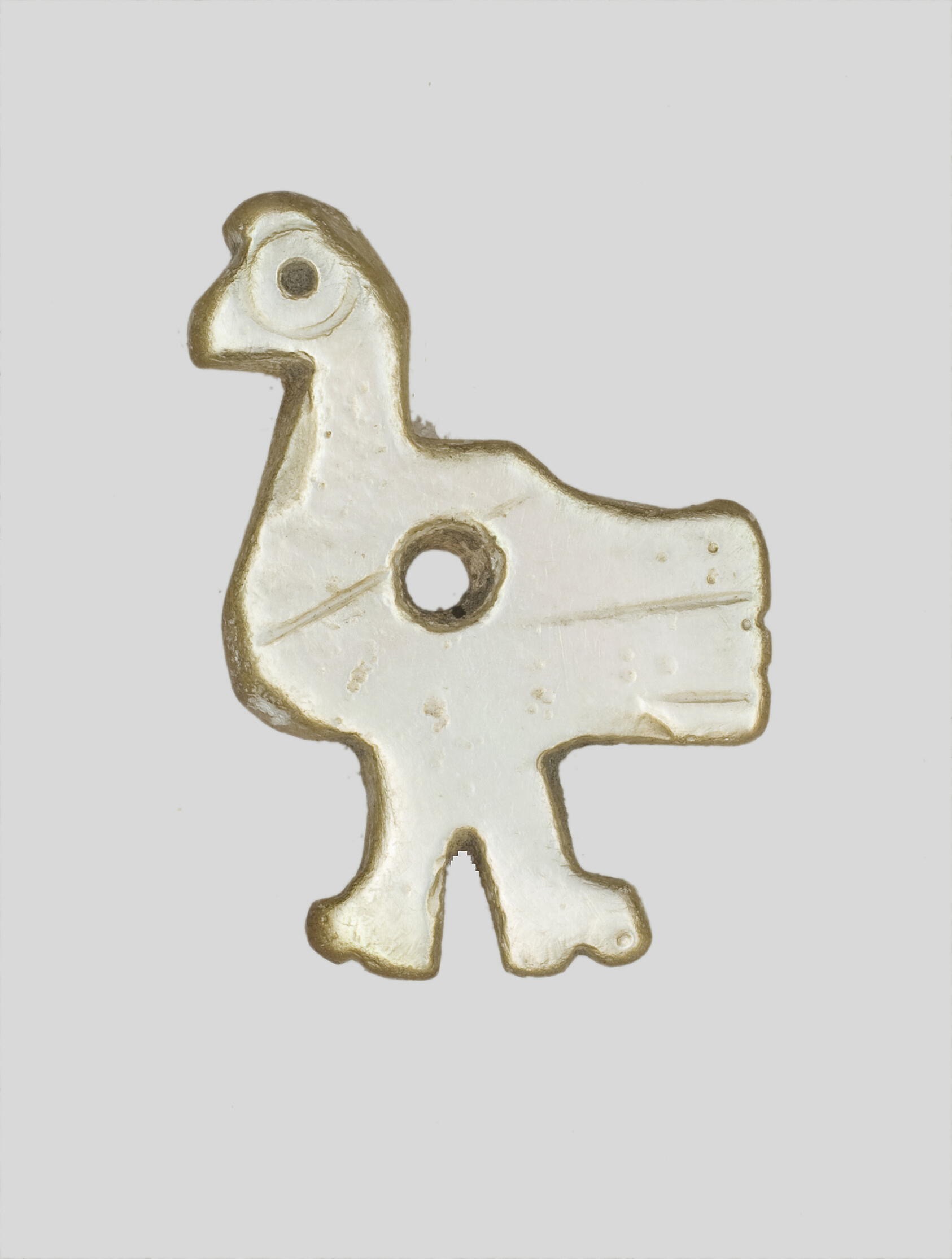
Unknown Egyptian Artist:
Amulet of a Rooster
(Byzantine Period: 4th–7th century)
"Hip, hip, hooray!"
For me, the 4th of July has always been a most regrettable holiday. It seems to encourage that distasteful style of jingoism (there’s a tasteful style?) that has so often manifested during the worst moments of our now long shared history. Rather than gathering together to regret all the regrettable wars we have fought, including the one for independence from the British crown, we trot out the War of 1812 Overture, complete with a Marine Corps howitzer battery, and pretend to blow the living shit out of our living history, followed by an over-long fireworks display that scares the living daylights out of pets and actual veterans, who well understand that freedom isn’t just a handy holiday catchphrase, but a concept that means something so much more than war. It means a kind of Prosperity that cannot be purchased or leased, and that cannot be used as an offensive weapon. It stands for an unshakeable conviction to live without permission, to be a responsible member of a genuinely pluralistic society. To live and god damn let live without favor or prejudice.
Our incumbent, who now shows clear signs of Frontotemporal Dementia on top of his pre-existing, lifelong narcissistic personality disorder difficulties, delivered a speech last night in a lame attempt to rewrite history as something other than what every living soul should have already known actually happened.
Weekly Writing Summary For The Week Ending 07/02/2026
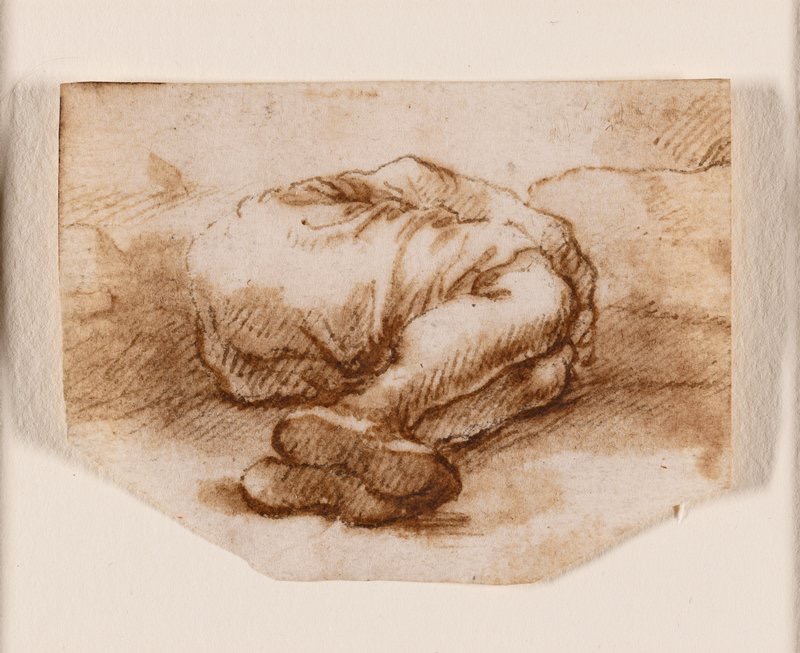
Salvator Rosa
Sleeping Boy
(17th century)
This week’s Prosperity dispatches arrived while I picked up a too-long-absent 1967 Martin D-18 guitar after SetTheory—does anybody remember that series from the Fall of 2022?—revealed itself as world-class prose as I listened to it in an AI-powered app (ElevenReader) that convincingly delivered it in Laurence Olivier’s voice. My Prosperity writing ranged from the abstract economy of Real_Work to the myth-making surrounding industrial development in Mythed, from the long economic betrayal of Posterity to the prosperous paradox of Profligacy, from the philosophical reframe of Foundational to the blushing self-awareness of Embarrassment. This series found its philosophical foundation this week.
Thank you for following along!
Embarrassment
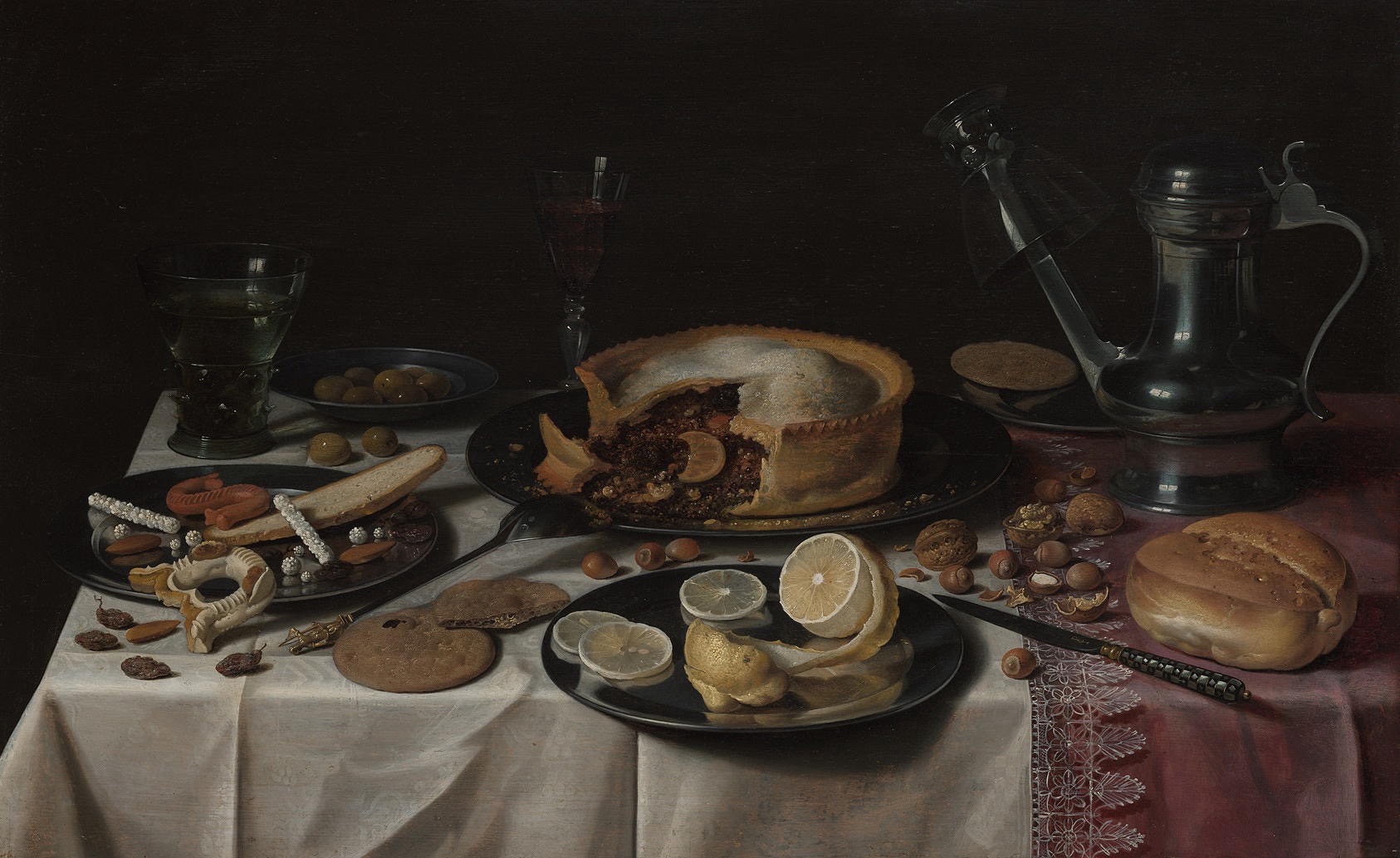
Pieter Claesz:
Still Life
(1625)
"As Mark Twain long ago insisted,
Humans are the only animal that blush, or need to."
Prosperity neither appreciates nor requires great wealth. Beyond some uncertain point, wealth becomes more of a burden than an asset, what’s popularly referred to as “An Embarrassment” of riches. This classification includes Scrooge McDuck’s gold coin-filled swimming pool and Midas’ freshly gilded daughter. Any overt display of plenty might quietly qualify: The tacky golden toilet. The personal Jumbo jet. The twelve-car garage. These embarrass because they seem to deflect otherwise perfectly decent assets out of useful circulation. In this world, too often inhibited by absences, taking useful assets out of circulation seems like an extreme example of The Sin of Self-Importance, the most easily avoidable sin on the books. These suggest some lack of discipline, a deeply-rooted emotional problem, perhaps an untreated mommy fixation, something no amount of wealth or show could ever help anyone recover from. An illness.
I suspect that the wealthiest somehow lose their essential gag reflex.
Foundational
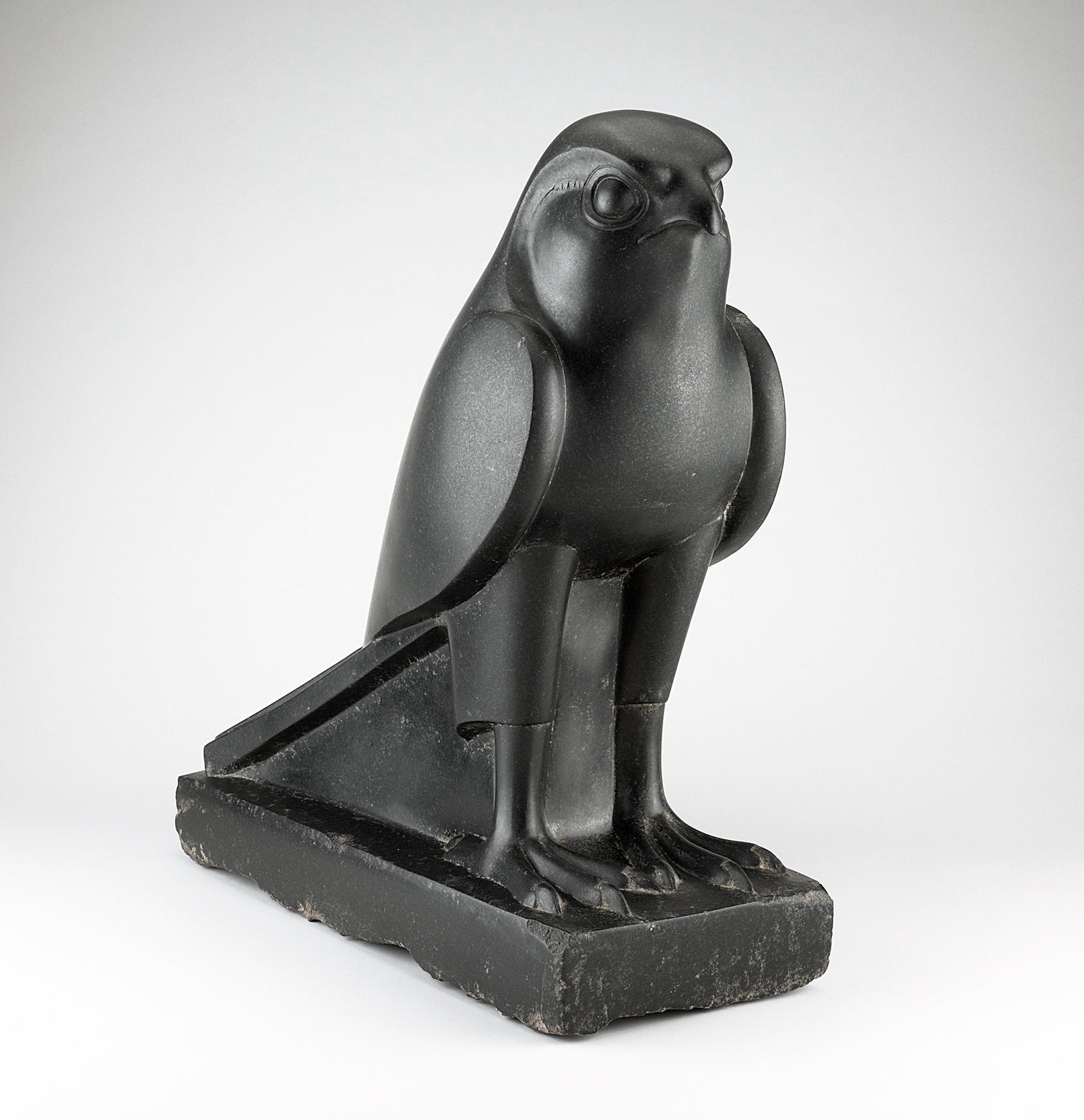
Unknown Egyptian Artist of the Ptolemaic Period
Statue of Horus
(332–30 BCE)
"Prosperity won't necessarily make anything easy, but it might render pretty much everything easier."
I began this series by classifying Prosperity as probably the goal, the attainment of which might serve as at least a prominent sub-theme of this work, if not the underlying purpose. In the week and a half since I started this effort, though, my perspective has shifted. What if Prosperity doesn’t qualify as an endpoint objective? Perhaps it works better if I consider it to be Foundational, table stakes in a larger, more dynamic puzzle. Would anyone be satisfied with a static and stable Prosperity, or would achieving it not open up otherwise unimaginable possibilities? Abraham Maslow long ago proposed what he labeled a Hierarchy of Needs. In it, he imagined human needs arrayed from lower to higher. He speculated that before satisfying the lower-order needs, the higher-order ones might remain out of reach. For instance, nobody seriously pursues enlightenment on an empty stomach, or so he insisted. In practice, of course, enlightenment might be best pursued on an empty stomach, and something else must propel a novice to chase after higher forms of consciousness. But what if—and I’m not insisting, like Maslow did, that this must be the case—what if I’m better off imagining Prosperity as being one of those lower-order needs as opposed to being of the highest order? What might happen then?
Prosperity becomes more a context than a purpose.
Profligacy
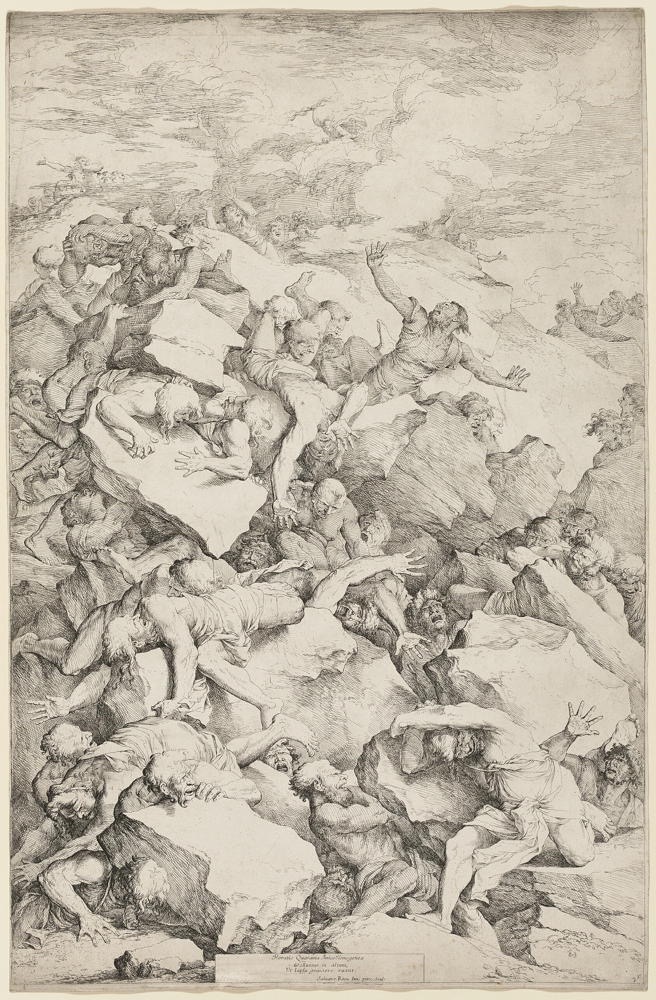
Salvator Rosa:
The Fall of the Giants
(1663)
"His adolescent attitude could ruin more than himself this time."
Something about Prosperity despises Profligacy. Prosperity seems curiously thrifty, even though it contains plenty. Of course, plenty remains a relative term. Some seem to thrive on a penny while others require vast sums to ever feel adequately supported. The apparent paradox that a thrifty Prosperity carries says much. Some self-discipline seems a necessary element if any Prosperity is to be achieved, let alone maintained. Those who would mortgage the farm on a whim either never gain Prosperity, or “mysteriously” lose it when they least expect it. A similar paradox accompanies every freedom, for none can be practiced as if absolute without somehow ruining its spirit. Each freedom seems to require a thrifty attitude in practice lest a resulting latitude overwhelm through unregulated practice. Brandy was meant for sipping, not chugging.
It seems common that the road to Profligacy usually appears as an opportunity.
Posterity
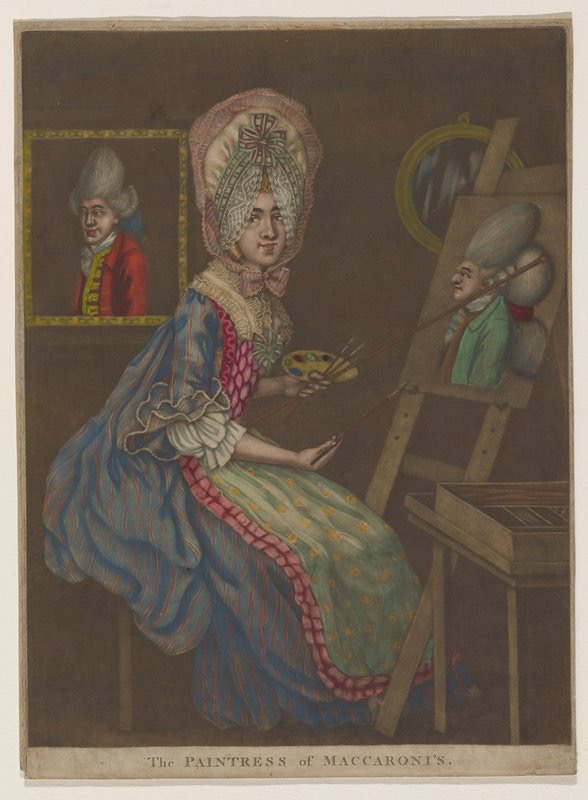
Robert Dighton:
The Paintress of Maccaroni's
(1770)
"May we choose to choose more wisely this time."
Prosperity cannot be accurately measured in any present sense. Current conditions can only hint at prospects. Because Prosperity must be relational, it cannot be possessed by a person or a time period, though history often misleadingly associates it with specific people and times. A prosperous person possesses a promising future, not merely a temporarily rewarding present. They might accumulate wealth, but not only for themself. They interpret freedom and liberty as associated with family, community, and nation, rather than merely governing an individual’s unbounded choices and personal portfolio. Prosperity might be ninety percent aspiration. It provides the motivation to continue creating, for reaching across space and time, beyond mere space and time. Prosperity manifests in opportunity. Not born-with-a-silver-spoon advantage, but the ability to take reasonable chances, investment rather than raw speculation.
I came of economic age during the infamous Reagan Devolution, where our country’s Prosperity was mortgaged for considerably less than a handful of magic beans.
Mythed
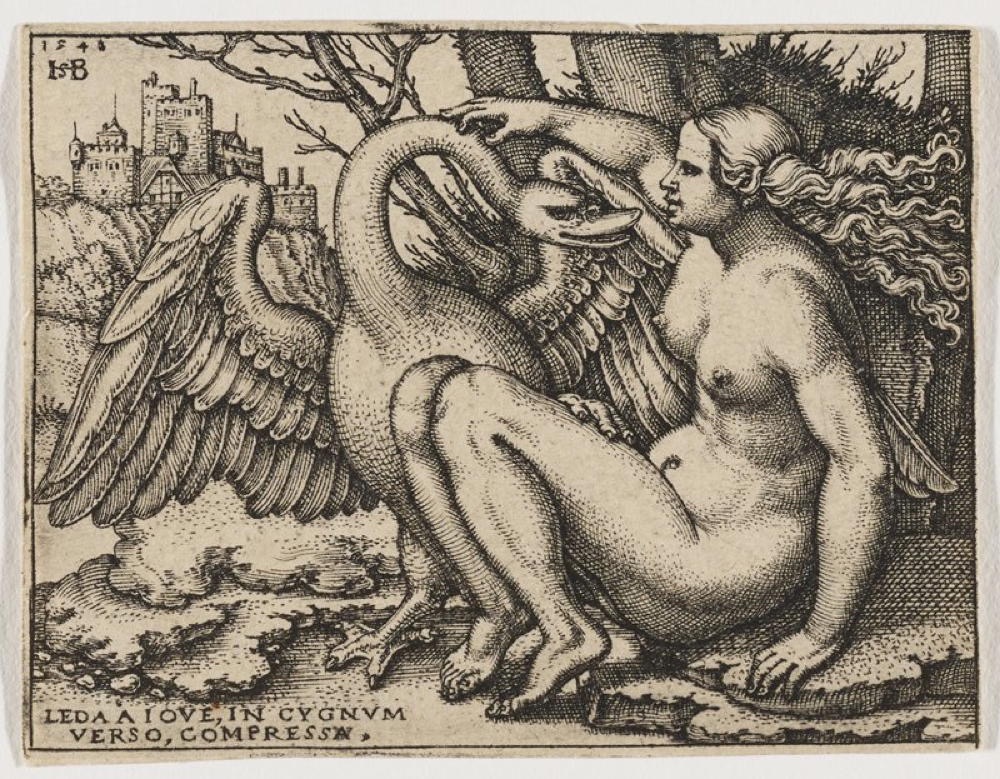
Sebald Beham:
Haman Recognizes his Fate
(1548)
"…constrained by law to consider facts rather than myths."
As a Port Commissioner, The Muse has been charged with promoting economic development in this county. Her elected position pays a modest stipend, something well South of the most modest minimum wage, plus expenses, for which she works seven days each week. She’s often up after midnight, studying some opportunity. Fortunately, she’s an information and data magnet, never happier than when she’s researching some issue. She’s especially skilled at separating opportunities from the myths often accompanying them. She insists upon more than merely due diligence, and she knows the tricks that reliably separate facts from popular fictions. Her constituents aren’t always so demanding, for they sometimes fall prey to the many myths surrounding essentially every economic development opportunity.
Probably nothing has been more damaging to Prosperity than the mythology surrounding industrial property development.
Real_Work
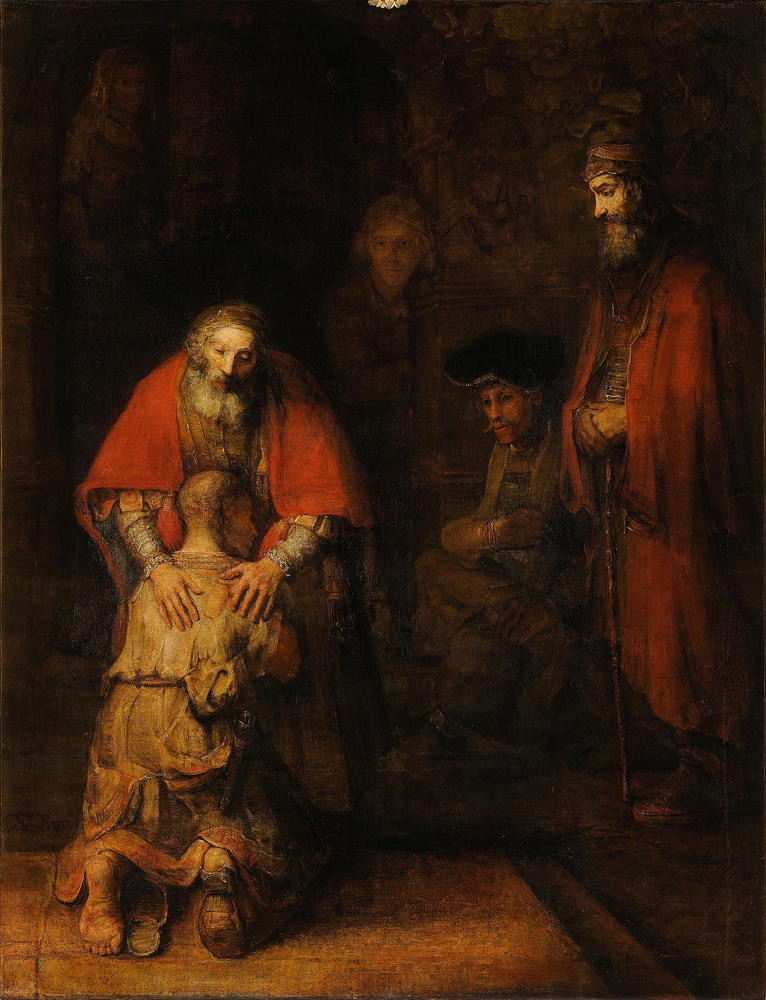
Rembrandt Harmenszoon van Rijn:
The Return of the Prodigal Son
(1668)
"…regardless of what any economist insists."
Most people in this country no longer engage in what our forebears would readily recognize as Real_Work. Real_Work once involved physical labor and was amenable to unambiguous measurement. An hour of labor created a certain indisputable volume of finished product. That product sold at a discernible price, enabling a clear assessment of the contribution a given laborer’s actions added to the ultimate value. High-value commodities reliably produced Prosperity, all other calculations being relatively simple. Almost nobody engages in this sort of labor/Prosperity trading anymore. We mostly work in teams today, sharing tasks and contributing rather than owning our own effort. Determining the value added requires layers of assumptions, none of which involves a finitely observable action. Time-and-motion studies long ago became meaningless measures of efficiency or effectiveness. Productivity has become an imaginary entity; Prosperity, an elusive objective.
Further, we seem to have grown some prejudices about what constitutes Real_Work.
Weekly Writing Summary For The Week Ending 06/25/2026
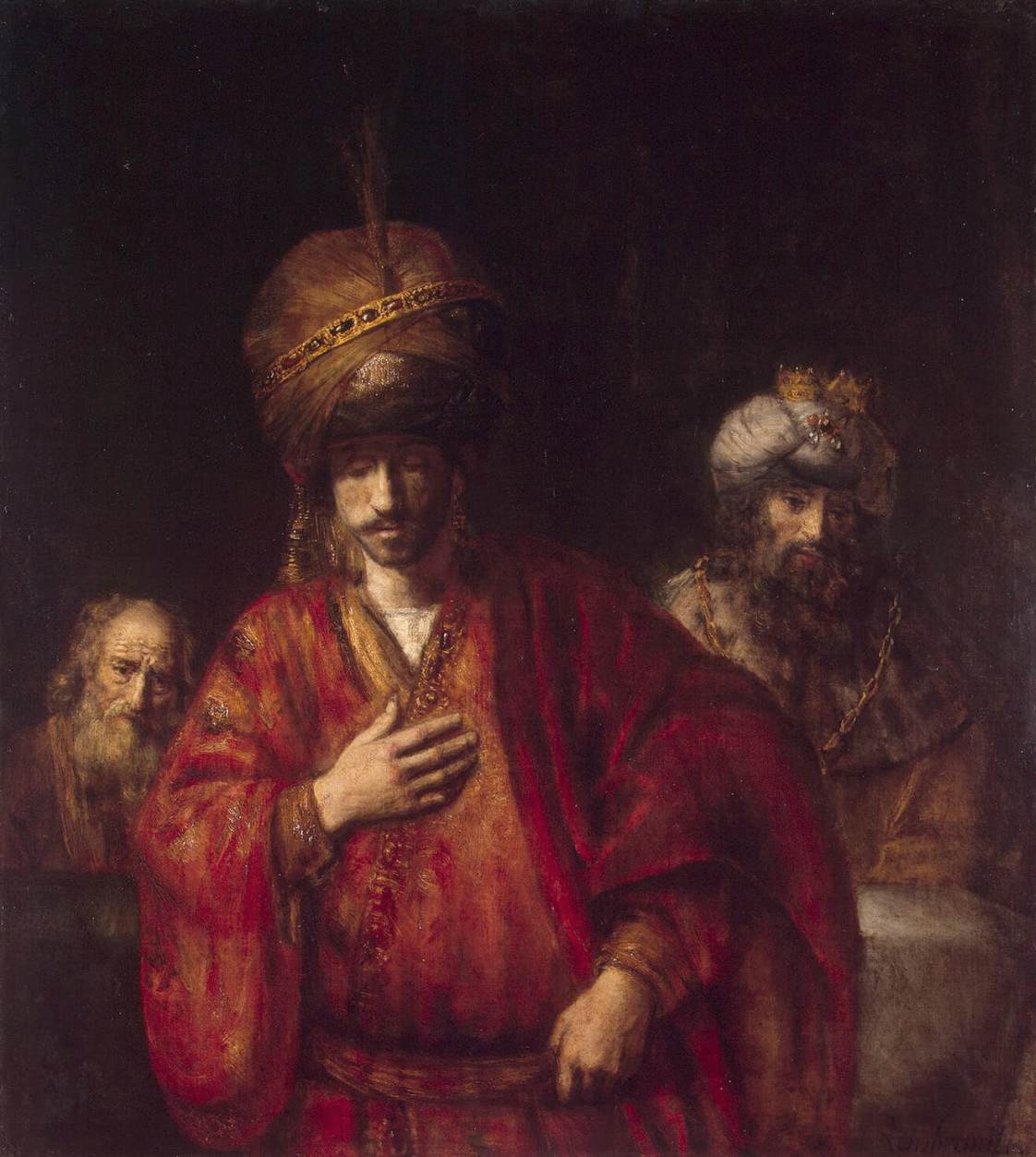
Workshop of Rembrandt Harmenszoon van Rijn:
Haman Recognizes his Fate
(1648-1665
This week’s writing marked a transition. The EndDays series concluded with its Preface, appropriately written last, after I had confirmed that the butler did it again. Then, on Sunday morning, the Prosperity series began. Five installments in, Prosperity already has its question, its necessary preconditions, its defining choice, and its primary obstacle. The writing ranged from the statistical indictment of MostProsperous to the personal philosophy of Plenty, from the Veblen-inflected Conspicuous Consumption argument of Waste to the unavoidable Responsibilities Prosperity imposes, and finally to the future-phobia of Anxiety that keeps Prosperity perpetually just out of reach. EndDays ended. Prosperity began. The practice continues.
Thank you for following along!
Anxiety
Rembrandt Harmenszoon van Rijn:
The Denial of Peter
(1660)
"They gladly flee backward into cowboy times when only a few pesky Comanche stood between them and promised Prosperity."
We fear more than we revere Prosperity. Oh, we’re all for decency when it proves convenient, but we have grown to distrust and deep-down fear our future, whatever it once was. We have seen more than enough Faster, Better, Cheaper® promotions to understand that they always propose much more than they ever deliver. Not one of us has ever experienced an upgrade that didn’t perform worse than all its predecessors combined. So, we have become future-phobic, anxious about our prospects. We might be nostalgia addicts, aching for some fantasy Good Old Days. Whatever new days might promise, we ain’t buying, or if forced to buy, we ain’t believin’ for a minute. I swear that every billionaire made his money with some new and improved bait-and-switch tactic. We expect to be cheated, and we even get even by cheating ourselves whenever given less than half a chance. Our Anxiety has come to define us and our age.
Given a decent opportunity, we’ll set about making up excuses why we can’t possibly agree to Prosperity’s terms and conditions.
Responsibilities
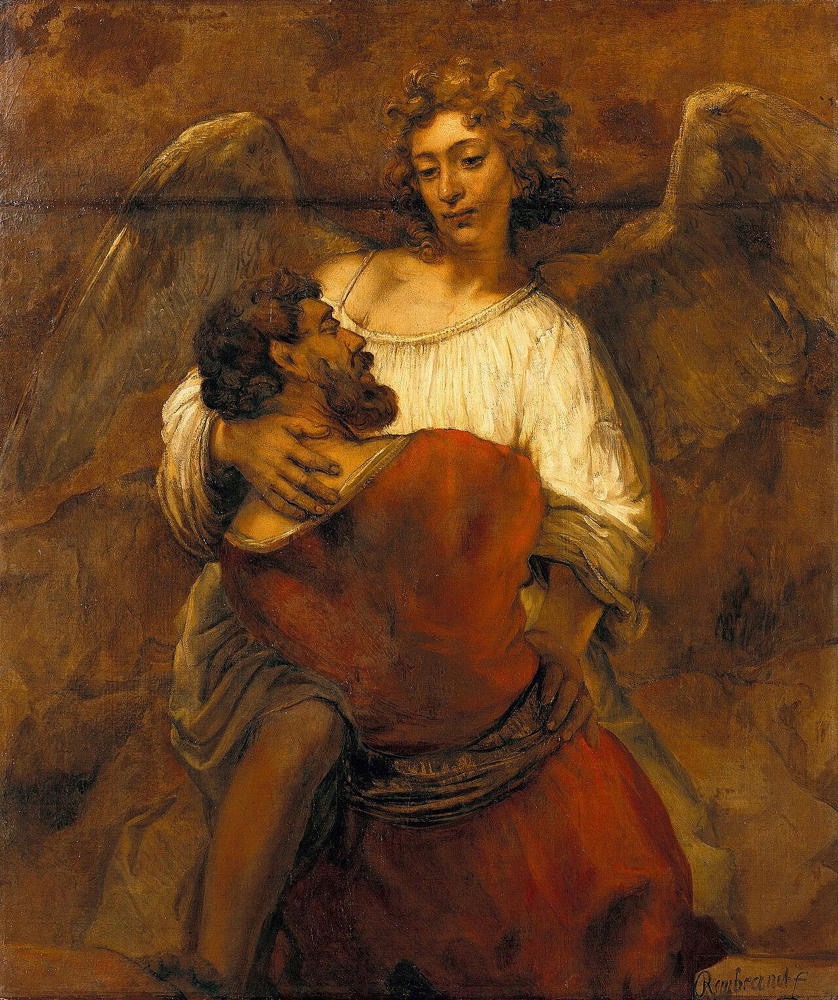
Rembrandt Harmenszoon van Rijn:
Jacob Wrestling with the Angel
(1659)
"I'm still not all that careful."
My mother often warned me to be careful what I wished for. She never extrapolated her warning into specifics, but I still caught her gist. She was saying that there’s just no escaping some uncertain load of externalities, whatever the activity. Youthful boredom could easily drive me into some activity that might cost me more than I’d ever bargained for. In the face of that boredom, I might agree to anything without thinking very far into even the more likely outcomes. I could end up with more work than I’d imagined possible as a result of trying to escape some work I knew for certain that I found disagreeable. Her admonishment usually reminded me that there’s no such thing as a free lunch, and even breakfast is likely to cost me more than I might have imagined.
Even Prosperity, that emerald city at the end of every rainbow, exacts taxes.
Waste
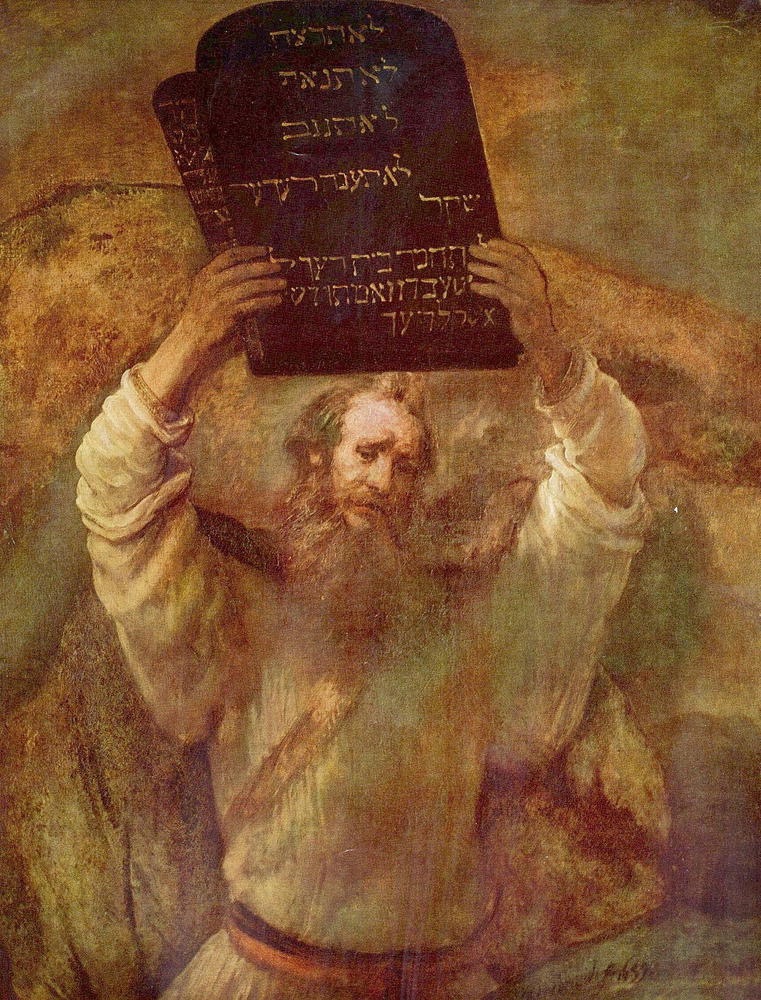
Rembrandt Harmenszoon van Rijn:
Moses Breaking the Tables of the Law
(1659)
"…what might have been Waste was, in fact, future Prosperity."
If Prosperity relies upon the presence of Plenty, its presence also seems to encourage some uncertain volume of Waste. Before Prosperity, a subsistence existence exists. People somehow survive, perhaps just barely getting by. After Prosperity emerges, some excess enters the survival equation, resources can no longer be characterized as wanting, and the resulting excess might prove defining. If nature abhors vacuums, it seems to despise excesses even more. An excess might be considered wealth, retained earnings, or leftover resources unneeded for present survival. It might also be considered Waste, worthless, since it proved itself unnecessary for sustaining survival. What a person or a society does with their excess determines the quality of their Prosperity, perhaps whether it exists at all.
Thorstein Veblen, a renegade economist who was widely shunned near the end of the nineteenth century, coined a term that best exemplifies the defining character of what I might consider Perverse Prosperity: Conspicuous Consumption.
Plenty
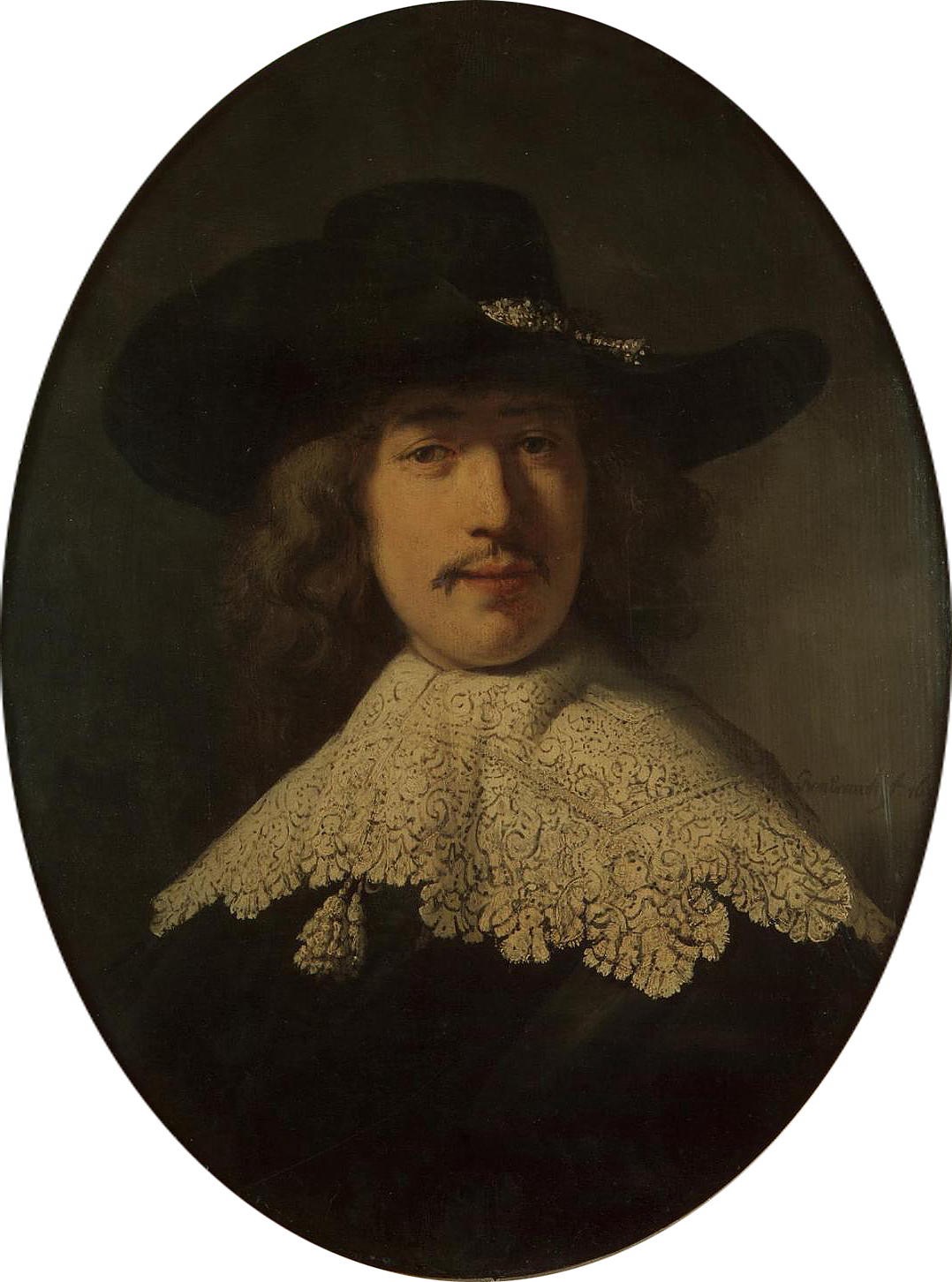
Rembrandt Harmenszoon van Rijn:
Portrait of a Young Bachelor
(1634)
"…if Prosperity isn't destined to continually evade one's grasp."
Prosperity must be a relative state, one that depends on many factors to be properly gauged. Some find satisfaction with much less than others, while others’ desires seem essentially insatiable. However measured, Prosperity seems to embody an underlying sense of Plenty, however one might choose (or feel compelled) to define it. When I was twenty, I could fit my worldly possessions in the backseat of a classic Volkswagen Beetle, and I sometimes felt burdened by them. Later in life, I’d need a large moving van to fit my stuff, but I’d still feel as if I might not have quite enough. I have been in active deacquisition mode for several years now, figuring I do not need half the stuff I have acquired, so I feel hesitant to add to my already overburdening collection. This results in some absurd situations, like when I wear threadbare clothes because I cannot quite bear to buy better. If I already feel that I have more than Plenty, I don’t feel moved to pursue any more.
Acceptance seems to accompany Plenty.
MostProsperous
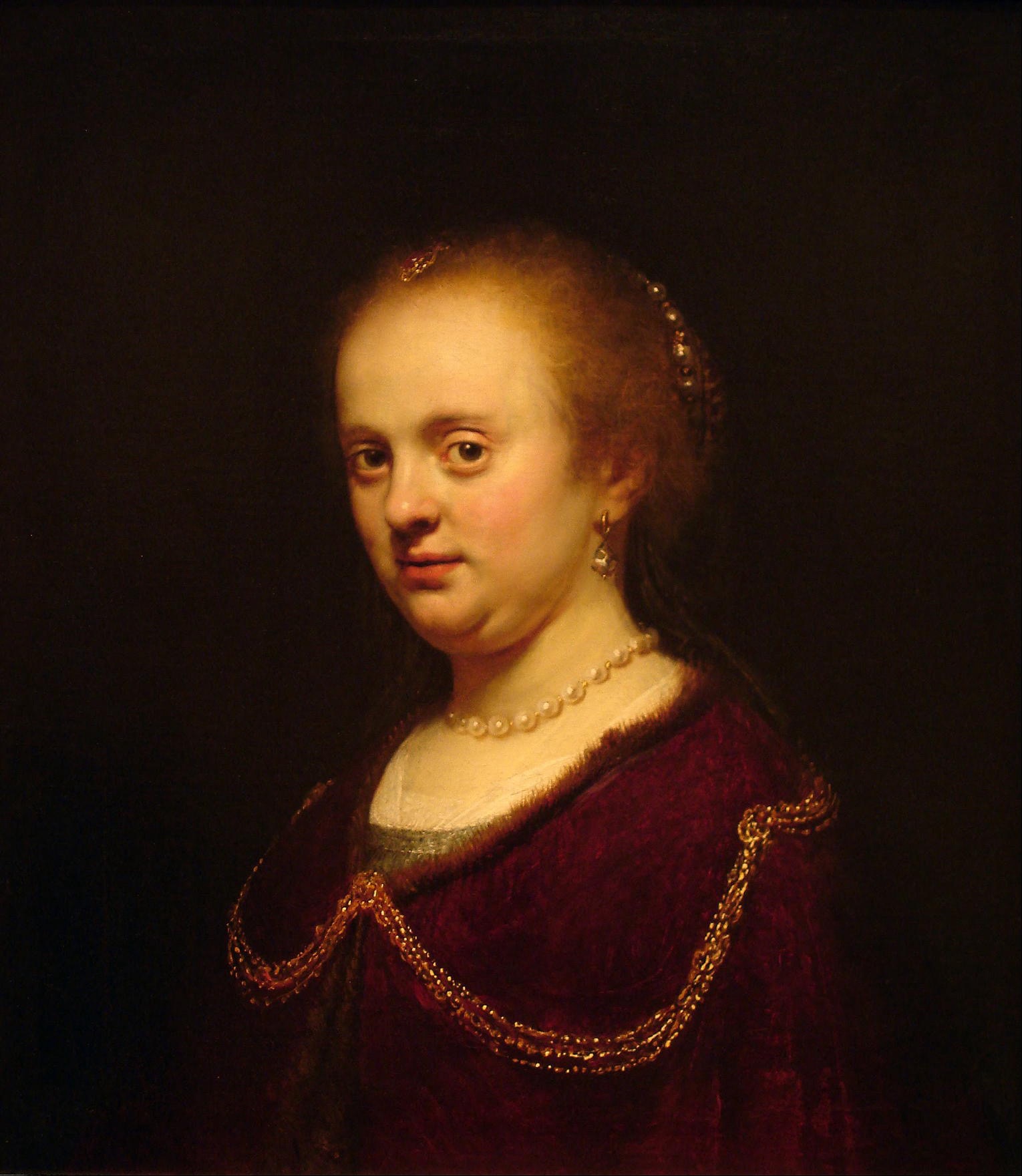
Rembrandt Harmenszoon van Rijn:
Retrato de mujer joven (Portrait of young woman)
(1634)
"Are we smart enough to share?"
The United States is not the most prosperous nation in the world, not by a long, long shot! Depending on the referenced index, the US ranks between 15th and 40th, despite its clearly enormous economic scale. It falls far short when it comes to equity. I might characterize Prosperity as a society’s capacity to transform income into social benefit. Our United States clearly wastes much of our income on the social equivalent of candy and gum. We seem to do this for all of the usual, truly terribly good reasons. We say we want to avoid socialism while forking over fortunes to industries that should have long ago become self-sufficient, like our poverty-stricken petroleum industry. Indeed, Texas would be another Mississippi were it not for Federal transfer payments made to industries there that could be profitably making their own ways. We purchase our penury at a personal premium. We each more or less contribute. Those most capable of contributing, by longstanding tradition, contribute a much lower percentage of their income and wealth than do the rest of us. This is not by any means Prosperity in action.
In practice, Prosperity might have little to do with wealth.
Good For A Goose

Decency (90)
Decency Unscrolling (1)
EndDays (92)
Exiled (90)
Fambly (93)
FollowingChapters (93)
Grace (92)
Humor (2)
iAlogue (1)
Letters to the Editor (1)
NextWorld (91)
Personal (18)
Prosperity (42)
Steam Festival (4)
Unscrolling (89)
Vaporized (6)
Work (16)
July 2026
June 2026
May 2026
April 2026
March 2026
February 2026
January 2026
December 2025
November 2025
October 2025
September 2025
August 2025
July 2025
June 2025
May 2025
April 2025
March 2025
February 2025
January 2025
December 2024
November 2024
October 2024
September 2024
August 2024
July 2024
June 2024
May 2024
April 2024
March 2024
November 2006
October 2006
September 2006
August 2006
July 2006
June 2006
May 2006
April 2006
March 2006
February 2006
January 2006