H-e-a-l-i-n-g
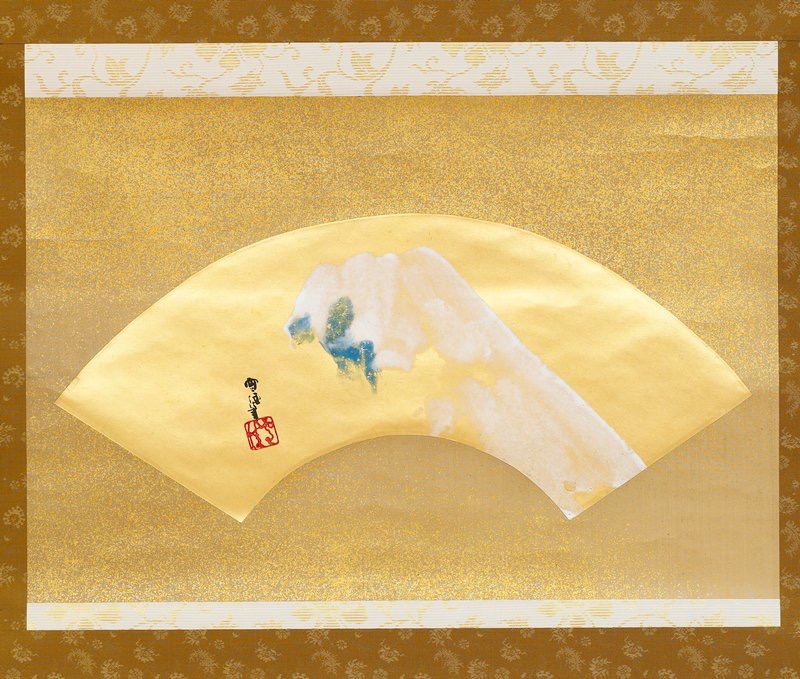
Kamisaka Sekka
Mt. Fuji
(1920s-30s)
"Out of many, one: Pluribus Unum, dammit!"
Healing might be the most egalitarian activity humans ever engage in. It knows no privilege or favor. It moves exclusively at one seemingly inexorable pace regardless of anybody’s relative Prosperity. It keeps its own counsel that everyone must accept and that they just get to guess at. The doctors and therapists predicted six to eight weeks before The Muse’s broken ankles might be fit for use again, but that projection was tempered with a terribly deliberate ‘more or less’ neither of us missed. Someone suggested that acupuncture might shorten that time by a week or more, but, honestly, why bother? Healing wasn’t supposed to be either a race or a competition. There’s nothing to be won if one heals faster or slower than the average, which trends toward the inexorable. There might be something worth learning either way, though.
Healing belongs in that class of human activities of which no human can ever become the master. No one was born with a special aptitude for it, and everyone eventually expires due to an inherent inability to continue succeeding at it. We must submit our wills in its presence. It moves at a pace much slower than that of a walking horse, which, since time immemorial, has been the base speed from which all others are calculated. Anything slower than the speed of a walking horse requires patience, a term, when nominalized, defines the role of those who are healing. They are referred to as patients, perhaps because they are presumed to be H-e-a-l-i-n-g, and that requires, first and foremost, patience. These familiar homophones work incredibly well together, since any return to wellness typically requires that the “patient” exhibit “patience.”
Forebearance also seems required, and not just by the designated patient, for the caregiver and even the odd self-designated Emotional Support Animal must also demonstrate a certain unquestionable patience. Willing another to get better faster to thereby deliver their caregiver can no more be allowed than impatience on the part of the patient. The difference being that the patient often has no alternative to being patient, or at least trying to learn the cruel art of patience. The caregiver might imagine that they’re at least physically independent from the cruel inexorability of that pace somewhat slower than that of a walking horse, but their relative ability might just make the situation worse for them. The patient has no alternative to learning patience. The caregiver might need to choose. Their choice depends upon both patience and discipline, which, in the case of the actual patient, gets forced upon them without recourse. The caregiver only has no ‘reasonable’ recourse, so their presence might seem like more of a sentence, even if they exhibit the patience of Job. They might well be faunching inside.
The H-e-a-l-i-n-g process mirrors perhaps the most significant lesson in leadership. The true leader is never the one who dispenses permissions, but the one who can say, “No!”, and make that stick. Those who don’t understand this fundamental principle don’t tend to make terribly good leaders, or they tend to become terrible leaders in practice. Those who can insist upon their “No!” sticking often come across as impudent, even childish. They might hold the role of some only rarely critical resource without much in the way of leverage power, unless or until some misfortunate choke point appears in the process. Then our impudent naysayer suddenly holds all the cards, and not even the most powerful presence in the universe holds enough authority to effectively nullify that impudent “No!”. It sticks.
H-e-a-l-i-n-g works like this. No matter how prosperous the wounded, they receive the self-same sentence as does the poorest pauper. Recovery speed depends upon ten thousand immeasurable factors, of which Prosperity might comprise no more than a single stitch. H-e-a-l-i-n-g seems among the most egalitarian activities available, one nobody would ever willingly volunteer for unless under the threat of not healing or death. In this way, H-e-a-l-i-n-g amounts to the opposite of an existential threat. It seems to be an existential essential, one absolutely required if our species needs to survive. But not even the self-proclaimed crown of creation gets to survive on their preferred terms. No! Sometimes, and especially whenever the chips are down, we humans survive in spite of our Prosperity and in spite of our innate cleverness. We get humbled and forced into patiently waiting for the gift that offers no priority service regardless of a person’s relative Prosperity, political party, or religion. H-e-a-l-i-n-g might be the purest form of Democracy or, perhaps, of Communism, offering no special privileges to anyone but its service equally to everybody. Out of many, one: Pluribus Unum, dammit!
©2026 by David A. Schmaltz - all rights reserved
Good For A Goose

Comeuppance (30)
Decency (90)
Decency Unscrolling (1)
EndDays (92)
Exiled (90)
Fambly (93)
FollowingChapters (93)
Grace (92)
Humor (2)
iAlogue (1)
Letters to the Editor (1)
NextWorld (91)
Personal (18)
Prosperity (94)
Steam Festival (4)
Unscrolling (89)
Vaporized (6)
Work (16)
September 2026
August 2026
July 2026
June 2026
May 2026
April 2026
March 2026
February 2026
January 2026
December 2025
November 2025
October 2025
September 2025
August 2025
July 2025
June 2025
May 2025
April 2025
March 2025
February 2025
January 2025
December 2024
November 2024
October 2024
September 2024
August 2024
July 2024
June 2024
May 2024
April 2024
March 2024
November 2006
October 2006
September 2006
August 2006
July 2006
June 2006
May 2006
April 2006
March 2006
February 2006
January 2006