SisypheanComeuppances
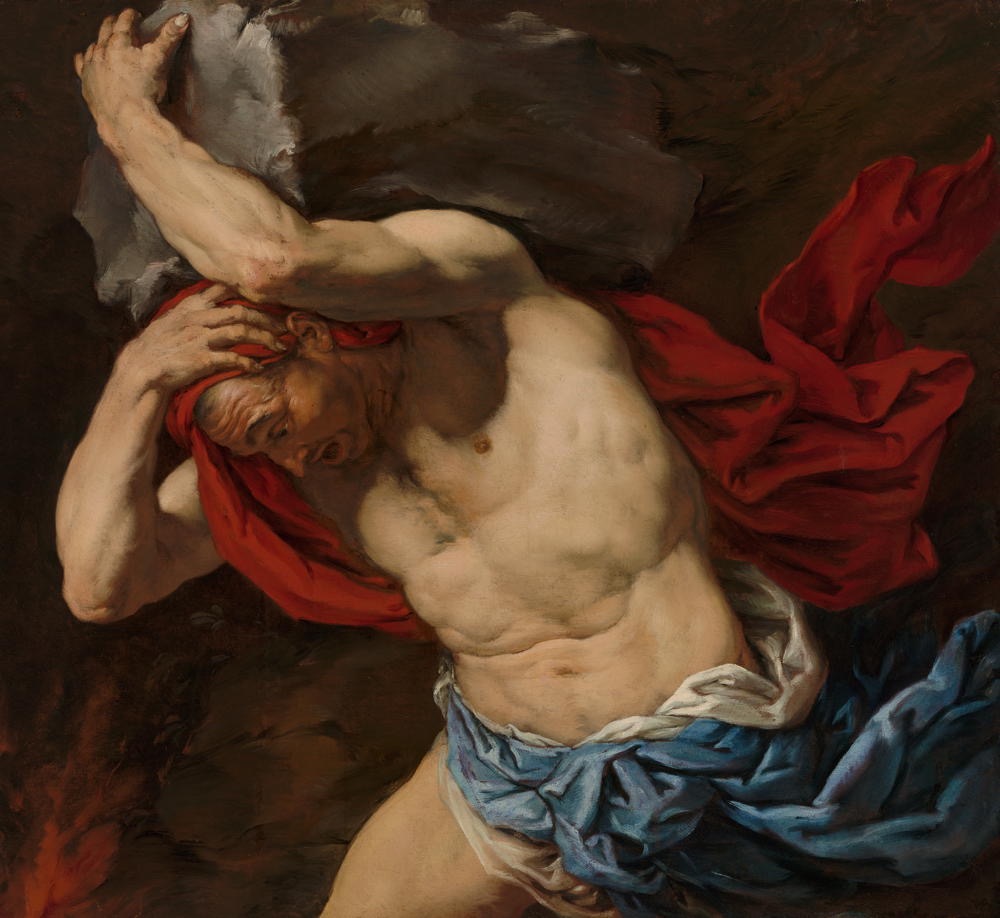
Antonio Zanchi:
Sisyphus
(1660/1665)
"I doubt that my modest contributions to literature really deserve much more than a decidedly Sisyphean existence."
Comeuppance doesn’t only occur at conclusions. It often, perhaps most often, occurs as what I might consider to be a lifestyle. Any task unlikely ever to be completed might exemplify this Comeuppance type, for its very uncompleteability might reasonably be considered a Comeuppance. Consider Sisyphus, that mythical king who, having offended some God or other, was sentenced to push a rock to the top of a very steep hill, only to have it roll back to the bottom once he’d successfully reached the top. His work might have been its own Comeuppance. In Sisyphus’s instance, he had no choice but to labor away unfruitfully each and every, literally, god-damned day. Most of the rest of us don’t have nearly as good an excuse for the obviously useless efforts we pretty much insist on engaging in each day. Often, a hobby stands in for formal employment, providing the means by which we might meaningfully pursue what anyone else might reasonably mistake for uselessness.
We should judge the relative usefulness of any effort more carefully, for the usual completion criteria fail to capture some of the more subtle, if even more significant, contributions the dung beetles among us routinely pursue. We chase, knowing we won’t catch. We rise early, explicitly not to get the worm, but to gain some other experience, perhaps one that routinely escapes our beaks. In those cases, the pursuit itself stands in for the purpose, just as old Sisyphus must have ultimately convinced himself, rather than driven himself insane, that his efforts were utterly futile. Then, the apparent Comeuppance might stand in for the purpose, employing the fiction, perhaps, that this might only prove to be a temporary condition. The starving artist persists in the belief that her efforts will certainly one day pay off, though any objective analysis, given the history of starving artist success rates, easily concludes that the imagined award will very likely never arrive. What will allow that artist to thrive despite or because of her starvation? What might render her successful enough simply as she is?
SisypheanComeuppances seem as common as dust, and almost exactly just as possessable. Nobody succeeds by hoarding the dust they receive. Few succeed in the way they originally imagined. Between dream and anything coming true lies a period of unavoidable irresolution, where our budding artists might be best described as simply starving, not having yet acquired the credentials essential to be considered anybody’s practicing artist, even their own. Yet she imagines, perhaps only on her better mornings, that she inhabits a genuine fantasyland existence with Cinderellas and handsome princes, and that she might even be so especially blessed that the misplaced shoe fits her foot! Most of her existence falls more similar to Sisyphus’, struggling up hills that seem more like mountains, sure and certain only of impending setbacks. Yet Cinderella persists. She does more laundry than she ever kisses princes, even if she eventually lives happily ever after with somebody handsome.
This must be us, each of us, even those seemingly born with a silver spoon inserted in their mouths. We each begin with unpromising futures, which seem utterly dependent upon some genuinely unlikelies-to-ever-happens. We persist in what initially sure seems like Sisyphean efforts, and even those who ultimately “succeed”, whatever that might mean, usually succeed on terms different from what they initially envisioned. The artist formerly known as starving might find herself, upon achieving her success, no longer the artist to whom she formerly attached her whole identity and existence. That artist went the way of Sisyphus. Most of us succeed this way, our original intentions, eternally unrequited. This universe seems just as indifferent near the end as it seemed encouraging nearer the beginning. How else could Sisyphus ever engage in his otherwise meaningless iterations? How else could generation after generation repeat this self-same pattern? It might never have been success, or even the promise of achieving it, that motivated each budding Sisyphus, but something else; certainly something other than the now popular and much-touted achievements.
I insist that there’s a meaningful existence beyond what we typically consider meaningful existences, one rooted in apparently meaningless routine and dignified by a certainly human insistence. I’m up every morning to write another story, even though it seems increasingly unlikely I’ll ever be discovered and become notorious or famous. I live in my own less significant way, very much like Sisyphus, though without the curse of the Gods that made his sentence inescapable. At any second, I could choose differently and head off into whatever sunset I choose. I could pursue a more alluring end, even one I might be much more likely to achieve one day, but I don’t. I probably won’t. This lifestyle I clearly chose for myself has not produced what might easily be mistaken for a justifying purpose. I am not rich and famous yet, and, like Sisyphus, I no longer really imagine myself ever achieving even the barest shadow of that objective, or any tangible objective I haven’t been realistically pursuing for years, which means I no longer subscribe to that popular fantasy.
I visited a beautiful little bookshop yesterday. Well-lit and thoughtfully appointed, it was clearly a Sisyphean establishment. It stocked far fewer than one percent of the four million books published in the last year, and featured many recognizable classics. It successfully avoided a few of the more annoying display habits of the chain booksellers who focus almost exclusively on distributing bestsellers. It seemed genuinely interested in satisfying browsers, those who enter a bookstore because they don’t know what they might find. These readers stumble into their meaningful futures, never for a second hoping to quench their thirst for knowledge, beauty, insight, or even distraction by finding that volume that might cure those conditions by reading it. There, I acknowledged the Sisyphean nature of my chosen profession, the one that actually chose me, and I sensed the many unaccountable-for benefits I enjoy from this blesséd lifestyle. I did not find my books on those shelves, thank heavens! I doubt that my modest contributions to literature really deserve much more than a decidedly Sisyphean existence. Neither should I.
©2026 by David A. Schmaltz - all rights reserved
Good For A Goose

Comeuppance (23)
Decency (90)
Decency Unscrolling (1)
EndDays (92)
Exiled (90)
Fambly (93)
FollowingChapters (93)
Grace (92)
Humor (2)
iAlogue (1)
Letters to the Editor (1)
NextWorld (91)
Personal (18)
Prosperity (94)
Steam Festival (4)
Unscrolling (89)
Vaporized (6)
Work (16)
September 2026
August 2026
July 2026
June 2026
May 2026
April 2026
March 2026
February 2026
January 2026
December 2025
November 2025
October 2025
September 2025
August 2025
July 2025
June 2025
May 2025
April 2025
March 2025
February 2025
January 2025
December 2024
November 2024
October 2024
September 2024
August 2024
July 2024
June 2024
May 2024
April 2024
March 2024
November 2006
October 2006
September 2006
August 2006
July 2006
June 2006
May 2006
April 2006
March 2006
February 2006
January 2006