Flurries
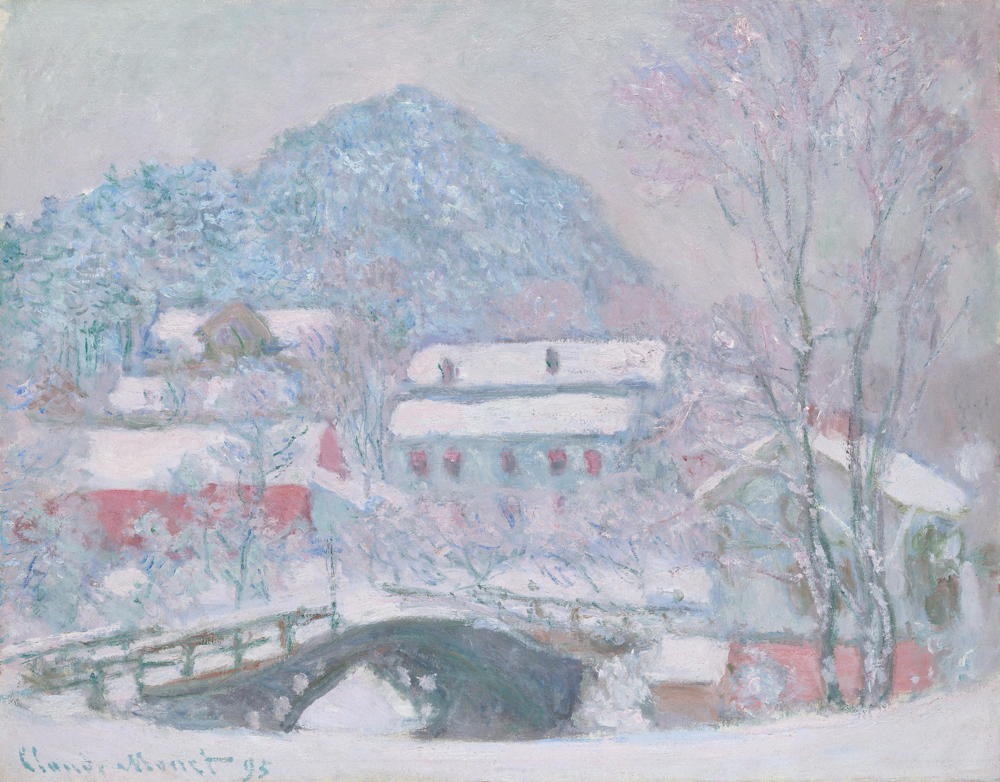
Claude Monet: Sandvika, Norway (1895)
ABOUT THIS ARTWORK
Claude Monet’s trip to Norway in 1895 was perhaps the most physically taxing of all his many painting campaigns. Touring the country with his stepson Jacques Hoschedé, who lived in Christiania (now Oslo), he was awestruck but initially frustrated in his search for good motifs amid the snow. Nevertheless, he painted 29 Norwegian scenes during a two-month stay. These included at least six views of Sandvika, a village near Christiania whose iron bridge may have reminded Monet of the Japanese bridge at his home in Giverny.
— — —
"Then I feel glad for my little social media addiction."
It’s not that scrolling only produces distraction. It also produces fantastic information, sometimes far superior to anything accessible before the unfortunate downfall of journalism and the rise of so many blogging platforms. Though blogs gained their initial popularity as a conduit for various nefarious conspiracy theorists, they have since attracted plenty of more credible contributors, some of whom the algorythm even allows me to access. Just when I’ve about convinced myself that scrolling cannot be justified, something actually happens out there in what still passes as the real world. Suddenly, all the foreground filled with idle speculation masquerading as news disappears, replaced by some actual reports from actual fields. For a change, and if only for a little while, mainstream breaking news matches the streaming contributors, and my scrolling manages to bring some events into actual focus. It was always tough to access adequate information surrounding any breaking news. In the old days, I’d frantically switch between the three available broadcast channels, trying to glean additional incremental bits of actual information. Now, of course, I just continue scrolling through what my algorythm serves.
The primary problem with any addictive substance lies in its beneficial qualities. Most possess redeeming value, whatever their nefarious reputation. When my daughter attended her junior year of high school in Chuquicamata, Chile, a copper mining town at over 9,000 feet in the Andes, her host family gave her coca tea because she was overly sensitive to the altitude. My mother’s Aunt Dora, publicly a Seventh Day Adventist teetotaler, routinely asked my mom to bring her a pint of that Mogan David wine, for medicinal purposes, of course. Scrolling, too, has its beneficial uses if its more damaging aspects can be kept contained. Even when I fail to contain those aspects, benefits can still slip in through my defences. Were I to completely cut myself off from access, I would be cutting off some of my nose to spite my face. Many greys remain even when a situation can be generally characterised as either black or white.
Abstinence might dictate a wholly different set of coping tactics. These might well prove to be simpler than managing continuing intermittent use. I find that I must frequently relearn moderation, and that prior successes do not necessarily preface any future easing of effort. Experience might well complicate responding to additional challenges because success produces memories of what occurred after the struggle rather than reinforcing what happened during the heat of the battle. Entering with confidence might undermine the senses needed to accept and cope with the sense of helplessness necessarily always accompanying any addictive activity. No redemption can occur without first stumbling into some pit and being genuinely surprised by the experience. Nobody ever gets skilled at getting unhooked again, though many seem to nurture their facility for repeatedly falling into their pit.
I seem to be getting awfully skilled at stumbling back into my scrolling pit again. My growing awareness of its dangerousness doesn’t usually disuade me from reentering. Nor am I necessarily haughty about my personal extrication skills. I stumble almost as blindly as I ever did, recognising the role my muscle memory must play in it. I am sometimes rewarded for my obvious weaknesses. Something actually happens out there in the real world, and there! I find myself perfectly situated to access additional information. The New York Times confirms that the initial announcement wasn’t something recycled from last April, and the informal network of knowledgeable citizens and the usual collection of internet idiots begin broadcasting seemingly every perspective. Of course, my algorythm is actively curating, protecting my more delicate sensibilities from exposure to the more exasperating right-wing perspectives, but to the extent of my feed, I’m feeling well informed. Of course, the news seems infuriating. That’s one way I can tell whether it’s real, though some level of exasperation does seem to be the background condition of even my everyday newsless newsfeed.
The headlines will shrink between now and the next genuine crisis, though with this incumbent, genuine crises seem to occur on a more frequently than daily basis. Still, his standard one hundred overnight “tweets” tend to be well worth ignoring since they’re usually just evidence that he’s stark raving. I know some swallow even those as gospel. They are damned to a Hell of their own making. I feel myself slipping down that slope sometimes, but I have so far managed to pull myself back from that brink many times. I’ve had no luck at completely avoiding the brink, and I cannot seem to avoid blinking when I’ve sworn to avoid social media engagement. I take my peeks and sometimes get sucked back into that predictable pit, but sometimes I stumble across Flurries of real, important news in there. Then I feel glad for my little social media addiction.
©2026 by David A. Schmaltz - all rights reserved

Good For A Goose

Comeuppance (31)
Decency (90)
Decency Unscrolling (1)
EndDays (92)
Exiled (90)
Fambly (93)
FollowingChapters (93)
Grace (92)
Humor (2)
iAlogue (1)
Letters to the Editor (1)
NextWorld (91)
Personal (18)
Prosperity (94)
Steam Festival (4)
Unscrolling (89)
Vaporized (6)
Work (16)
September 2026
August 2026
July 2026
June 2026
May 2026
April 2026
March 2026
February 2026
January 2026
December 2025
November 2025
October 2025
September 2025
August 2025
July 2025
June 2025
May 2025
April 2025
March 2025
February 2025
January 2025
December 2024
November 2024
October 2024
September 2024
August 2024
July 2024
June 2024
May 2024
April 2024
March 2024
November 2006
October 2006
September 2006
August 2006
July 2006
June 2006
May 2006
April 2006
March 2006
February 2006
January 2006