No-ing
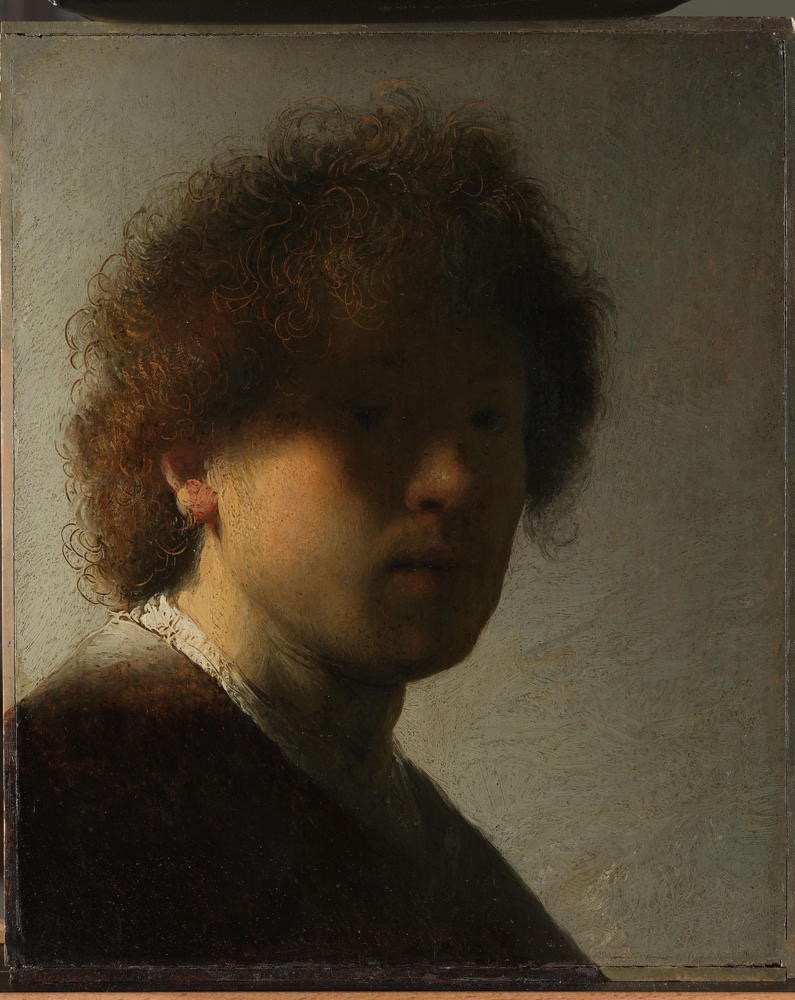
Rembrandt van Rijn: Self-portrait ( c. 1628)
Gallery Notes: Even as an inexperienced young artist, Rembrandt did not shy away from experimenting. Here the light glances along his right cheek, while the rest of his face is veiled in shadow. It takes a while to realize that the artist is gazing intently out at us. Using the butt end of his brush, Rembrandt made scratches in the still wet paint to accentuate the curls of his tousled hair.
"…I'd take my marbles home while mumbling"Good riddance!" under my breath."
It might be that I scroll to try to identify shifting power. In times as volatile as these, advantage seems to be continually shifting. Any news cycle, any odd minute, might hold evidence of where power might be shifting next. Our incumbent, widely acknowledged idiot that he has proudly proven to be, shifts focus more frequently than he farts, so he creates much churn in the channels, and so sparks my near constant interest. Scrolling sometimes seems like reading a truly terrible novel I can’t bear to set down for a minute, completely beyond my volition. I might need permission to stop, though from whom such permission might come seems like another fundamentally unanswerable question. This brings an old understanding into suddenly sharper focus.
In my youth, I believed that power came from granted permission, that somebody powerful could bestow the authority for something to happen, and that it consequently did. As a budding project manager, I watched each project’s sponsor dole out a budget and a remarkably fuzzy set of objectives for the effort. What was ultimately delivered seems to have little to do with what that sponsor allocated, either initially or eventually, after approving additional funding and several iterations of an inevitably reduced requirements set. Something other than the sponsor’s budget and requirements seemed to determine development. The power never really resided in either the purse or the objectives, but more often in some of the more obviously unpowerful places in the community. It took me a long time before I finally figured out what those actual power sources had in common, and it was never the authority to grant permission. Quite the opposite, they each held the curious power to say, “No!” and somehow make it stick.
Maybe they held a skill that was absolutely needed but in terribly short supply. The sponsor might insist the product be delivered by July, but the guy whose specialty needed to be involved wasn’t available in that time frame, so the whole effort would morph around what was actually available, and begrudgingly reset expectations, usually with the sponsoring authority gnashing its teeth in the background. Such authority was almost always inadvertantly held. Nobody plans to create such narrow passages, but whether the effort was managed as an authoritarian invasion or a more democratic intrusion, someone or something invariably stepped in to more properly define the reality the effort was actually inhabiting. The plans were always inescapably naive. What emerged in execution always ruled. The result was at least partly an adaptation, an improvisation that accounted for what proved possible within that context. The clever project manager would avoid punishment by promoting radical acceptance. For any dream to come true, the ‘how to get there’ has to die.
Our incumbent reminds me of the more hapless sponsors. They cajole when encountering an unsettling reality. They believe themselves to be in the superior negotiating position because they wield the bigger budget. They believe themselves indispensable, at least until subtler realities rule. Democracies seem to have been based upon a similar proposition. If the electorate votes, “No!”, their decision sticks. Authoritarians deal almost exclusively in permissions: payoffs, bribes, commandments, orders. Their influence will always be limited by the extent of their resources. Making a “Yes!” stick might require impossibilities no “No!” ever does. Simply withdrawing often costs the dissenter nothing. Making that ‘No!’ stick might demand nothing beyond their absence. Those who can say, “No!” and make it stick, always wield the most power.
I’m currently struggling to make my “No!” stick when it comes to Unscrolling. I can’t seem to tolerate being out of the loop on whatever’s currently cliffhanging. I am witnessing the dismantling of much I’d been unaware I’d held so dear. Subtle balances and checks that I’d never known as absences leave glaring holes as they depart. They wound my heart. I find myself cheering for our trading partners as they find their hind legs and extend themselves to standing straight and properly proud. A Canadian pension fund owns the largest employer in my county, and I’ve been reading how Canadian pension funds have been withdrawing their investments in our suddenly intolerably volatile economy. They can say, “No!”, and that might stick it to me. We have been dependent upon the kindness of absolute strangers who have invested their life savings with us, only to have our incumbent insult their decency and intelligence. If I were them, I’d take my marbles home while mumbling, ”Good riddance!” under my breath. I can’t help but continue watching our dismantling.
©2026 by David A. Schmaltz - all rights reserved
Good For A Goose

Comeuppance (31)
Decency (90)
Decency Unscrolling (1)
EndDays (92)
Exiled (90)
Fambly (93)
FollowingChapters (93)
Grace (92)
Humor (2)
iAlogue (1)
Letters to the Editor (1)
NextWorld (91)
Personal (18)
Prosperity (94)
Steam Festival (4)
Unscrolling (89)
Vaporized (6)
Work (16)
September 2026
August 2026
July 2026
June 2026
May 2026
April 2026
March 2026
February 2026
January 2026
December 2025
November 2025
October 2025
September 2025
August 2025
July 2025
June 2025
May 2025
April 2025
March 2025
February 2025
January 2025
December 2024
November 2024
October 2024
September 2024
August 2024
July 2024
June 2024
May 2024
April 2024
March 2024
November 2006
October 2006
September 2006
August 2006
July 2006
June 2006
May 2006
April 2006
March 2006
February 2006
January 2006