StrategicForgetfulness
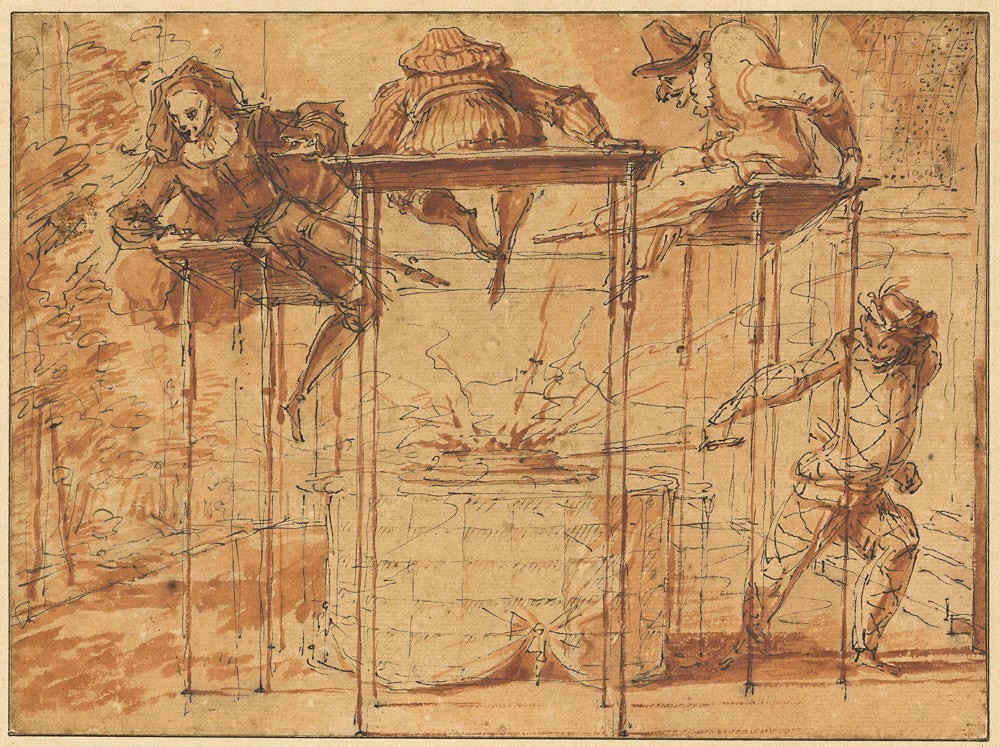
Claude Gillot: Harlequin Espirit Follet: The Comedian’s Repast
(c. 1700–1715)
"…forgetting my phone on purpose when I'd most often accomplish that by default."
However I might try to slice the challenge, Unscrolling still seems difficult. It carries the usual difficulties associated with trying not to do something, a philosophical impossibility if not necessarily a physical one. It might just as well be impossible for all the success I seem to engender whenever attempting to accomplish it. Not even my very best intentions, freshly shaved, showered, and dressed in clean jeans, seem capable of succeeding very often, and even then, it seems more accidental than intentional. Still, I accept accidental as a valid tactic, except I cannot will an accident any more than I seem to be able to not do something as seemingly innocuous as scrolling. Maybe I’m hopeless.
Hopeless or not, I don’t seem to yet be beyond leveraging my budding forgetfulness towards this end. If I were to forget my phone, I would lack the means to scroll anything until I returned. A lack of opportunity has probably prevented more felonies than all the discipline in Christendom. What if I could strategically engineer absences of opportunity? How might that be as a strategy for me to at least accumulate some otherwise absent Unscrolling experience? The beauty of this strategy lies in the fact that I do not need an ounce of discipline for it to succeed, other than that moment of forgetfulness when I might accidentally or even deliberately remember. Once I’ve left the mothership, I’m gone until I return.
I know a bit of how that first astronaut felt when he engaged in that unteathered Extra-Vehicular Activity. He crossed a Rubicon, uncertain if he could ever return. He might have volunteered to participate in his own demise. Wise or stupid? Only the suddenly unknowable future could know, and only will know then.
I told The Muse that I was heading out to see if I could get a haircut. It was a foggy Saturday afternoon, and I was between obligations. I slipped into some outdoor shoes and hopped into the Schooner. I was more than a mile away before I noticed that I hadn’t plugged in my phone. I was a little farther afield when I discovered that I’d apparently left my phone at home. A fleeting moment of terror washed over me. I was incommunicado! What if The Muse tries to connect with me? What if she needs me to pick up something on my way back home? After a few frantic thoughts, I felt something snap inside my head. I’d brought a book to read during the inevitable wait. I wouldn’t be out late. Chances are, The Muse would not even notice I’ve gone until after I return. Further, I’d lost the ability to scroll while waiting. My forgetfulness had taken that threat out of my hands.
The barber shop was closed. I was home fifteen minutes after I’d left. Even then, I didn’t rush into the house to hunt down my phone. I left it alone. I sat and read, as I’d planned to read while waiting my turn in the barber chair. It was at least another hour before I felt compelled to check in on what was happening out in the world. My ability to engage in instant communication doesn’t mean I’m required to engage in it. It remains as optional as if it were impossible until I feel the necessity of engaging in it. When I was a kid, I never felt the urge to initiate instantaneous communication, and not only because it was not yet possible. Some doubtless suffered from an unrequitable urge then, and some might today when separated from their sacred damned communication instrument. I hope to become sanguine, indifferent when I strategically forget to bring my phone along. I’m not so important that I need to stay in continuous contact. Continuous accessibility seems to be more in the way of a problem for me these days. Maybe THE problem I face.
I figure that a man of my age and stature might conveniently integrate forgetfulness into my daily routine. I sense that it might even be integrating itself, without me having to necessarily instigate anything. Time mediates all afflictions, albeit ironically, by inflicting additional afflictions to ultimately undermine whatever’s troubling. Scrolling might become a self-correcting problem, or come to seem self-correcting, anyway, especially if I come by the strategy honestly, the old-fashioned way. I can inflate my waning self-esteem by insisting I’m engaging in a strategic ploy, forgetting my phone on purpose when I’d most often accomplish that by default. I’m brilliant!
©2026 by David A. Schmaltz - all rights reserved

Good For A Goose

Comeuppance (31)
Decency (90)
Decency Unscrolling (1)
EndDays (92)
Exiled (90)
Fambly (93)
FollowingChapters (93)
Grace (92)
Humor (2)
iAlogue (1)
Letters to the Editor (1)
NextWorld (91)
Personal (18)
Prosperity (94)
Steam Festival (4)
Unscrolling (89)
Vaporized (6)
Work (16)
September 2026
August 2026
July 2026
June 2026
May 2026
April 2026
March 2026
February 2026
January 2026
December 2025
November 2025
October 2025
September 2025
August 2025
July 2025
June 2025
May 2025
April 2025
March 2025
February 2025
January 2025
December 2024
November 2024
October 2024
September 2024
August 2024
July 2024
June 2024
May 2024
April 2024
March 2024
November 2006
October 2006
September 2006
August 2006
July 2006
June 2006
May 2006
April 2006
March 2006
February 2006
January 2006