AlternativeFutures
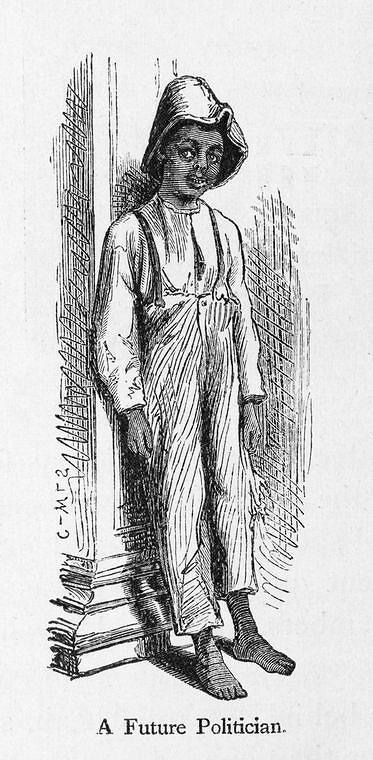
Edward King: A future politician (1874)
"Decency’s probably more resilient than even the most practiced cynicism."
My old colleague and friend, Al, who has followed my writing for about thirty years, reminds me after reading my recent story featuring pointed comments about cynicism that, as a species, we seem to be much better at predicting long recoveries than at experiencing them. He contends that most systems recover much more quickly than their intimates predicted. This pessimism about our resiliency might fuel much despondency. As we watch what we consider Decency crumbling before us, we do more than just order handbaskets. We believe we might never recover from this latest round of insults, even though our history seems resplendent with examples of more rapid recovery. Even if we held the power to regenerate a severed limb spontaneously, we wouldn’t necessarily relish the experience. We might come to believe that we were more finite than we’d ever actually been, and confidently predict that any individual lobbing off would do us in.
We are already recovering from these latest insults, even as the wolves continue devouring so much of what we hold so dear. The disassemblers are no more skilled at demolition than they seem to be at construction. They’re disrupters. In the strict parlance of that business, disruptions represent interruptions rather than permanent destructions. Though The Muse reminds me that we don’t build back, we do seem to be capable of building forward. Recovery, always residing in the future, permanently remains speculative. We cannot know its true nature. We cannot, as my fifth-grade teacher insisted, start with the end in mind and outline the path forward before advancing. If only this universe allowed such reassuring projection. The absence of that capability, though, need not necessarily insist that we can’t get anywhere from here, or that we must by fate move ever further backward. Time moves tenaciously forward. We inexorably follow.
My friend Al commented on how quickly children seem to grow up, even though, watching them closely, they don’t seem to change from day to day. The scale of observation seems materially different than the scale of existence. Maybe I cannot see at the actual speed of whatever’s evolving before me. It looks frozen to my perception, though it moves without exception. I surround myself with nouns and miss the verbs endlessly swirling around me. Maybe we need to freeze what we perceive to believe it exists. Verbs make unreliable neighbors. Nouns reassure us, but also mislead us to conclude that we’re more screwed than we might otherwise be. In December, Spring seems an unlikely future. In Summer, Winter seems impossible.
Cynicism about the future might be the residue of some vestigial sense that our futures were not supposed to be different. Because they are different, we experience much that makes little sense to us. We might believe that our children are genetically incapable of maintaining the world they inherit, without recalling how unprepared we were to inherit the world we received. It would likely take forever to make progress toward social justice, and not one of us understood what it would take to accomplish much. Backsliding discouraged even the most stalwart, just like it did for those who came unprepared before us. Whatever it is, whatever it was, this too shall pass, rather more quickly than anticipated. The replacement will find balance more rapidly than we can imagine, because we seem to be incapable of imagining such a thing, not because recovery must necessarily remain out of reach for long. Perhaps that cynicism was just skepticism gone to seed. Optimism returns faster than it’s ever overturned. Decency’s probably more resilient than even the most practiced cynicism.
©2025 by David A. Schmaltz - all rights reserved

Good For A Goose

Comeuppance (31)
Decency (90)
Decency Unscrolling (1)
EndDays (92)
Exiled (90)
Fambly (93)
FollowingChapters (93)
Grace (92)
Humor (2)
iAlogue (1)
Letters to the Editor (1)
NextWorld (91)
Personal (18)
Prosperity (94)
Steam Festival (4)
Unscrolling (89)
Vaporized (6)
Work (16)
September 2026
August 2026
July 2026
June 2026
May 2026
April 2026
March 2026
February 2026
January 2026
December 2025
November 2025
October 2025
September 2025
August 2025
July 2025
June 2025
May 2025
April 2025
March 2025
February 2025
January 2025
December 2024
November 2024
October 2024
September 2024
August 2024
July 2024
June 2024
May 2024
April 2024
March 2024
November 2006
October 2006
September 2006
August 2006
July 2006
June 2006
May 2006
April 2006
March 2006
February 2006
January 2006