Ungrounding
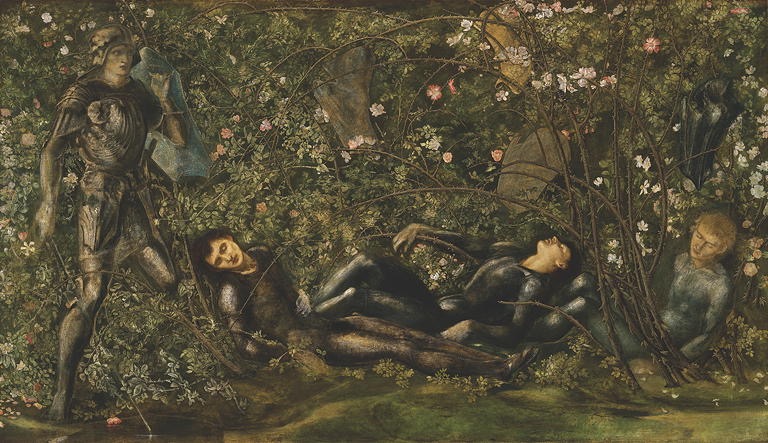
Sir Edward Coley Burne-Jones: The Prince entering the Briar Wood
(1869)
"Sic semper tyrannis!"
Just like too many EndDays Stories, this one properly begins with the fateful phrase, “If anyone had told me just two years ago…”, before going on from there. Today, I routinely engage in previously unimaginable actions, formerly genuinely unthinkable ones. Some, in defense, hoping to ward off an indistinct yet ever-present sense of impending evil, and others in preparatory offense, as if for an anticipated assault. I’m mostly making my actions up as I go along. I engage in rituals every bit as effective as those my forebears invoked to prevent The Evil Eye from getting them, rubbing salve on imaginary future wounds. For the first time in my pacifist life, I’ve begun to understand the urge my Second Amendment friends must feel when they fondle their assault rifles. I feel protective of my past, which has most certainly already passed now, and I feel genuinely insulted by what seems too likely to become our future.
The Muse and I were invited to join a conversation convened by a local executive.
TheLimit
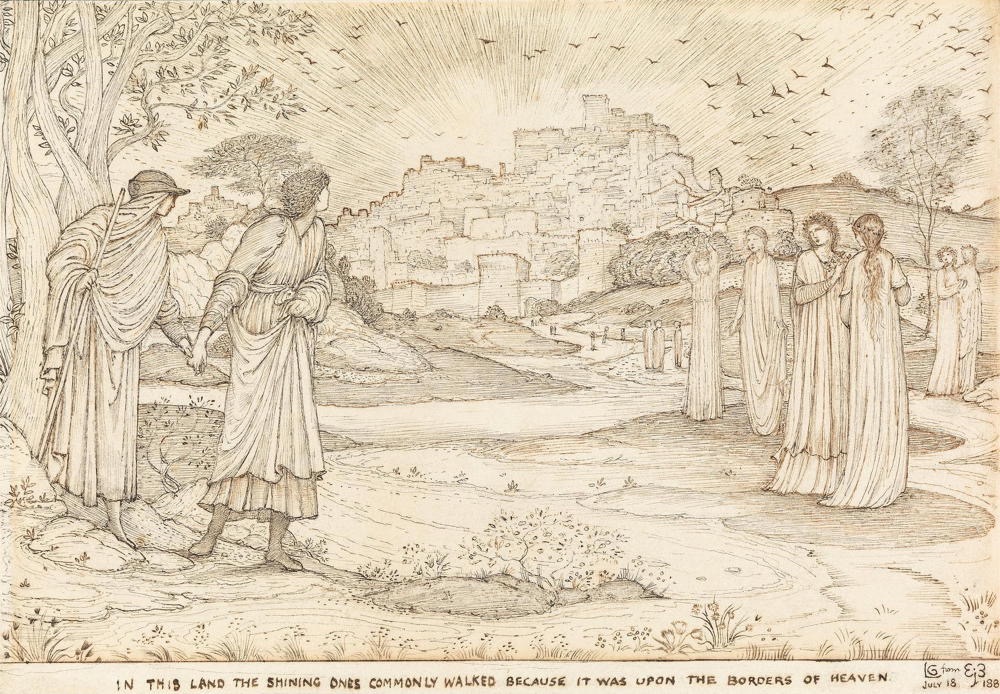
Edward Burne-Jones: The Land of Beulah (1881)
"…when there are perfectly satisfying wishes lurking much closer and more convenient to home…"
In EndDays, apparent limits shift. What might once have been measured in ‘sky’ seems not nearly as impressive or high. More modest boundaries apply. I might ascribe this narrower sense to the usual limits imposed by age and experience. I’ve learned to moderate my possibility senses in anticipation of not being able to fully satisfy them. This might seem like a dandy adaptation to prevent discouragement or depression, but it also materially affects my sense of possibility. If I give up on myself without much in the way of challenging, it seems I must be prelimiting my influence. Those who cannot imagine might struggle to manifest. Back when the sky served as TheLimit, I felt much less restrained than I do entering my waiting dotage, where I hold the benefit of so much more experience manifesting even impossibilities. I feel forced to admit that I’ve been limiting myself.
I remember consulting with a group in a company that had just been acquired in a buyout.
LetThereBe
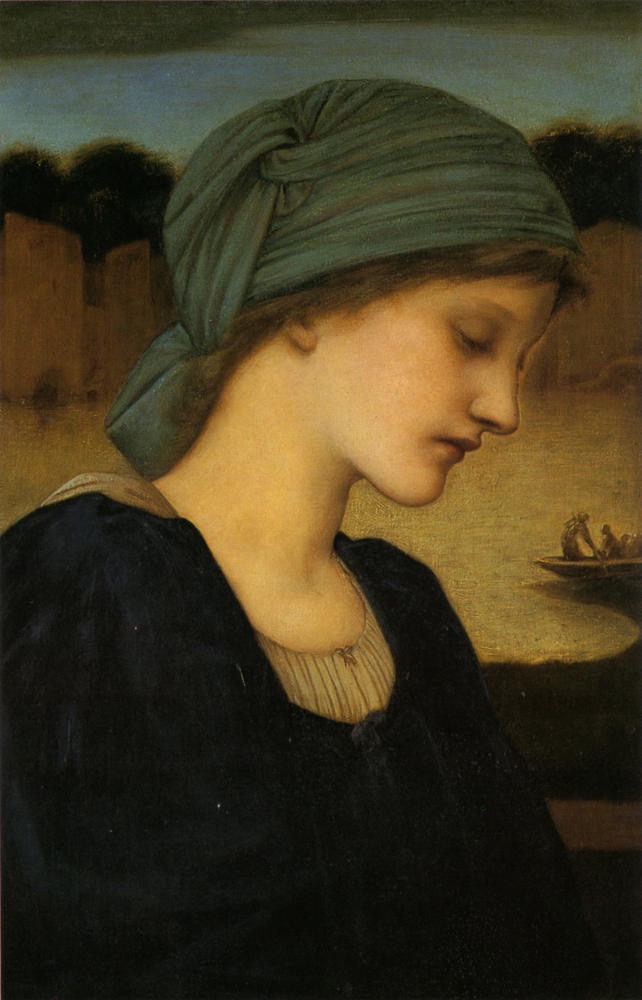
Edward Burne-Jones: Flamma Vestalis (1884 - 1890)
Gallery Notes:
Burne-Jones’s daughter Margaret modeled for this painting. The Latin title refers to the Vestal Virgins of Rome, who tended the perpetual fire on the altar of the goddess Vesta. Begun before Margaret’s marriage in 1888, the painting aligns her with these chaste women, suggesting her innocence and purity.
— —
"Let there be light" is an English translation of the Hebrew phrase יְהִי אוֹר (yehi 'or) found in Genesis 1:3 of the Torah, the first part of the Hebrew Bible. In Old Testament translations of the phrase, translations include the Greek phrase γενηθήτω φῶς (genēthḗtō phôs) and the Latin phrases fiat lux and lux sit. It is part of the Genesis creation narrative. Wikipedia
I had grown to take light in all of its variety for granted.
DayOfRest
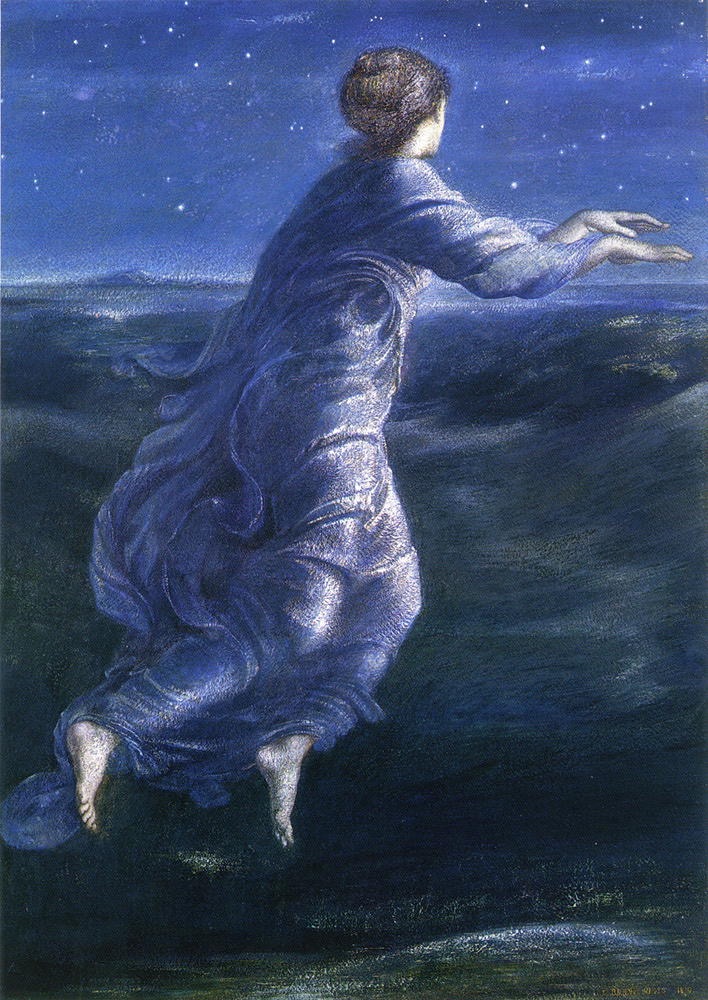
Edward Burne-Jones: Night (1870)
"I'm planting those flowers this morning."
The Muse and I have several flats of plants sitting beneath our sacred apricot tree. We bought them over the past two weeks in fits of the usual enthusiasm, as Spring started emerging, imagining that they’d somehow just plant themselves, I guess. It’s been more than a week now, and there they sit, still not planted. We love to plant. It’s been our shared ritual since that first Spring we spent together back in that little apartment overlooking The Willamette, just downwind from where my prior relationship played out its EndDays. We planted flowers to thumb our noses at what had so recently seemed like the end. They represented our new beginning, and planting them then seemed like the opposite of work. It was renewing and rewarding, and reassured us that we still inhabited a welcoming world, regardless of the EndDays still trailing their toxicity along just behind us. Planting day always feels like a DayOfRest to us, yet I’d still been resisting engaging.
I spent time earlier this morning, warmly anticipating planting those flowers today.
Weekly Writing Summary For The Week Ending 03/26/2026
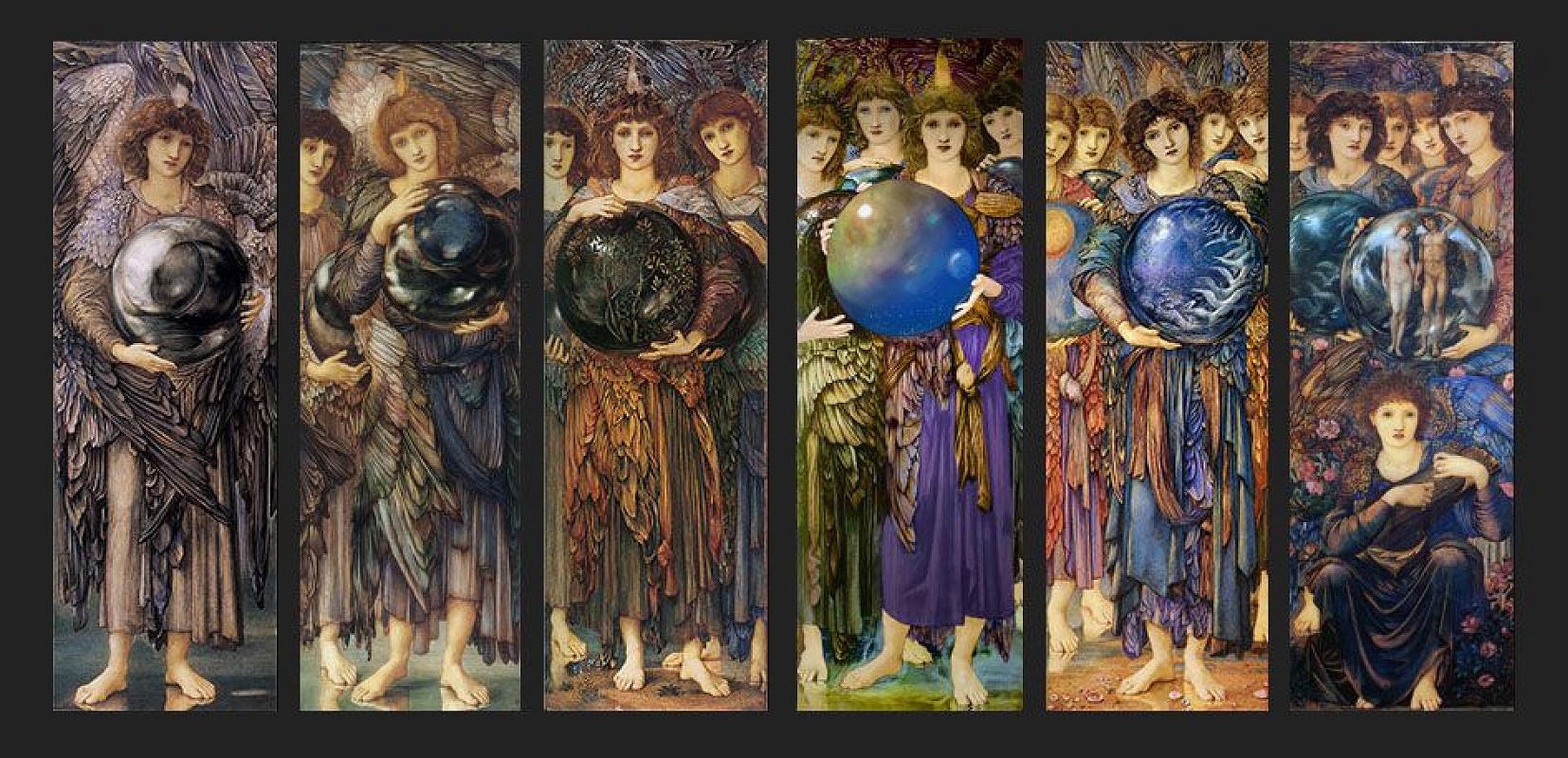
Edward Coley Burne-Jones: The Days of Creation (1876)
This was the most remarkable writing week I've experienced since I began writing this series of series 35 quarters ago. The flow quickly and easily established itself, and I found myself following two patterns I'd barely imagined before becoming entranced by them. I was pursuing deeper understanding of the EndDays sensations that almost everyone I'd spoken with lately had been remarking upon. It sure seems like something's coming to an end: civility, democracy, sanity, the rule of law, common sense. I sensed that EndDays belong to that class of sensations that cannot be wholly validated, or, indeed, really experienced until they're over, since there's no way to determine between actual and mere sensation until the EndDays end. Counterbalancing those sensations, I stumbled upon the remarkable Days of Creation hexaptych by Pre-Raphaelite painter and designer Sir Edward Coley Burne-Jones — a single work composed of six panels. These six panels functioned both independently and as a unified whole, which was precisely how I employed them this writing week. Each panel stands alone as the image for its corresponding EndDays installment, while the complete sequence forms a single, coherent creation narrative underlying the entire series.
In effect, each installment this writing week introduced a part of the universe the bulk of this series will inhabit.
TheBeast
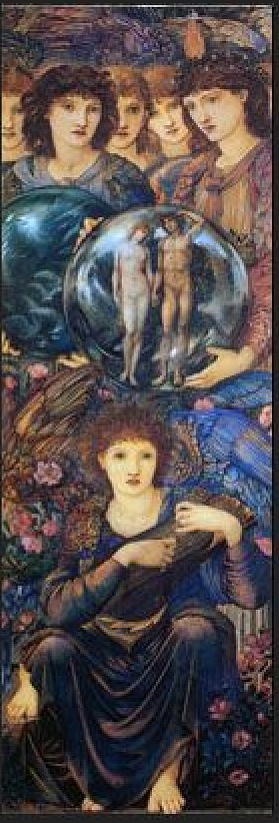
Edward Burne-Jones: The Days of Creation: The Sixth Day
(1870-1876)
"On the Seventh Day, The People rested."
However unsettling the election results had seemed, TheBeast that emerged from that victory was much, much worse. It became clear even to those who had not before figured out the scam that they had been had, and not by any particular master. They had been fooled by a fool, which only amplified their sense of betrayal. The sacred promises he swore all along the campaign trail fell one by one into a gutter soon overflowing with treachery. His inauguration came off as more like a funeral, with fewer attending than at any such gathering in modern history. That first day in office set a fresh record for perfidy as each presidential proclamation seemed to amplify a sense that he was abandoning reason to pursue who knew what? A deep sense of dread and stunned recognition echoed out from the quickly despoiled Oval Office. We were being screwed.
The resistance responded immediately.
Fictos
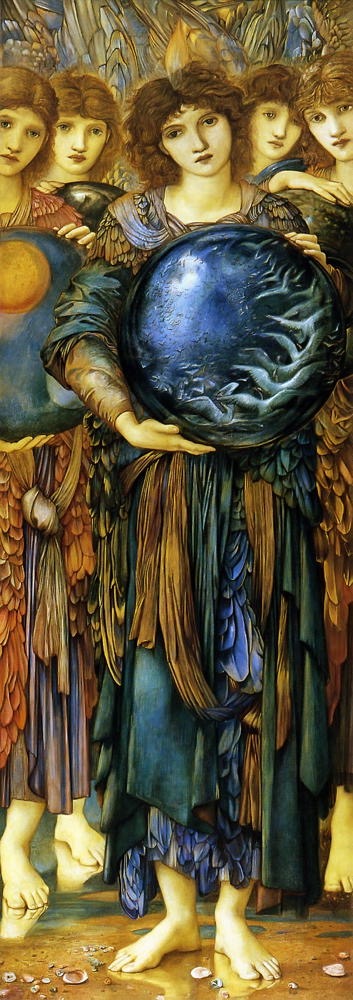
Edward Burne-Jones: The Days of Creation: The Fifth Day
(1870-1876)
"…if, indeed, our politics even survives this latest unbridled EndDays assault."
Few human activities can seem more boring than the practice of good governance. It definitely does not ordinarily qualify as anything resembling any actual spectator sport, except sometimes it engages in activities of such monumental importance that it manages to attract quite the audience. This quality of only occasionally qualifying for full attention encourages politicians to engage in some studied myth-making. They speak of such things as Masters of the Senate, a label that at best describes some especially skillful bureaucrat. They occasionally engage in brinksmanship, seeming to leave society teetering on some cliff-edge, but much of that amounts to performative statecraft. The actual deals get struck far away from the House and Senate floors, though the office of the President carries by far the greatest volume of mythos, if only because the presidency’s responsibilities definitely border on the mythical.
Chief administrator of every department of government, Commander-in-Chief of the military, perennial plenipotentiary of seemingly damned near everything in our political universe, our president more than borders on the edge of a mythical being.
MassDeception
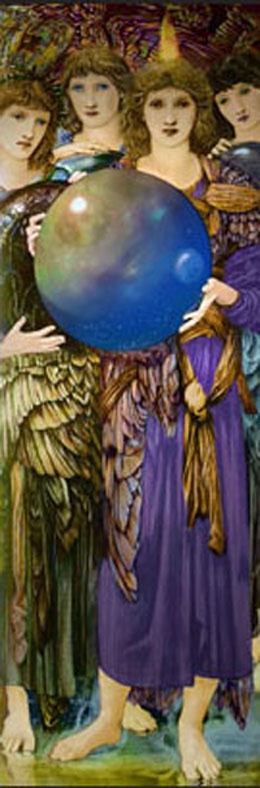
Edward Burne-Jones: The Days of Creation: The Fourth Day
(1870-1876)
"His results can't and don't validate anything."
The future of each despotism was written before it began, back when its founding deception barely qualified as a foundling. When the lie, wrapped in swaddling clothes, still seemed charming in comparison with many competing distractions. There will always be evil in this world, but some evils have always been worse than others. Those who merely color or circumscribe seem somewhat better than those who exemplify somebody’s essence. When their very presence depends upon some founding deception, the resulting story was already headed in an inexorable direction at inception, for there can be no redemption if the basis upon which one exists is, at root, a deception. Peel away the misrepresentations to produce perhaps much worse than a founding lie: an abiding, all-consuming hollowness inside.
Despotism harbors nothingness in its core.
Collapsing
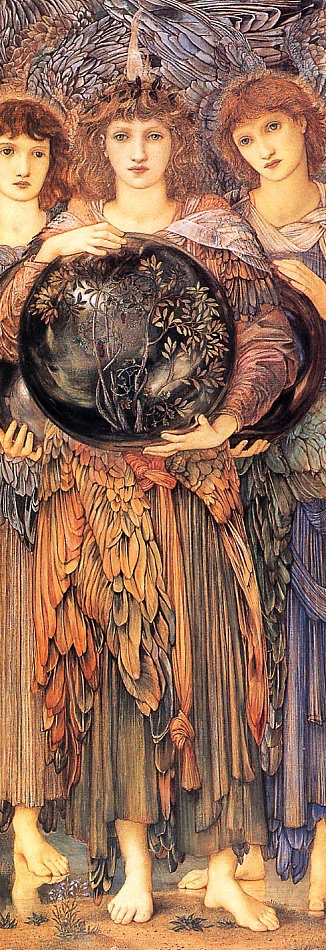
Edward Burne-Jones: The Days of Creation: The Third Day
(1870-1876)
"…these thoughts haunt and terrify me every day."
Collapsing cannot be properly characterized as a state, for it cannot be validated until after it completes, and much naturally prevents that end from ever appearing. Certainly, the peril might always exist, but distinguishing between growing pains, for instance, and Collapsing patterns should properly prove frustrating. Societies thrive on experiments. They can also die due to them. There can be no sure or certain recipe for avoiding Collapsing, and even the Ancient Greeks understood the principle that one tends to produce whatever they vehemently attempt to avoid. Fifteen months ago, the United States’ economy was widely acknowledged as the envy of the world. It now seems to be leading the world into an economic depression the likes of which we haven’t experienced in almost a century. Leading indicators seem grim, though still not yet completely certain.
Our incumbent seems to embody the very ills he visits upon our society.
Goodness
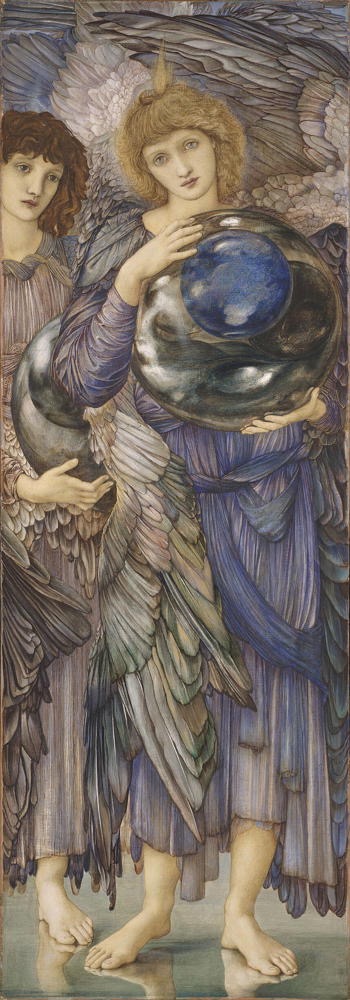
Edward Burne-Jones: The Days of Creation: The Second Day
(1870-1876)
"…a Goodness we will certainly have earned when it finally arrives."
The definition of Goodness changes during EndDays. What was bad before becomes a deeper sign of impending collapse, and so it becomes a harbinger of sorely needed change. In most ways, things have gotten worse each day as our self-saboteur incumbent reliably raises his already unwinnable stakes. It’s as if he’s trying to prove he can do even worse if he simply applies himself, and, increasingly, astonishingly, he repeatedly succeeds at appearing increasingly simple. However low he already showed he could go, he goes even lower. However indictable he had already seemed, he becomes convictable. However survivable his previous perilous state might have appeared, he seems just that much more like a gonner this time. While each infraction fully qualifies as truly terrible, not mere misdemeanors, the accumulating undermining effect arrives as curiously reassuring. Each insult brings him closer to total collapse. This might be the only beauty in self-sabotage.
I find many once-sturdy isms undermined like this.
EndDaysIntro
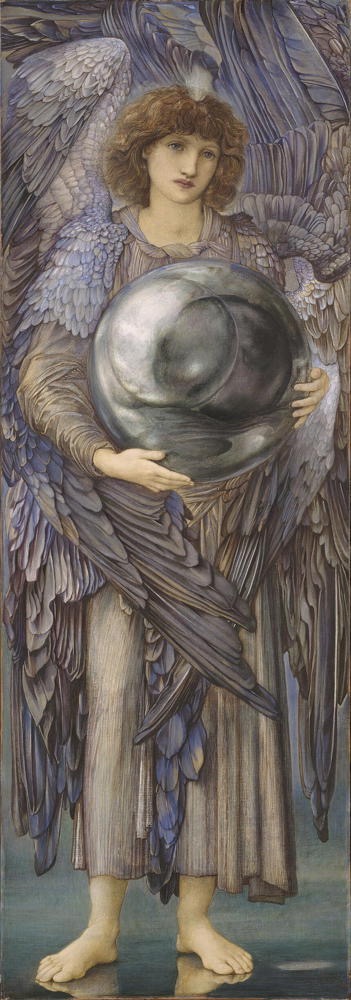
Edward Burne-Jones: The Days of Creation: The First Day (1870-1876)
"I intend this series to serve as a ring-side seat for witnessing the upcoming EndDays."
Another new beginning, if that image isn’t too redundant to hold its intended meaning, or even if it might be. Even EndDays need a decent beginning. Not even they can survive on nothing but endings. I begin this series, my thirty-sixth by my count, since I began writing series on June 21, 2017. I sought a new beginning then, after months of professional discouragement. My courage at a historical low, I mustered my foolhardiness and committed to a practice I’ve continued since. I declared myself a writer that morning, though I insisted that I produce clear, unambiguous evidence. I proposed that acceptable evidence might appear in the form of writing, a story every morning, because writers write. If I were insistent upon being so outrageous as to declare myself a writer, I would henceforth hold myself to actually writing rather than merely thinking or talking about it. I would just need to do what I intended.
And so I have continued through thirty-five, ninety-some installment series, each began on the first day of a calendar quarter, and each ended on the eve of the following solstice or equinox.
Weekly Writing Summary For The Week Ending 03/19/2026
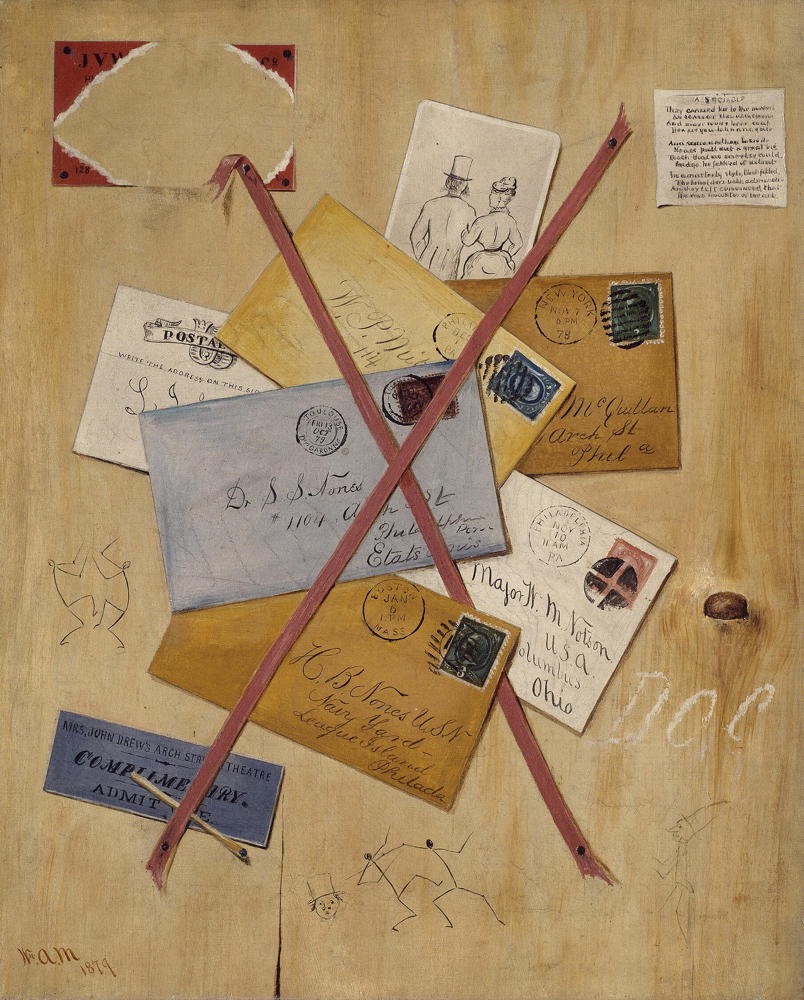
Attributed to William A. Mitchell: Rack Picture for Dr. Nones (1879)
The final writing week of my Unscrolling Series snuck up on me, even though I could have sworn I was paying close attention. I’d hoped to bring it in for a near-perfect three-point landing, but then I can never know until after I land whether or not that will prove possible. I feel very positive about how this series seems to be ending, with the JuryStillOut. This last week, I waded through Plopaganda into ConspiratorialCertainties. I felt like DickTracy tracking down the usual suspects. I created my most romantic story title ever with FlurriesWithTheCertaintyofSnow, though it spoke to neither flurries nor snowfall. I declared the Nature of Social Media and ended wiser than I’d started this series, thirteen long weeks ago, just before Christmas. Thank you for following along!
JuryStillOut
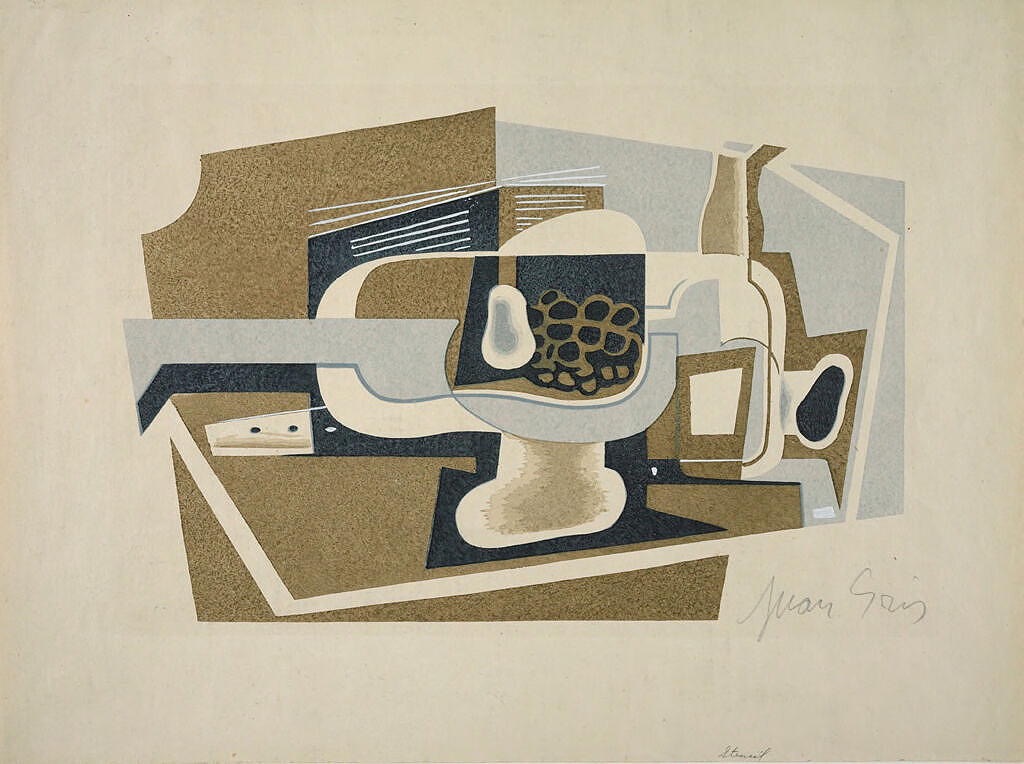
Juan Gris: Still Life (1922)
"It holds deeper purposes than escape and addiction."
Before the judge in the landmark Social Media case unfolding in Los Angeles, while I created this Unscrolling Series, released the jury to begin their deliberations, he instructed them that they would not be deciding using Section 230 of the Communications Decency Act of 1996, a foundational law that generally shields online platforms, websites, and users from liability for content posted by third parties. This law did not apply to these deliberations because the case was not about product liability per se, but platform engineering and design rather than content. Should Meta and YouTube have known their social media services posed a danger to children? Were their designs negligent in this way? These must have been challenging questions because after weeks of prosecution and a week of deliberation, the jury remains out.
In closing arguments, the plaintiff’s attorney harangued the defendants for profiting from users’ attention, comparing their features to a Trojan horse.
Nature
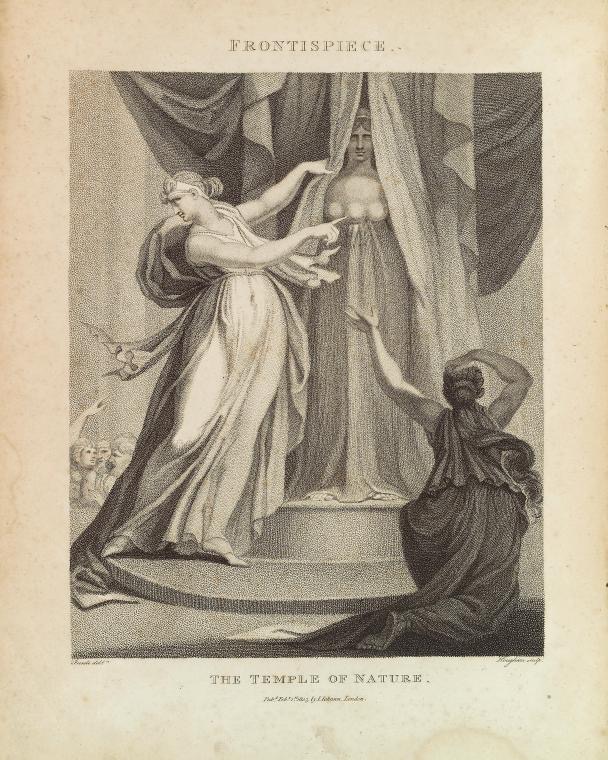
Henry Fuseli, artist; Moses Haughton, engraver:
The temple of nature: Frontispiece
from the Collection:The temple of nature; or,
The origin of society: a poem, with philosophical notes
(1803)
Carl H. Pforzheimer Collection of Shelley and His Circle, The New York Public Library. "The temple of nature: Frontispiece" New York Public Library Digital Collections. Accessed March 18, 2026. 'https://digitalcollections.nypl.org/items/8f556120-c604-012f-eb75-58d385a7bc34'
"…a singularity of sorts, utterly unusable."
It seems to be the Nature of things that they become ever more complex as they age. Maturity rarely brings clarity. It most often introduces obfuscations unimaginable earlier, as if accompanying sophistication. Social Media seems destined to become even more of whatever it was before. Through upgrades and legislation, specifications will more than merely morph over time, but will very likely utterly transform these platforms into the unrecognizable, and for some, into utter unusability. We’ve seen these evolutions before, and they do not bode well.
If Social Media presently seems mildly distracting, it seems destined to become ever more so into the future, for its DNA seems to be programmed that way.
FlurriesWithTheCertaintyOfSnow
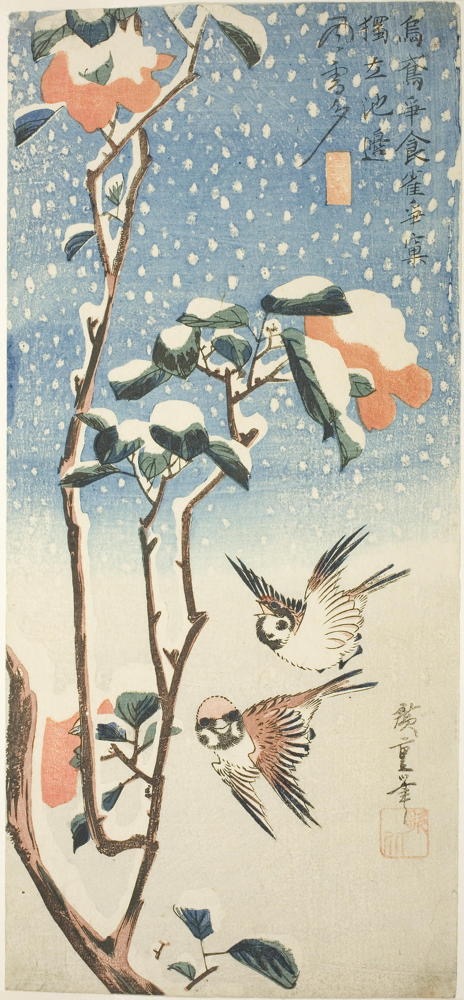
Utagawa Hiroshige 歌川 広重:
Sparrows and Camellia in Snow (c. 1831-33)
"The worms in our apples might keep us human…"
Social Media represents just another instance of us getting what we insisted upon but not what we’d expected. The chief difficulty with Social Media might lie in just those expectations, but then that diagnosis does not render either Social Media or human expectations exceptions to any rule, but rather exemplars of one immutable rule. We tend to expect in slim dimensions, suspending the understanding that everything simultaneously manifests in multiple dimensions. We usually clearly specify expectations on one or two of those many facets, leaving the bulk of them to manifest without specs, to essentially default to what usually happens. Then, what usually happens does happen. We routinely surprise ourselves with the shocking differences between what we asked for and what we received.
As near as I can determine, such outcomes have always been the case.
DickTracy
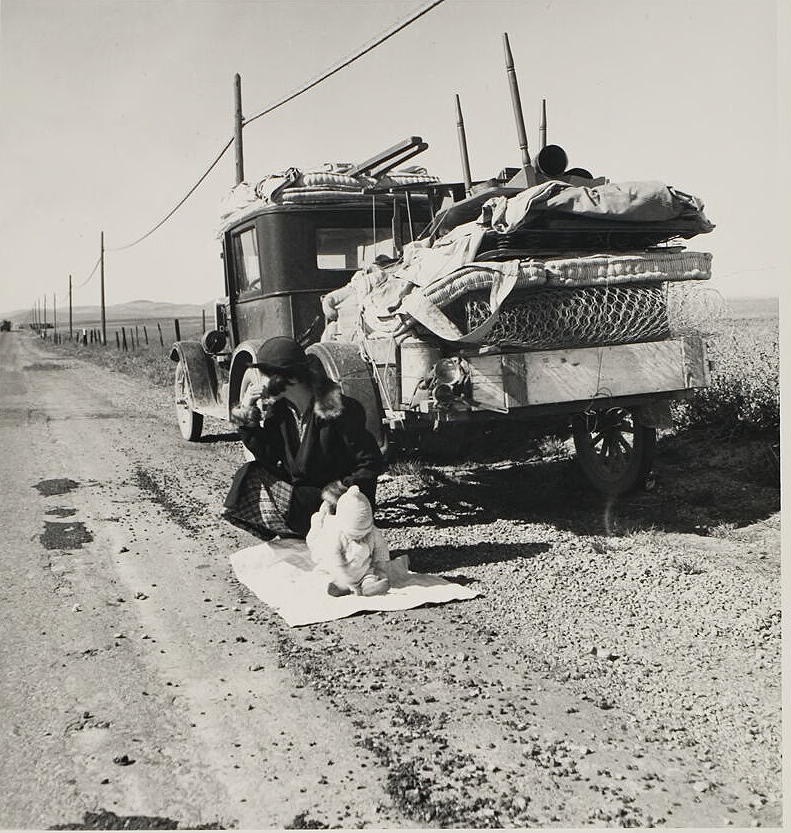
Dorothea Lange: Tracy (vicinity), California. Missouri family of five (1937)
"The human condition remains, perhaps improved but also little changed."
I remain amazed that my future has actually arrived. Dick Tracy’s two-way wrist radio, later TV, has caught up to me. It no longer qualifies as a distant fantasy, but my everyday lived reality. How could this be? Way back in the Dirty Thirties, when Chester Gould started creating Dick Tracy comics, long before I was born, my day-to-day existence today wasn’t even focused fantasy yet. Between Tracy and Buck Rogers, futures were endlessly projected, though those anticipations would prove to be far too modest to accurately represent the eventual actual technological progress, though two-way wrist radios contributed little to actual human progress. I’d contend that we seem little different, even if our lives today might not seem nearly as short and brutish. We remain contentious, maybe more so.
A careful reader of Dick Tracy would catch the character’s unshakeable faith in human goodness, though Tracy would often have to resort to violence to achieve a laudable end.
ConspiratorialCertainties
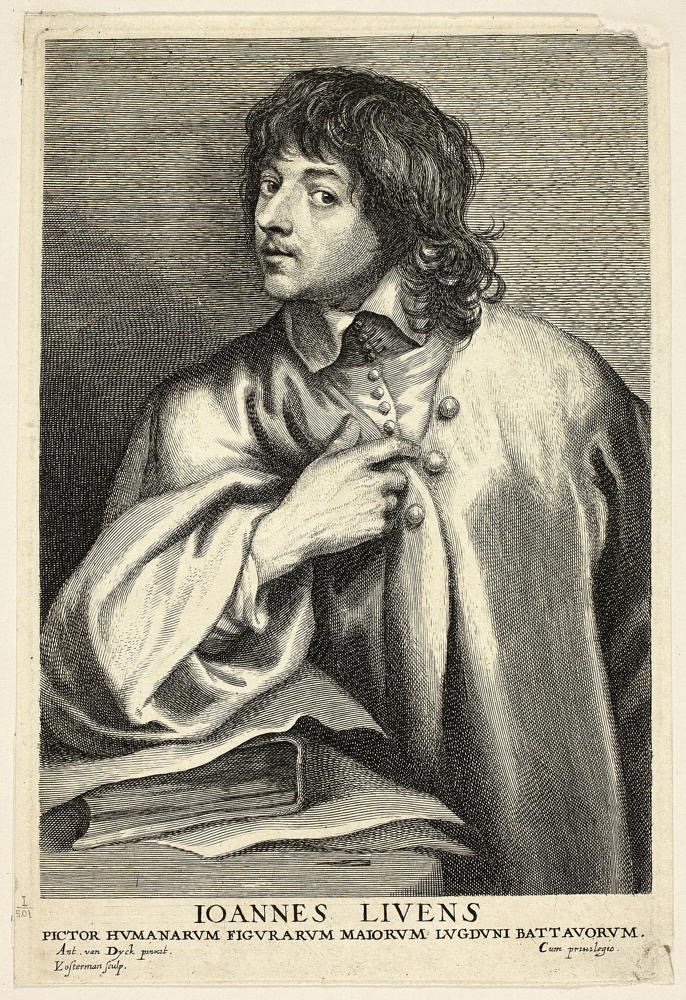
Lucas Emil Vorsterman: Jan Lievens (1630/45)
"The meanings could not be clearer if they were written on the mirror he's pretending to peer through."
After an uncertain number of iterations, the speculative might become a certainty, as the previously unknowable slowly becomes routine. So have conspiracy theories gone in what seems in retrospect like a remarkably brief time. It seems like just yesterday, when that certainty still evaded us, when we genuinely felt blindsided by some fresh-ish revelation. We had no idea how low they could go, and we held out for the longest time, hoping that they and we might prove more trustworthy than we all became. It seemed like a game at first, to somehow concoct some fresh worst-case scenario before second-guessing our hard-won earlier conclusions. In the years before Jeffrey Epstein’s suicide became common fiction, we blythely disbelieved most of whatever the vast right-wing conspiracy served up because it beggared belief. Now we can be almost one hundred per cent certain that whatever they declare describes one hundred per cent the opposite of whatever might actually be there. Conspiracy theories have become reliable ConspiratorialCertainties.
Conspiracy theory has become clinical certainty, though the stories still seem to be delivered backwards.
Plopaganda

The Fords, Rock Creek Zoo Park, Washington, D. C.
Detroit Publishing Company postcards 10000 Series
(1898 - 1931)
The Miriam and Ira D. Wallach Division of Art, Prints and Photographs: Photography Collection, The New York Public Library. "The Fords, Rock Creek Zoo Park, Washington, D. C." New York Public Library Digital Collections. Accessed March 14, 2026. (https://digitalcollections.nypl.org/items/c18e35e0-c62e-012f-caa8-58d385a7bc34)
"Social Media's way more scary than it first appears."
This world has never provided a better medium for spreading disinformation than our present Social Media system. Not that the system isn’t trying to improve itself, not to reduce the proliferation of deliberately misleading crap, but to improve its overall efficiency in disseminating it. So far, attempts to encourage self-regulation have resulted in responses ranging from Meta’s insistence that any attempt at regulating Social Media speech amounts to too much to the EU’s conclusion that their attempts at regulating have not produced the systematic behavioural change it was designed for. The difficulty seems to lie in Social Media’s design. The outrage and algorithmic engagement Social Media relies upon to profit produce the same dynamics that encourage propaganda to spread. Further, most Social Media firms are based in the United States, which has traditionally viewed Social Media speech as protected under its First Amendment.
I liken immersing myself in my Social Media stream as similar to Health and Human Services Secretary R. F. Kennedy, Jr. swimming in Washington DC’s famously polluted Rock Creek, which is essentially an open sewer.
Weekly Writing Summary For The Week Ending 03/12/2026
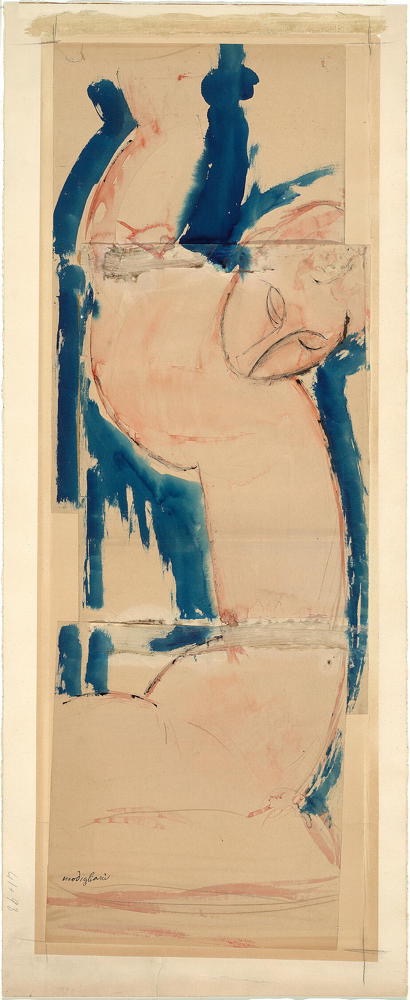
Amedeo Modigliani: Caryatid: Rose and Blue (1912–14)
This writing week, I entered the final glide path for this Unscrolling Series. My purpose no longer remains the mystery it was when I began, and yet I have not yet discovered the full meaning of this excursion. I have learned, or I believe I’ve learned, that my purpose here was never to learn how to stop scrolling, however much I might have aspired to achieve that end when I began. I realized last week or the week before, that Unscrolling would become gratefully unattainable, another one of those innocent aspirations the Gods rarely satisfy. No need to wonder why, for that becomes obvious in the failing effort to succeed. At some indefinite point, success becomes what I would have earlier characterized as failure, and all continues to be righter than I ever suspected with this world.
I began this writing week investigating one of the founding memes of this meme-laden era, Meta’s ultimately discredited MoveFast/BreakThings motto.
SmallSlanders
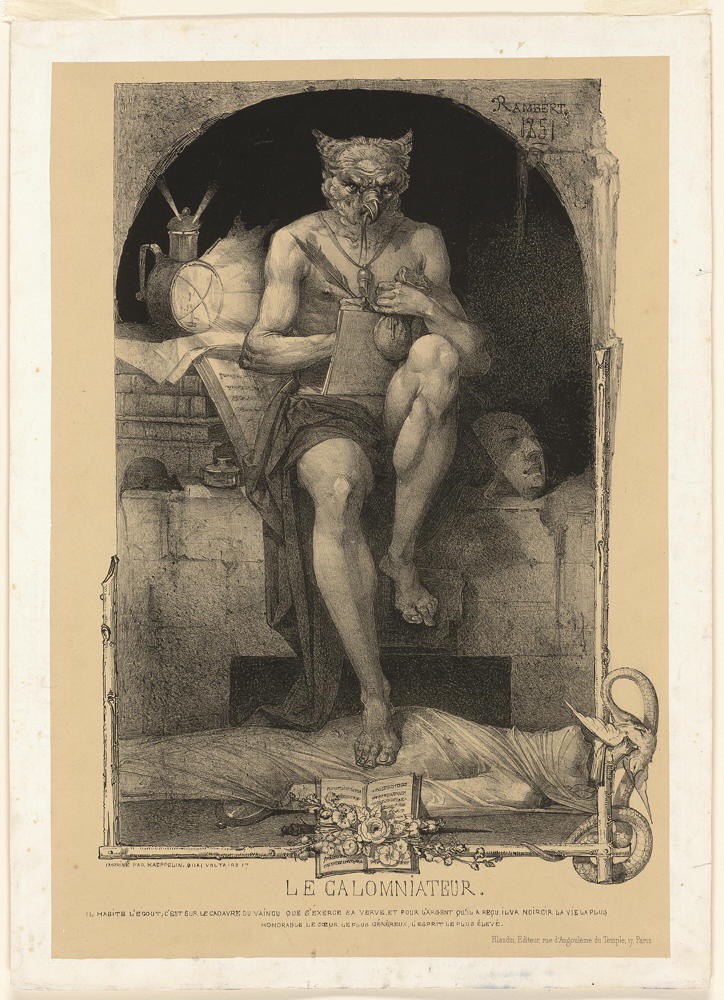
Charles Rambert: The Slanderer (1851)
"…therein lies its rub."
Early American newspapers were filled with slanders great and small, though their limited distribution rendered them relatively benign. Thomas Jefferson famously railed on about the destructive nature of the popular press, yet still concluded, “Were it left to me to decide whether we should have a government without newspapers, or newspapers without a government, I should not hesitate a moment to prefer the latter.” The press never suggested it was anything more than the first draft of history, anyway, rather than anybody’s final word. That history continues unfolding today in all of its original contention and more. Social Media easily amplifies SmallSlanders into much broader coverage. Even a half-baked lie can today even more quickly circumnavigate the globe before truth puts on his shoes. Some days, it seems as though truth cannot find its shoes and so simply slumps back into snoozing. I worry about the SmallSlanders and find them continually unsettling.
The Muse has finally managed to get sideways with some portion of her constituency.
UnEnlightenment
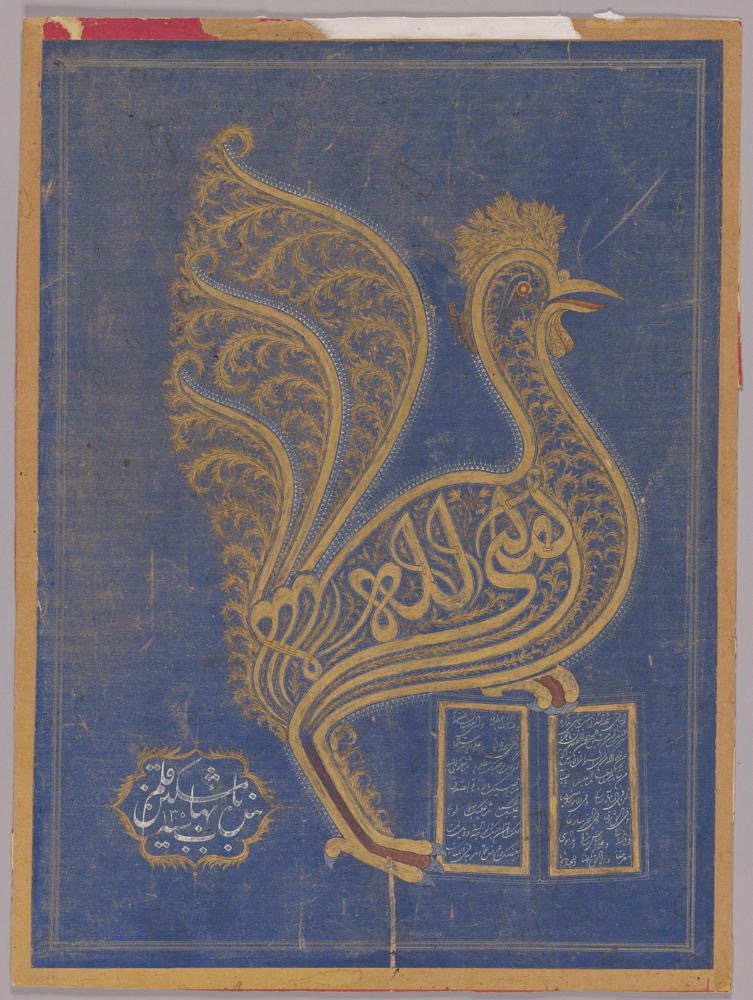
Calligraphy by Mishkin Qalam:
The Name of "Baha'ullah" in the Form of a Rooster (1887-1888)
Creation Place: Middle East, Iran
"…we haven't always insisted upon this in our Social Media presence."
Could it be that Social Media, as presently practiced, creates a pervasive disharmonic resonance? Instead of vibrating at a renewing frequency, might it vibrate all over the place, amplifying not coherence, but incoherence incarnate? This seems to be the case. Worse, the incoherence seems to be spreading. It would have been unthinkable for our current incumbent to have ever been elected dog catcher, let alone President, even in our most recent pasts. We’ve elected scoundrels before, but never one so absolutely incoherent, one apparently incapable of even acknowledging the presence of even our most self-evident rights. He commits greater crimes than those his presumed perpetrators committed when arresting them, and calls that even. He violates the emolument clause with more than mere impunity. He continually violates simple human decency. He personifies the context within which Social Media rages.
Never before in the history of this world had such a powerful potential presented itself.
SelfDiscipline
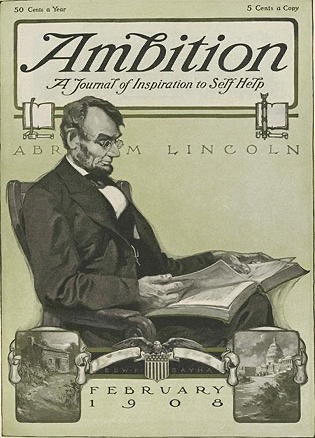
Ambition; a journal of inspiration to self help, [Cover] (February, 1902)
International Correspondence Schools (Publisher)
General Research Division, The New York Public Library. "Ambition; a journal of inspiration to self help, [Cover]" New York Public Library Digital Collections. Accessed March 10, 2026. (https://digitalcollections.nypl.org/items/39f65f90-c608-012f-027d-58d385a7bc34)
"Well-produced but vacuous undertakings."
Living in our time requires perhaps more SelfDiscipline than at any previous time in history. Just in my short lifetime, the latitude I have enjoyed for choosing for myself has expanded exponentially, and with that ever-expanding freedom, came the equally-expanding necessity of extending my ability to discipline myself. Fifty years ago, I would joke that the radio reception was so poor along a stretch of what was then called Interstate Eighty North across northern Gilliam County, Oregon, along the mighty Columbia River Gorge, that the only accessible station played only Gary Puckett and The Union Gap tunes, with the very occasional Marilee Rush. Today, I complain when my satellite radio kicks out when the basalt rimrock interrupts reception along that stretch. I have instant access, in season, to live hometown announcer play-by-play from each and every team in Major League Baseball, in either English or Spanish. Sorting from among such overwhelming choices demands a whole bunch of SelfDiscipline.
Some turn on their television the instant they get up in the morning.
Episidiodic
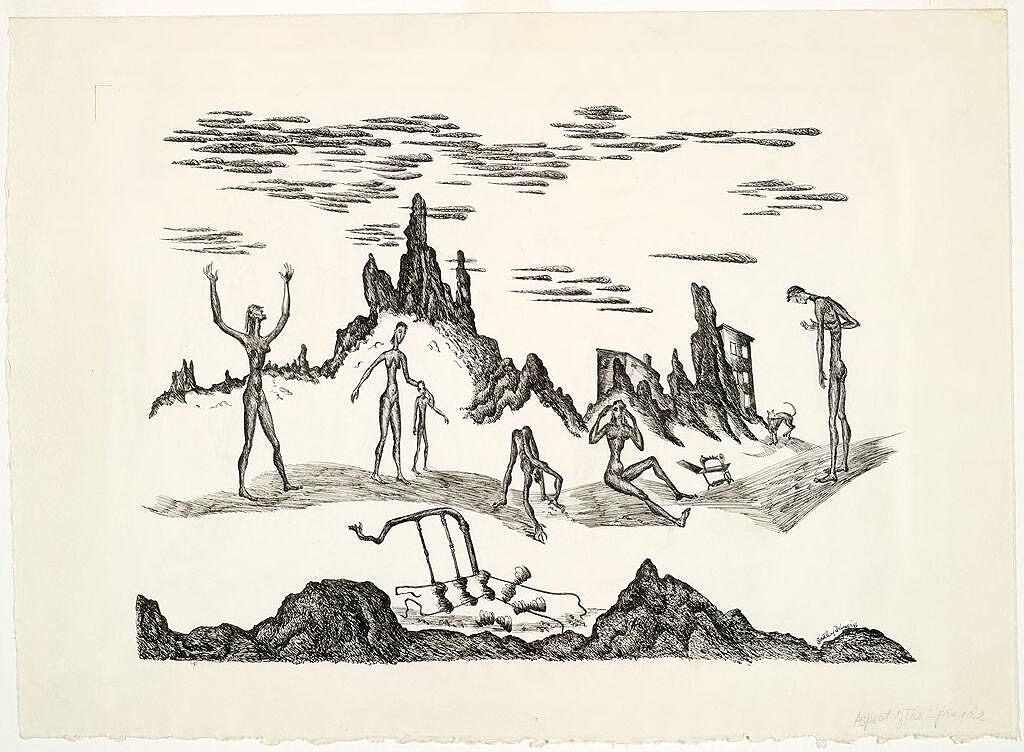
Dorothy Dehner: Damnation Series: Aspect of the Episode (1946)
"This creates a different context for living than I was expecting."
Either life mirrors art or art mirrors life. It might not matter which. I believe that both occur so that it might prove impossible to ever tell whether the chicken or the egg arrived first. Life certainly imitates art; otherwise, fashion would not influence any of us. It also seems obvious that art at least attempts to imitate art, however imperfectly. It used to be, or it certainly used to seem as though I lived within a rather grand narrative arc. I lived in the middle of some greater adventure, definitely heading somewhere, making history along the way. These days, my life seems less cinematographic, hardly a short story. I live rather like a Social Media stream, in a series of unrelated episodes without much in the way of any grander plotline.
Some thinkers have ascribed this sense, increasingly common, to simple aging.
AayEye
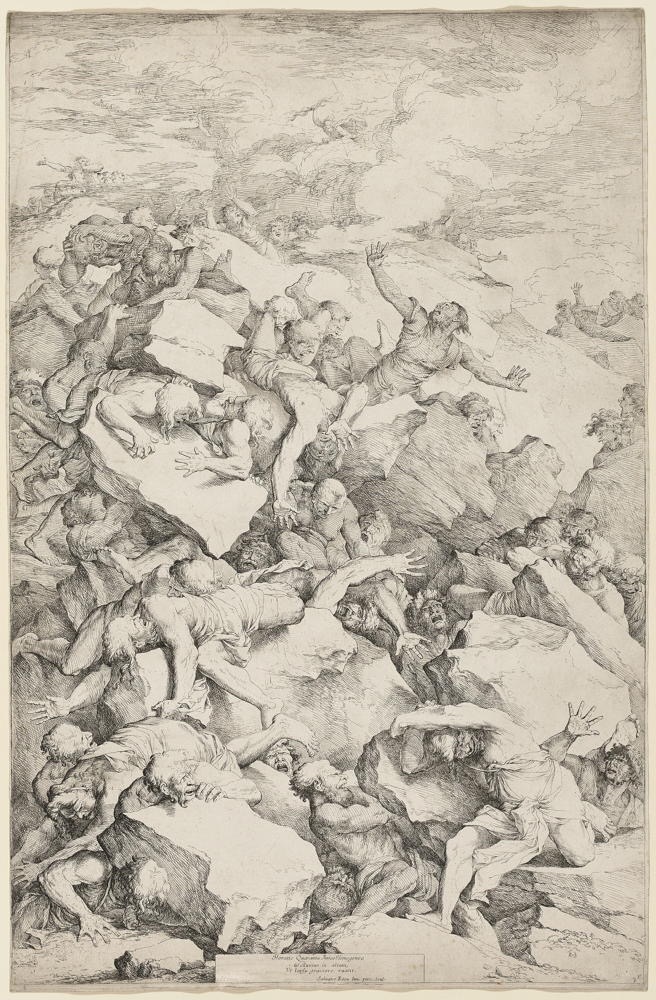
Salvator Rosa: The Fall of the Giants (1663)
"We're stuck in some middle."
The artificial seems to underpin much of what passes for Social Media, most prominently, the curiosity called Artificial Intelligence, or AayEye. As a concept, AayEye has been attracting interest since nobody remembers when, with perhaps more insistence that it always was and still remains impossible because we believe intelligence to be a solely human capability. Some controversy seems understandable, though, because as machines have acquired abilities that used to be considered evidence of intelligence, those abilities have been removed from the list of evidence of intelligence, if only because the very fact that a machine can perform them must mean by definition that they cannot be evidence of intelligence. Our definition of intelligence has perhaps been the greatest change brought about by advances in AayEye.
We seem to better understand what intelligence isn’t than whatever it might actually be.
MoveFast/BreakThings
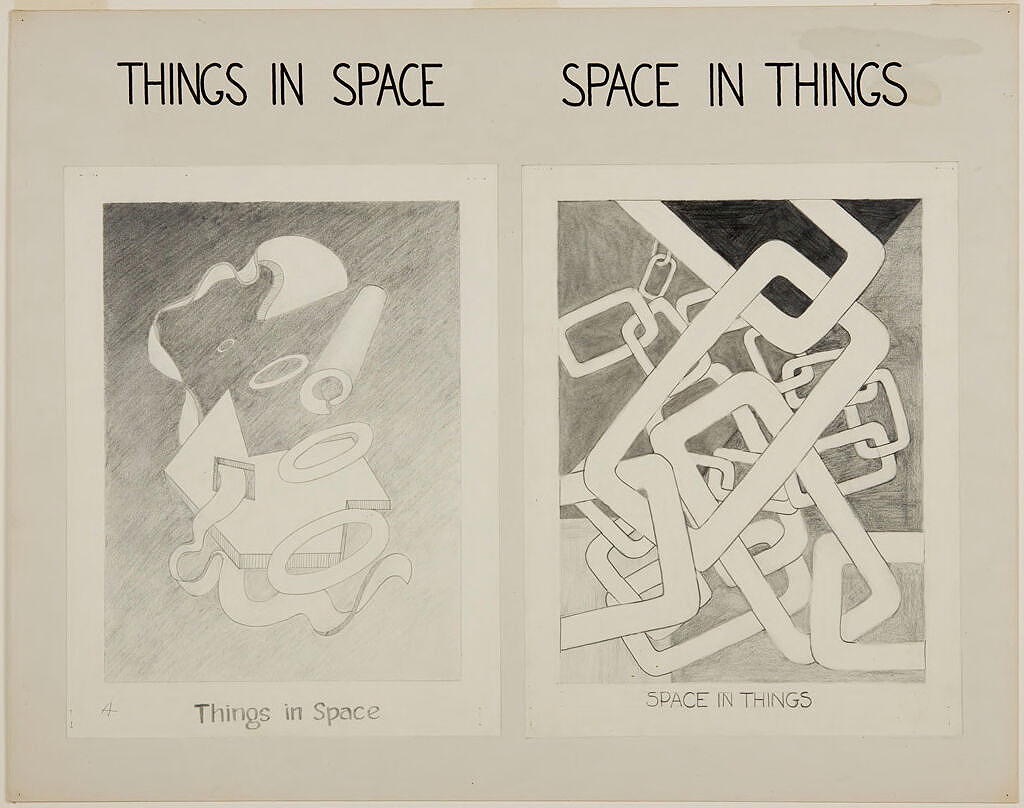
Unidentified Artist: Things in Space/Space in Things (1942-1949)
"This concludes today's lesson in engineering futures."
"Move fast and break things" was the original internal motto and core engineering philosophy for Facebook (now Meta). Coined by Mark Zuckerberg, it prioritized rapid development, risk-taking, and innovation over stability, guiding the company's culture until it was updated to "Move fast with stable infrastructure" in 2014. Business Insider (2/16/2022)
Social Media giant Meta’s first motto might seem both ironic and telling when considered from today’s distance from its founding. Then, it was young and filled with itself and hope, believing itself to already be master of a universe not yet concocted. Like anybody, its founder believed he could create his own rules of engagement because he was blazing trails. The history of such development has always been paved with just this sort of arrogance, the belief that reality was theirs to define rather than to align themselves to. This tiny perspective shift has been turning grand intentions to shit since way back before Egyptian times. If anything, moderns have only become more adept at deluding ourselves.
We might create seemingly sparkling new futures, but we also inadvertently concoct their eventual Achilles Heels.
Weekly Writing Summary For The Week Ending 03/05/2026
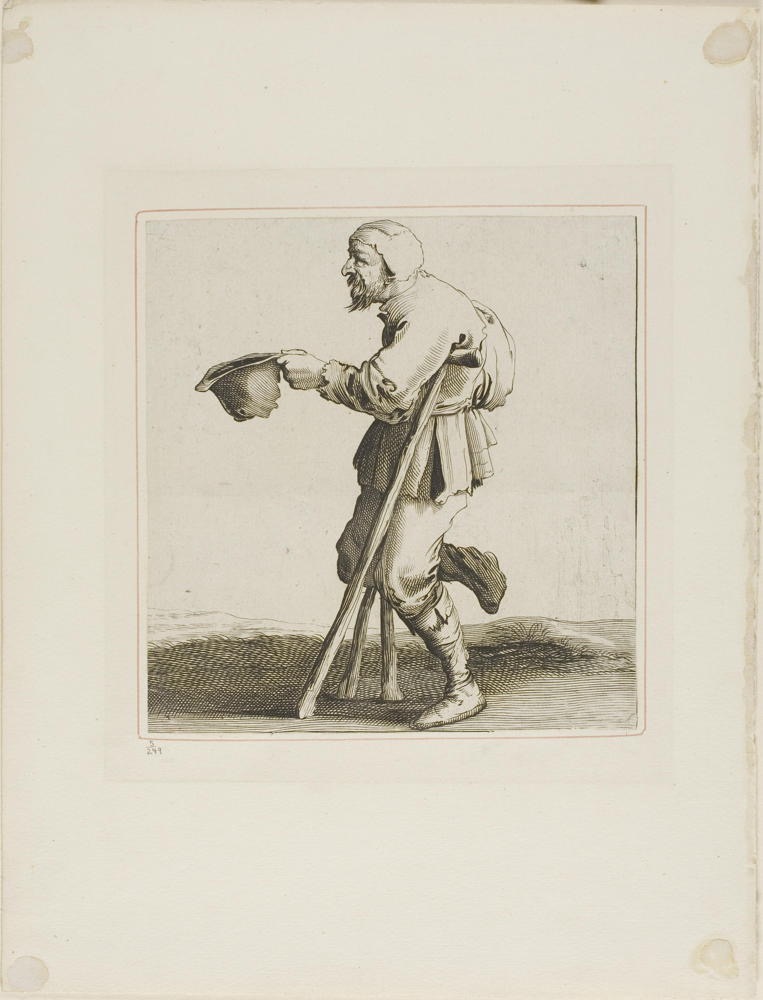
Pieter Jansz Quast: Lame Beggar Asking for Alms,
from T is al verwart-gaern [It’s already confusing]:
(n.d.; Artist's working dates 1612–1650)
This Writing Week marked the transition into the final scant three weeks remaining in this Unscrolling Series. I realized—or, re-realized—that I would not be abandoning my scrolling as a result of my investigating into my nefarious habit or addiction. I’m coming to accept that scrolling amounts to a part of modern living. I should not feel surprised if it sometimes seems to suffer from the same self-importance that encourages most everything these days. It seems to be fairly integrated, however much it’s occasionally hated. I scroll in greyscale now, and I doubt that I’ll ever return to color display on my iPhone. I know, greyscale hides some essential detail. That’s precisely why I chose it. Scrolling devils seem to lurk within full-color display.
I began this writing week acknowledging that technology seems destined, if not necessarily designed, to go off TheRails.
Cloud
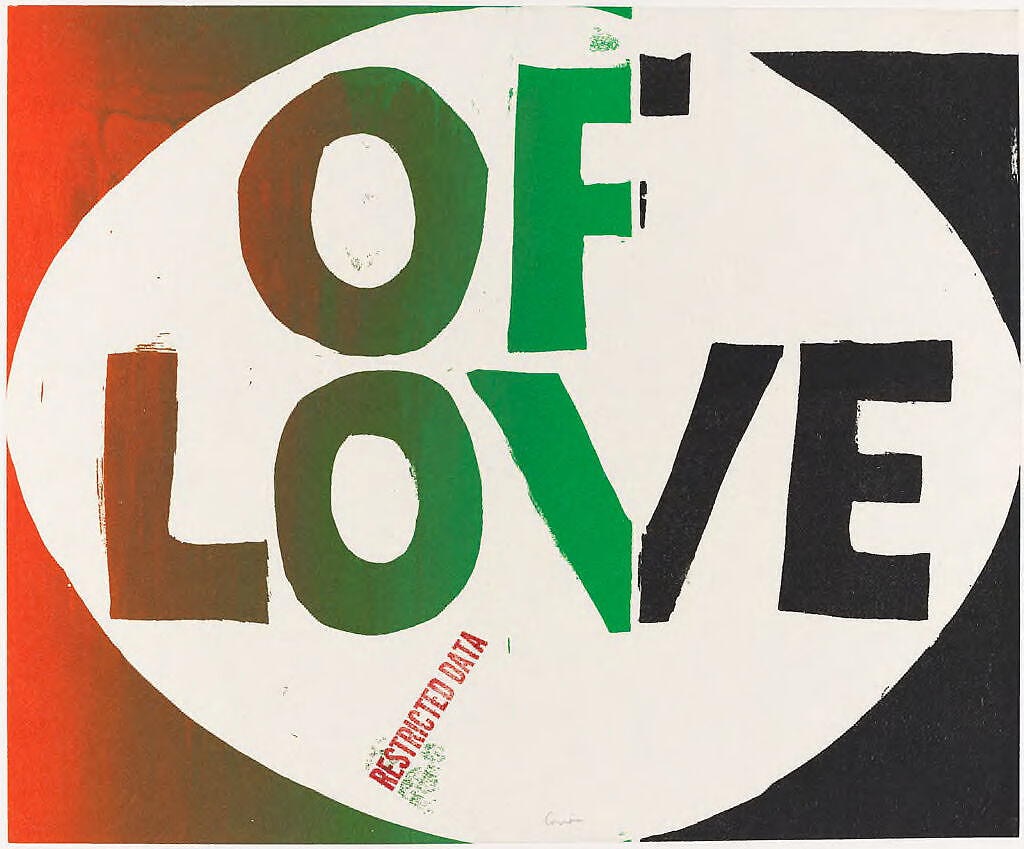
Corita Kent (Sister Mary Corita): of love (1967)
Persistent Link: https://hvrd.art/o/328973
Physical Descriptions: Screen print
Dimensions: 38.1 × 45.7 cm (15 × 18 in.)
Inscriptions and Marks: Signed: l.c.: Corita
(not assigned): Printed text reads: OF LOVE
RESTRICTED DATA [stamped in red ink]
Standard Reference Number
Corita Art Center Cat. #67-42
Harvard Art Museums/Fogg Museum, Margaret Fisher Fund
© Courtesy of the Corita Art Center, Immaculate Heart Community, Los Angeles / Artists Rights Society (ARS), New York
— — —
"Those who fear our future fear themselves."
My iPhone draws my attention like a manic Van Gogh. I can hardly look away, but that tiny display holds almost none of what attracts my attention. Much of what attracts me resides somewhere else, off in what’s referred to as The Cloud. That Cloud contains much besides moisture. Ask your favorite AI engine, which also resides in The Cloud, to describe the kinds of data commonly found there, and you’ll receive a dizzying array of data types, most of which I can guarantee you’ve never heard of before. They represent the ecosystem from which your scrolling emerges. Scrolling couldn’t exist without this cloud’s contents, and those contents could not exist without that amorphous Cloud.
The Cloud serves as the metaphor for what we know as Data Centers.
Rumor
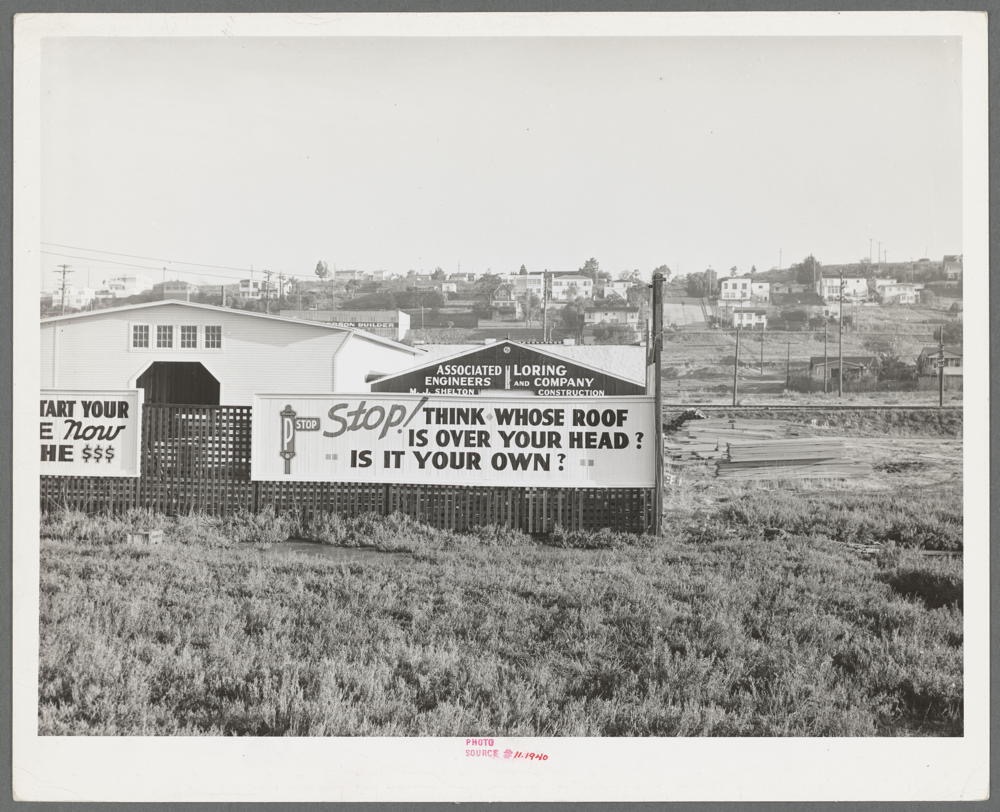
Russell Lee: "Sign at lumber company. San Diego, California. Building supply companies in San Diego are doing a tremendous rush business and there are rumors (unverified) of shortage in building materials." [Farm Security Administration Photographs] (12/1940)
The Miriam and Ira D. Wallach Division of Art, Prints and Photographs: Photography Collection, The New York Public Library. "Sign at lumber company. San Diego, California. Building supply companies in San Diego are doing a tremendous rush business and there are rumors (unverified) of shortage in building materials" New York Public Library Digital Collections. Accessed March 4, 2026. (https://digitalcollections.nypl.org/items/140a3880-7017-0137-9e01-05b46baa16fe)
"Rumors of information's demise on social media have been greatly exaggerated."
Rumor seems to be the very stuff of Social Media. While doubtlessly, many postings contain provable facts, fact-checking has never been a requirement or a significant element governing social media posting. I think of it as a slightly focused form of crowd-sourcing, as if a coherent gist could be derived by blindly repeating approximations. Some postings fully qualify as wild, not even attempting reliability—many intended only to rile—while others have received relatively rigorous proofing. One cannot reliably determine which postings are which, so it behooves the peruser to presume that every posting qualifies as little more than the rumor it most probably is. The only onus occurs when someone mistakes a probable rumor for an immutable fact, and that’s the straw that repeatedly bends social media’s camel’s back.
This situation’s no different than perhaps the most tragic of the many literary misinterpretations, the one where people interpret their Bible as literal history.
PostTruth
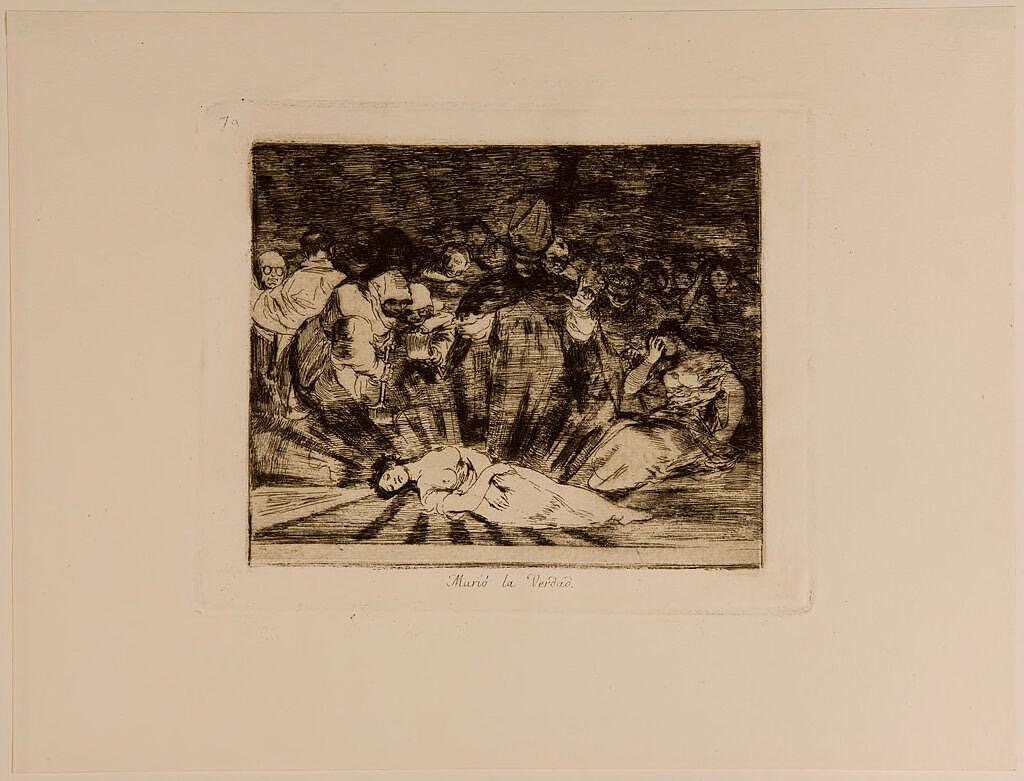
Francisco José de Goya y Lucientes: Truth Is Dead
Other Titles: Series/Book Title: Los Desastres de la Guerra, 79
Series/Book Title: The Disasters of War
(18th-19th century)
"Social Media ultimately seems simply nihilistic, an homage to PostTruth meaninglessness and little else, even though it attracts engagement."
Perhaps the single most compelling reason to avoid engaging in social media lies in the lies it spreads. Its engagement model does not distinguish between good and evil, truths and lies. Whatever attracts attention, encourages engagement, and engagement embodies the whole purpose of its existence. Lies reliably rile potential audience, thereby encouraging engagement. Repeated ad infinitum, a PostTruth context emerges, inverting historical measures of goodness. Where truth was once widely believed to be superior to fiction, the once sharp distinction eroded into what became, in practice, a superior fiction, trumping truth for many intents and purposes. If value directly correlates to hits, and hits relate most to lies, then goodness follows this trajectory, too. Truth holds little currency in any PostTruth society.
We each saw this coming.
UnNews
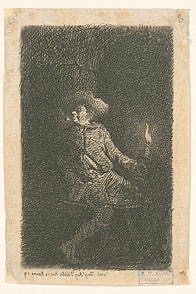
Samuel Putnam Avery (Collector)
Charles Emile Jacque (Etcher)
Auguste Delâtre (Printer of plates):
Un homme dans une cave. [A Man in a cave.] (1842)
The Miriam and Ira D. Wallach Division of Art, Prints and Photographs: Print Collection, The New York Public Library. "[Un homme dans une cave.]" New York Public Library Digital Collections. Accessed March 2, 2026. (https://digitalcollections.nypl.org/items/6d488120-c611-012f-7b0d-58d385a7bc34)
"There's nothing new under this sun."
Social Media has become an egalitarian’s dream come true. Imagine a space wherein everyone can be a writer if they choose, even a journalist, without the questionable benefits of training. Where every opinion finds a ready audience and every otherwise mundane happenstance can be publicly celebrated. Where world events can be dissected without being constrained by facts, and headlines can scream whatever they please without fear of being challenged. Think of it as the Wild West with coffee service.
It’s almost a full-time job just searching out the few pinpoints of truth, though following those does not guarantee that the algorithm will reliably serve them up in the future.
SickDay
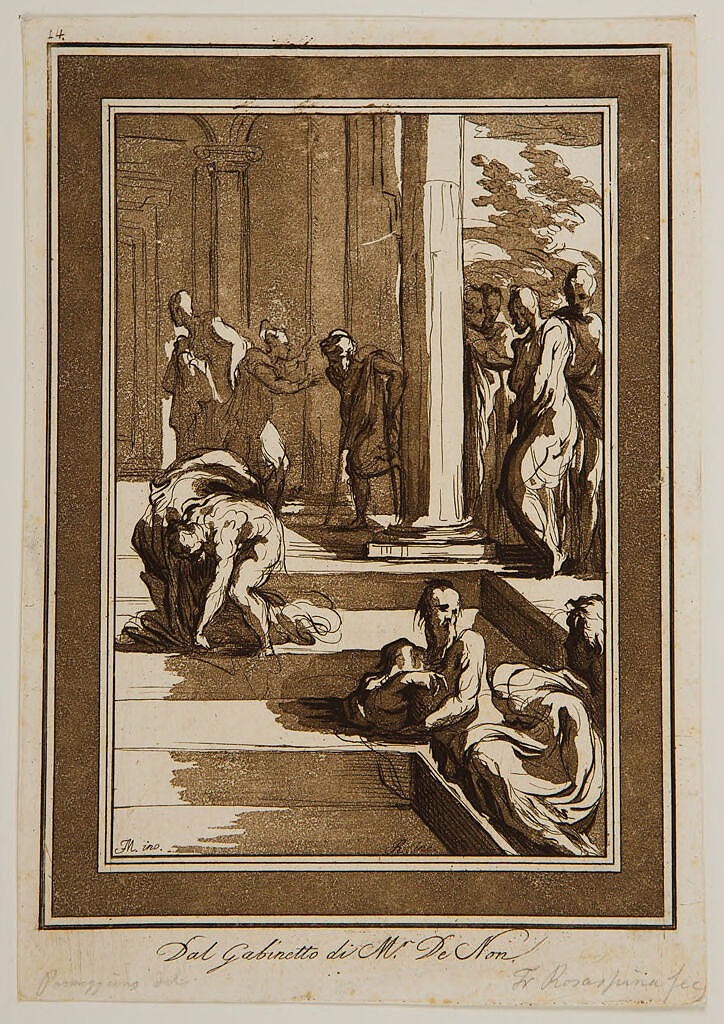
Francesco Rosaspina: Healing the Sick (18th century)
"Engage in some extended scrolling and call me the next morning if you're ever experiencing a SickDay."
I must have already apologized at least once for my short-sightedness in naming this series Unscrolling, for that title presupposes something. It strongly suggests that the underlying purpose of these stories must necessarily be to eradicate scrolling, when that was never my entire objective. Yes, I admit that I sought to reduce my scrolling habit, which had, at times, overwhelmed me. I couldn’t always control that urge to access my social media feeds, but that alone couldn’t have motivated me to dedicate an entire quarter to such an endeavor. Scrolling seems only intermittently annoying. It’s not destroying my life. It often contributes important benefits, one of which appeared yesterday when I experienced one of the rare visits of a SickDay disrupting my semi-sacred routine.
Since the damned pandemic, I continue to curtail my circulation out in the general population.
Good For A Goose

Comeuppance (30)
Decency (90)
Decency Unscrolling (1)
EndDays (92)
Exiled (90)
Fambly (93)
FollowingChapters (93)
Grace (92)
Humor (2)
iAlogue (1)
Letters to the Editor (1)
NextWorld (91)
Personal (18)
Prosperity (94)
Steam Festival (4)
Unscrolling (89)
Vaporized (6)
Work (16)
September 2026
August 2026
July 2026
June 2026
May 2026
April 2026
March 2026
February 2026
January 2026
December 2025
November 2025
October 2025
September 2025
August 2025
July 2025
June 2025
May 2025
April 2025
March 2025
February 2025
January 2025
December 2024
November 2024
October 2024
September 2024
August 2024
July 2024
June 2024
May 2024
April 2024
March 2024
November 2006
October 2006
September 2006
August 2006
July 2006
June 2006
May 2006
April 2006
March 2006
February 2006
January 2006