Boobs&Sonsabitches
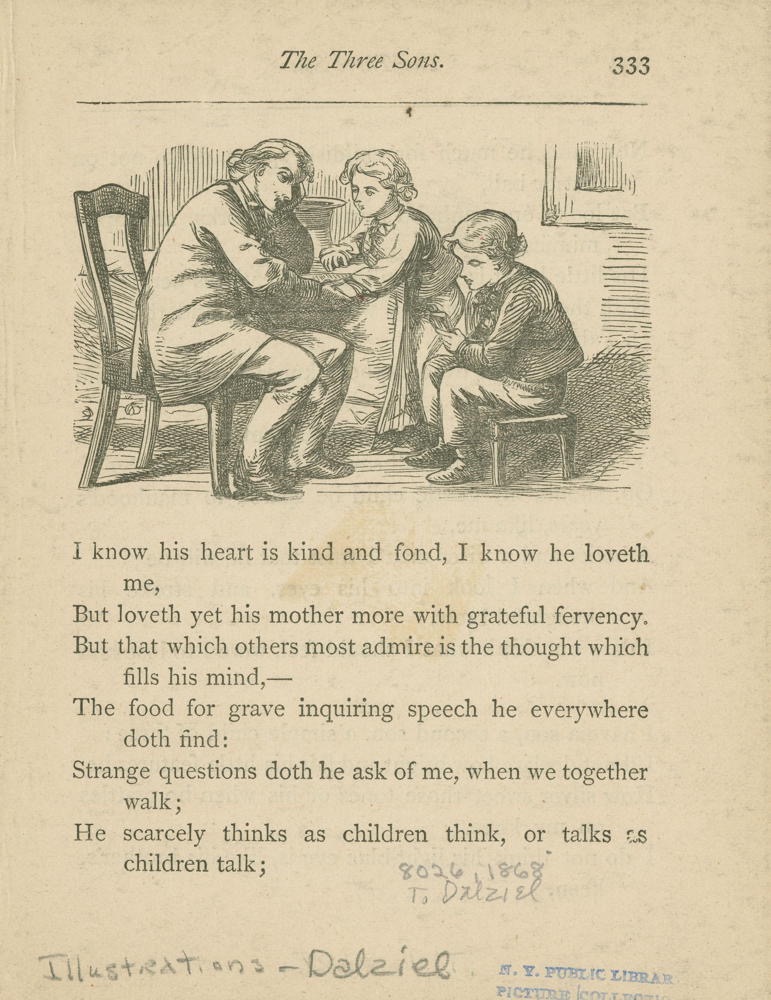
Thomas Bolton Gilchrist Septimus Dalziel:
Illustration of "The three sons" by poet John Moultrie (1868)
The Miriam and Ira D. Wallach Division of Art, Prints and Photographs: Picture Collection, The New York Public Library. "The three sons." New York Public Library Digital Collections. Accessed February 14, 2026. (https://digitalcollections.nypl.org/items/faee0690-c5bb-012f-199f-58d385a7bc34)
"These are who we’ve entrusted our precious attention spans to."
Who are these people we so easily entrusted with our precious attention spans? Most of us had no clue how precious our attention spans might have always been until technology made it practical to distract them. But even given that technology made mass distraction a practical possibility, who might find tapping into that an attractive occupation? Cue the thoroughly modern corporation. Such an occupation seems to demand a certain sense of presumption beyond what any technological capability might impart. A sense of privilege and self-possession might enable one to engage in any of the snoopier professions. One spies on lesser beings, not on equals; on fools. One must identify as a spy, an occupation that hardly lends itself to gentile persuasion. One lurks, often under misleading pretenses, and draws attention away from one’s actual operations. The providers of such services tend to grant themselves expansive labels: Meta, Google, Amazon, and X come readily to mind, names that provide little hint at what might pass for day-to-day operations going on under their hoods, but hint at the enormous and infallible.
They seemed the very soul of accommodating at first. Heck, they didn’t even charge for their services. The typical user found a rather threadbare system that allowed easy connection with friends, family, and business colleagues. The more competitive users quickly accumulated scores of followers, but most seemed satisfied checking in on at most a few distant cousins. The services provided seemed ridiculously modest: personal profile, friends, birthday announcements. Services quickly expanded into forms of commerce, with classified advertising and bartering proving to be popular. The real customers were the advertisers, however. The apparent users, the individuals and small businesses who used the platform as a matter of convenience before it became a necessity, were actually the product whose search patterns could prove valuable to advertisers. Data, which almost nobody used to have, came into existence and became a sought-after commodity. Every one of the advertisers’ tricks would eventually find its way into the everyday experience of each and every social media user, with no thought by the platform owner of ever sharing the proceeds of these surreptitious surveillances.
The platform owners improved their services to include invisible guides. The so-called algorithms that deftly directed users’ attentions toward potentially interesting content. Those algorithms trained the users to explicitly choose their interests, better for the advertisers to survey ever more distinct demographics. Social media became something more than a handy Rolodex replacement. It became the purpose for many sessions, as check-ins lured users into wandering further afield than they’d intended. Social media grew to become the national pastime, the national obsession, the universal habit. Advertisers went batshit crazy, as if they hadn’t always leaned heavily in that direction already.
Needless to say, social media companies were not populated by choirboys. Their missions became little less than world dominion. Their revenues grew until they exceeded what any brick-and-mortar company had ever produced. They became the nearly invisible bankers and stockbrokers who controlled even public opinion through clever, surreptitious manipulation of survey data surrounding elections. They did more than host people with opinions; they attempted to become the opinion makers, transforming their users from innocent sources to explicit agents. They “weaponized” their content, withholding access to fair and balanced reportage. They amplified whatever message they chose. They began exhibiting most of the symptoms common to what would become known as Billionaire Poisoning, the tenacious need to turn everybody into bloodsucking conservatives. We were complicit, if only via our presence.
In my vocabulary, the bigger a business becomes, the stupider it inexorably turns. Nobody speaks of wise monopolies. Oligopolies have, throughout history, proven to be remarkably stupid. If businesses were people, the largest and outwardly most successful inevitably turn out to be either Boobs or Sonsabitches. Which one they become might not matter, because both archetypes tend to be remarkably predictable. Of course, they tout themselves as capitalist enterprises, though they won’t always play by anything resembling free market rules. Boobs and Sonsabitches classify their self-serving acts as benevolent ones, under some inherited abiding sense of privilege the wealthiest have always possessed. What’s good for us is even better for the whole, or so their corporate mottos seem to go.
The greatest error any individual can make when engaging in any commercial activity might be to mistake Boobs or Sonsabitches as benevolent entities. They are and will always remain the enemy, if not necessarily explicitly avowed. They play by rules exclusive to their privilege. They tout customer service, but serve themselves first. They might consent to split some differences, but only after they’ve already covered their overhead first, their competitors and customers be damned. These are who we’ve entrusted our precious attention spans to.
©2026 by David A. Schmaltz - all rights reserved

Good For A Goose

Comeuppance (31)
Decency (90)
Decency Unscrolling (1)
EndDays (92)
Exiled (90)
Fambly (93)
FollowingChapters (93)
Grace (92)
Humor (2)
iAlogue (1)
Letters to the Editor (1)
NextWorld (91)
Personal (18)
Prosperity (94)
Steam Festival (4)
Unscrolling (89)
Vaporized (6)
Work (16)
September 2026
August 2026
July 2026
June 2026
May 2026
April 2026
March 2026
February 2026
January 2026
December 2025
November 2025
October 2025
September 2025
August 2025
July 2025
June 2025
May 2025
April 2025
March 2025
February 2025
January 2025
December 2024
November 2024
October 2024
September 2024
August 2024
July 2024
June 2024
May 2024
April 2024
March 2024
November 2006
October 2006
September 2006
August 2006
July 2006
June 2006
May 2006
April 2006
March 2006
February 2006
January 2006