Civil-Liability
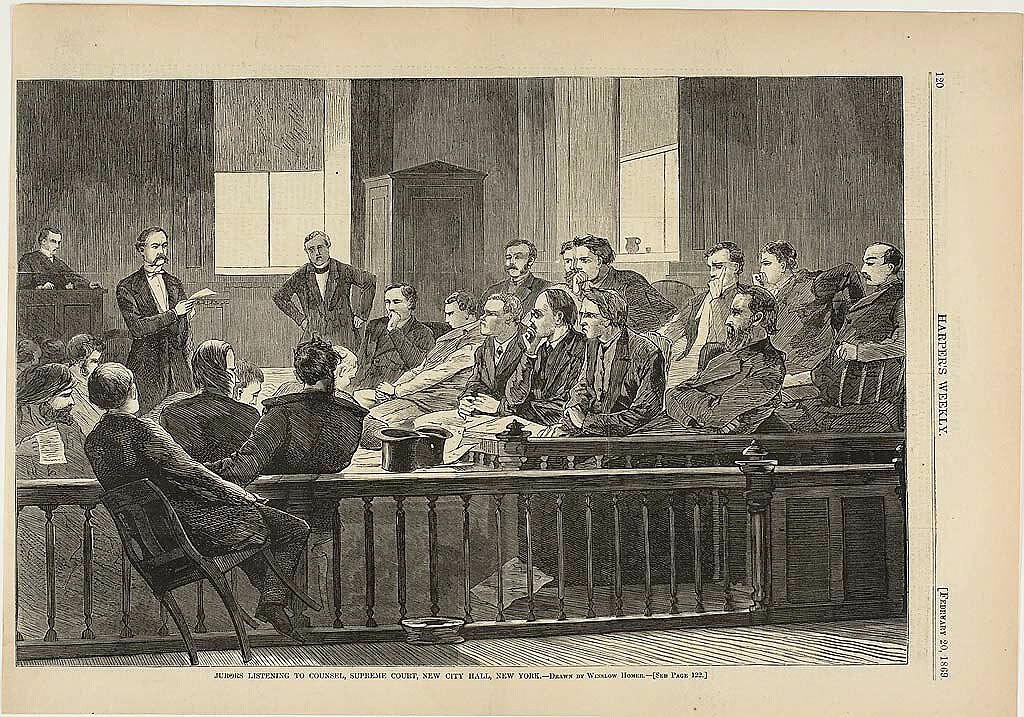
Winslow Homer: Jurors Listening to Counsel,
Supreme Court, New City Hall, New York (published February 20, 1869)
"Stay tuned. We all might end up on the payday side of some future class action."
This week, in January 2026, marks the start of what might prove to be a new era in the history of social media in the United States. A civil suit brought by a 20-year-old woman, identified as “K.G.M.”, who created a YouTube account at age 8, then joined Instagram at 9, Musical.ly, now TikTok, at 10, and Snapchat at 11, finally comes before a jury. Her lawsuit claims she became addicted to the social media sites as a child and experienced anxiety, depression, and body-image issues, including attempted suicide, as a result. TikTok and Snap, the parent company owning Snapchat, settled with the plaintiff before trial began. The remaining defendants will claim protection under a federal shield law, Section 230 of the Communications Decency Act of 1996, that has thus far protected them from liability for what their users post online.
K.G.M. seeks monetary damages and will reportedly present a case based upon similar arguments that resulted in huge settlements against Big Tobacco in the 1990s, when companies like Philip Morris and R.J. Reynolds were accused of hiding information about the harms of cigarettes. Those suits resulted in over two hundred billion dollars in fines, a ban on cigarette advertising, and a dramatic reduction in the number of people who chose to smoke. The New York Times reports that documents showing concerns expressed among the cited social media companies’ executives will likely be presented as evidence that the defendants knew their products were addictive and posed risks to target user groups. This suit serves as the first of more than ten filed, but yet to come to trial, in California. Recently, Australia banned the use of any social media for its citizens under the age of 16. School districts in this country have increasingly banned the use of smartphones on school property, responding to growing evidence that social media use proves to be at least distracting to achieving their educational mission.
Observers have commented that the threat of monetary damages and the nature of civil suits give plaintiffs an advantage when presenting their cases to juries, who have proven much more likely to award damages when corporations are characterized as having inflicted harm. “In 2019, Meta removed some Instagram beauty filters that made users look as if they had undergone plastic surgery. Internal documents showed that in 2019 and 2020, Meta executives emailed Mr. Zuckerberg, asking him to reconsider a plan to restore those beauty filters. The filters were known internally to lead young users, particularly girls, to body-image issues. One executive said her own daughter had suffered from body dysmorphia. The filters were still restored.” Social Media Giants Face Landmark Legal Tests on Child Safety, New York Times, January 27, 2026
I spoke with my 4th-grade granddaughter about this case, and she proved aware and shockingly conversant about issues like body dysmorphia. She had learned about this in her school, whose district has restricted cell phone use by students. School districts are reportedly preparing lawsuits as well. It appears that the social media giants might be forced to shift their focus. Of course, they have very deep pockets and have hired the best litigators to defend their position that their products do not produce the effects they obviously produce. Who are we supposed to believe, Zuckerberg or our lying eyes?
I struggle to imagine the effect of findings that hold these giants responsible for these effects. It seemed unimaginable back before the states brought those cigarette suits against the tobacco giants that the cigarette business could ever be different, but once they were held accountable, they changed, and we changed, too. Addictions only ever become choices when viable alternatives become recognized. We remain easier victims as long as evidence remains in the realm of accusations. Once a jury transforms anecdotes into facts, perhaps not beyond reasonable doubts, but, as with all civil suits, facts enough to justify hefty payouts, choices change along with the products offered. We might have always been fully capable of healing ourselves, but the addition of a few hundred billion encouragements floating around has, in the past, opened significant ground.
What will our society become once we become ex-social media scrollers, no longer lurking just outside public buildings, surfing sites like smokers used to flock when trying to respect the legislated safe distance between smokers and the public? Will we no longer see people reflexively drawing their phones upon exiting to check into their own continuing hyper-personal distraction? Will we become more reflective instead, holding thoughts in our heads instead of instantly sharing what we barely even know ourselves yet? Our world could be dramatically different, though I can’t predict how it might be then, or how I might become. The most radical evangelicals have used the inherently abusive nature of social media to the greatest destructive end. It would be a godsend to erect some barriers to undermining civilization via social media addiction. We’ll have to wait and see if K.G.M.’s suit gains any traction. I suspect that this sort of suit will come into popular fashion. Stay tuned. We all might end up on the payday side of some future class action.
©2026 by David A. Schmaltz - all rights reserved

Good For A Goose

Comeuppance (31)
Decency (90)
Decency Unscrolling (1)
EndDays (92)
Exiled (90)
Fambly (93)
FollowingChapters (93)
Grace (92)
Humor (2)
iAlogue (1)
Letters to the Editor (1)
NextWorld (91)
Personal (18)
Prosperity (94)
Steam Festival (4)
Unscrolling (89)
Vaporized (6)
Work (16)
September 2026
August 2026
July 2026
June 2026
May 2026
April 2026
March 2026
February 2026
January 2026
December 2025
November 2025
October 2025
September 2025
August 2025
July 2025
June 2025
May 2025
April 2025
March 2025
February 2025
January 2025
December 2024
November 2024
October 2024
September 2024
August 2024
July 2024
June 2024
May 2024
April 2024
March 2024
November 2006
October 2006
September 2006
August 2006
July 2006
June 2006
May 2006
April 2006
March 2006
February 2006
January 2006