Content/Context
Thomas Bolton Gilchrist Septimus Dalziel, (Artist)
Dalziel Brothers (Wood-engraver):
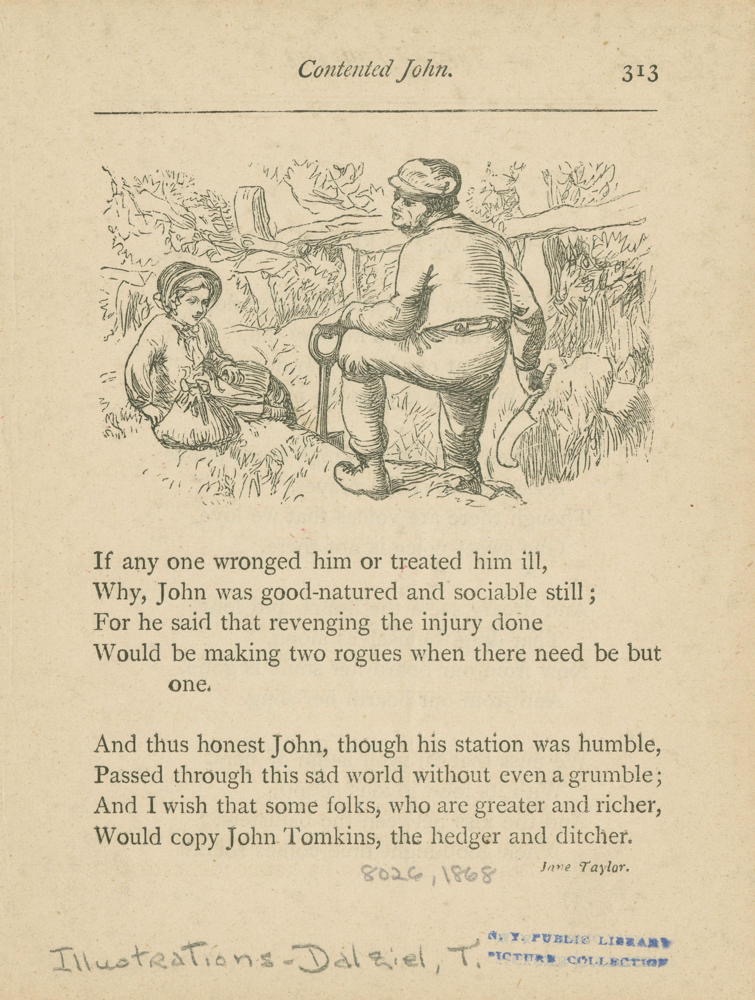
Contented John. (1868)
Content: Illustration of "Contented John" by poet Jane Taylor.
Source Note: The children''s poetry. Being a selection of narrative poetry for the young; with illustrations by Thomas Dalziel, engraved by the Brothers Dalziel. 1868) Dalziel Brothers , Engraver. Dalziel, Thomas Bolton Gilchrist Septimus (1826-1906), Illustrator.
The Miriam and Ira D. Wallach Division of Art, Prints and Photographs: Picture Collection, The New York Public Library. "Contented John." New York Public Library Digital Collections. Accessed February 11, 2026. (https://digitalcollections.nypl.org/items/fa2a2ba0-c5bb-012f-990f-58d385a7bc34)
— — — —
"We can't seem to stop ourselves from coming back again and again to such contexts."
The plaintiff in the breakthrough social media lawsuit against YouTube and Meta, now taking place in Los Angeles, has introduced a novel approach to the proceedings. Internet “content providers” like Meta and YouTube have thus far operated under an act of Congress immunizing them from liability for content posted by third parties. Since both YouTube and Meta thrive largely as Context providers, with a few exceptions, they’ve survived accusations that their moderation excused offensive materials. The law explicitly assumes good faith moderation and that they cannot be treated as the publisher or the speaker of any information provided by another information content provider. This law, Section 230 of the Communications Decency Act of 1996 (47 U.S. Code § 230), has been referred to as the law that built the internet, for Congress created it to encourage the growth of the internet and to foster free expression. It has succeeded, though at some cost.
Many have expressed frustration when platforms like X, formerly Twitter, and Facebook, published lies and hate speech before elections, proclaiming exemption due to § 230 protections. It seemed more common-sensical to moderate content, though nobody seemed able to define just where lines should be properly drawn. The result has produced what appears to be haphazard regulation, where what offends any particular one seems to get protected as another’s freedom of expression. We have our current mis-administration in no small part due to just this sort of misregulation.
The novel approach our current plaintiff has employed to sue YouTube and Meta involves focusing not on protected content, but on the context they’ve provided to contain content. The plaintiff insists that their context, featuring ‘like’ buttons and infinitely automatically invoking videos, more closely resembles slot machine design. They’ve introduced some internal memos where executives argued about whether they were designing gambling equipment. One memo even discussed targeting three and four-year-olds. The defense has introduced extensive counselling records from the mysterious plaintiff, K.G.M., now a twenty-year-old. They contend that whatever psychological troubles the plaintiff has encountered can be better explained as being the result of her offline family of origin experiences. That family has apparently suffered divorce, and most of the usual troubles families tend to get into. Nobody’s digital life exists in a totally isolating bubble. The defense contends that K.G.M.’s treatment records will clearly demonstrate that social media has been the least of the problems.
This case has been called a bellwether case because it attempts to plow fresh ground. The context focus seems just novel enough to perhaps sidestep § 230 liability restrictions. I suspect that many reasons might emerge to appeal any decisions the jury concludes. Everyone seems to expect a flood of class action lawsuits to follow this one, however the jury decides. Parallel litigation is also occurring. In New Mexico, the Attorney General has sued social media for failing to protect minors from obscene material. Oakland, California, has joined with several other school districts to seek damages for the expenses they claim to have incurred helping their students recover from various degrees of what might be called social media poisoning, the effects of over-exposure to the slot machine-like context.
We inevitably start in ignorance. I suspect that not one of us inspected the context we were immersing ourselves into when we first engaged with social media. The context seemed completely hidden behind the content, though it was, I seem to remember, context that proved by far the most frustrating of the elements I encountered when first browsing social media. I’d lose what I’d mistaken for a thread. I’d try to forward some posting only to learn that the receiver didn’t have proper permission to receive it. The rules of engagement were either never delineated or hidden down some nearly invisible rathole. The mysteries curiously kept us returning, believing that we might eventually feel as though we’d mastered something. Social media has always been, if anything, supremely frustrating to use. Perhaps that frustration was always the hook, the alluring unresolvable. Like in a casino, there’s no mastery ever involved. The context subtly compels continuing engagement even though the payoffs remain random or worse. We can’t seem to stop ourselves from coming back again and again to such contexts.
©2026 by David A. Schmaltz - all rights reserved

Good For A Goose

Comeuppance (31)
Decency (90)
Decency Unscrolling (1)
EndDays (92)
Exiled (90)
Fambly (93)
FollowingChapters (93)
Grace (92)
Humor (2)
iAlogue (1)
Letters to the Editor (1)
NextWorld (91)
Personal (18)
Prosperity (94)
Steam Festival (4)
Unscrolling (89)
Vaporized (6)
Work (16)
September 2026
August 2026
July 2026
June 2026
May 2026
April 2026
March 2026
February 2026
January 2026
December 2025
November 2025
October 2025
September 2025
August 2025
July 2025
June 2025
May 2025
April 2025
March 2025
February 2025
January 2025
December 2024
November 2024
October 2024
September 2024
August 2024
July 2024
June 2024
May 2024
April 2024
March 2024
November 2006
October 2006
September 2006
August 2006
July 2006
June 2006
May 2006
April 2006
March 2006
February 2006
January 2006