DecentPeople
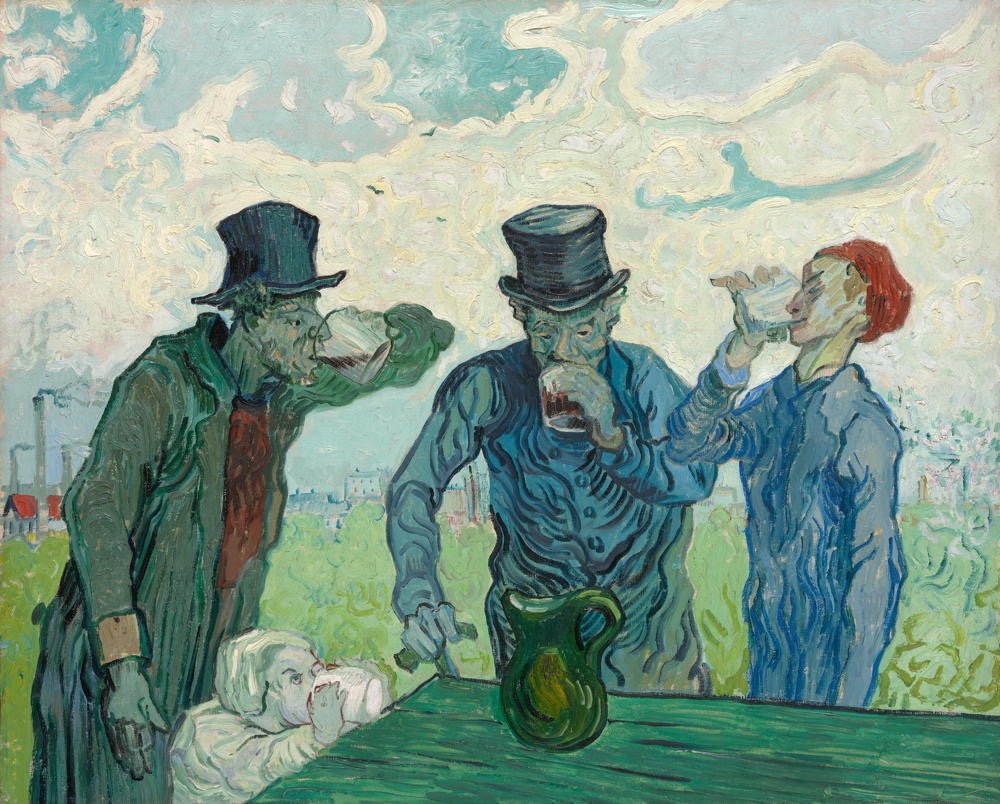
Vincent van Gogh: The Drinkers (1890)
ABOUT THIS ARTWORK
During his time in the Asylum of Saint-Paul in Saint-Rémy, a small town near Arles, Vincent van Gogh made a number of copies of the work of artists he admired, which freed him from having to produce original compositions and allowed him to concentrate instead on interpretation. For this image, Van Gogh copied a wood engraving from Honoré Daumier’s Drinkers, a parody on the four ages of man. The exaggerated figure types capture Daumier’s characteristic humor and convey his sad message about the horrors of alcoholism. The greenish palette may well be an allusion to the notorious alcoholic drink absinthe.
— — —
"My Decencies seem as fleeting as my days."
People seem to have a deep need to classify each other into categories. A deep need for self-esteem might drive this tendency, though there must be better ways for us to feel good about ourselves. This practice seems the likely source of prejudice, misogyny, and a startling list of the more prominent human frailties. I wonder why we couldn’t be generally better than this, since we hold the capacity to make finer judgments and even to choose to make no judgments at all. Would it kill us to make fewer judgments under some ‘judge not, lest ye be judged’ rule? I suspect so.
I feel embarrassed to acknowledge that, in this whole series, of which this writing finds me 85% finished, I have been spouting deep antipathy toward a class I labeled Indecent without clearly defining who belonged to that group. Likewise, I have been promoting an apparently opposite group whom I labeled DecentPeople, as if Decency were a tendency common to swaths of society rather than an individual instance of human behavior. It seems a bit more than a stretch to create a class of otherwise faceless individuals based on my perception of their prior behavior. Many, maybe all, I preconsciously included in my indecent group remained fully capable of committing some Decency in their next act. None necessarily deserved to be damned due to their history, especially a history cobbled together by me so that I could assume some form of superiority.
If Decency has an evil side, I suspect it lies along this exclusionary line, the one delimiting one person’s prejudice more than their reasoned judgment. We presume to know whatever lives in another’s heart based solely upon our personal perception of their behavior. We manufacture the bad actors surrounding us. I know this assertion sounds naive, for what besides precisely this sort of judgment, however flawed, might allow me to pass the judgments that keep me safe? This might provide a sorry sort of safety, though its conclusions seem almost perfectly self-sealing. We might misclassify somebody as indecent when they’re more often not. So what? We might just as easily classify DecentPeople as indecent without ever suffering any adverse effects from passing such judgment. The ill effects, if they show up at all, probably appear as a narrowing of association. We might shun some we could otherwise have known, or know some we might otherwise have ignored.
I plead guilty to the sin of censoriousness, the act of being severely critical of others’ behaviors. This behavior seems roughly equivalent to any other -ism I might revile. I have been a practicing indecency-ist, reviling others’ personal practices. Certainly, some of those practices do seem indecent, but we all occasionally dabble in our own indecencies; none stand innocent of that sin. We might define each other more generously and, maybe, sometimes choose not to judge each other at all. On our better days, we might even manage to forego the harsher judgments we might routinely make against ourselves.
Am I so needy that I feel I must disparage whole classes of individuals? Their past no more defines the indecent than Jewishness defines any individual’s potential. The past was never prologue, but practice, and while repetition might never produce perfection, it never definitively defines future capability. There’s little leverage in damning anybody to anyone’s Hell. Nor is there much advantage to be gained by continual virtue signaling. Whom am I signaling, and why am I seeking their approval? Am I so needy that I must maintain an army of indecency around me for my innate Decency to show?
Indecency seems to be a fleeting thing, if it ever qualifies as a thing at all. Decency might describe the next act and the ones thereafter, though some indecency’s more than likely to slip in there, too. The dichotomy says much more about me than it says about my world. I might better inform myself without resorting to finite classifications, or perhaps rely on more value-neutral ones. The beiges that dominate the late autumn landscape would seem indecent in the middle of May. My Decencies seem as fleeting as my days. My judgments alone might stand most eternal. If that notion’s not sobering, I don’t know what is.
©2025 by David A. Schmaltz - all rights reserved

Good For A Goose

Comeuppance (31)
Decency (90)
Decency Unscrolling (1)
EndDays (92)
Exiled (90)
Fambly (93)
FollowingChapters (93)
Grace (92)
Humor (2)
iAlogue (1)
Letters to the Editor (1)
NextWorld (91)
Personal (18)
Prosperity (94)
Steam Festival (4)
Unscrolling (89)
Vaporized (6)
Work (16)
September 2026
August 2026
July 2026
June 2026
May 2026
April 2026
March 2026
February 2026
January 2026
December 2025
November 2025
October 2025
September 2025
August 2025
July 2025
June 2025
May 2025
April 2025
March 2025
February 2025
January 2025
December 2024
November 2024
October 2024
September 2024
August 2024
July 2024
June 2024
May 2024
April 2024
March 2024
November 2006
October 2006
September 2006
August 2006
July 2006
June 2006
May 2006
April 2006
March 2006
February 2006
January 2006