Ferocency
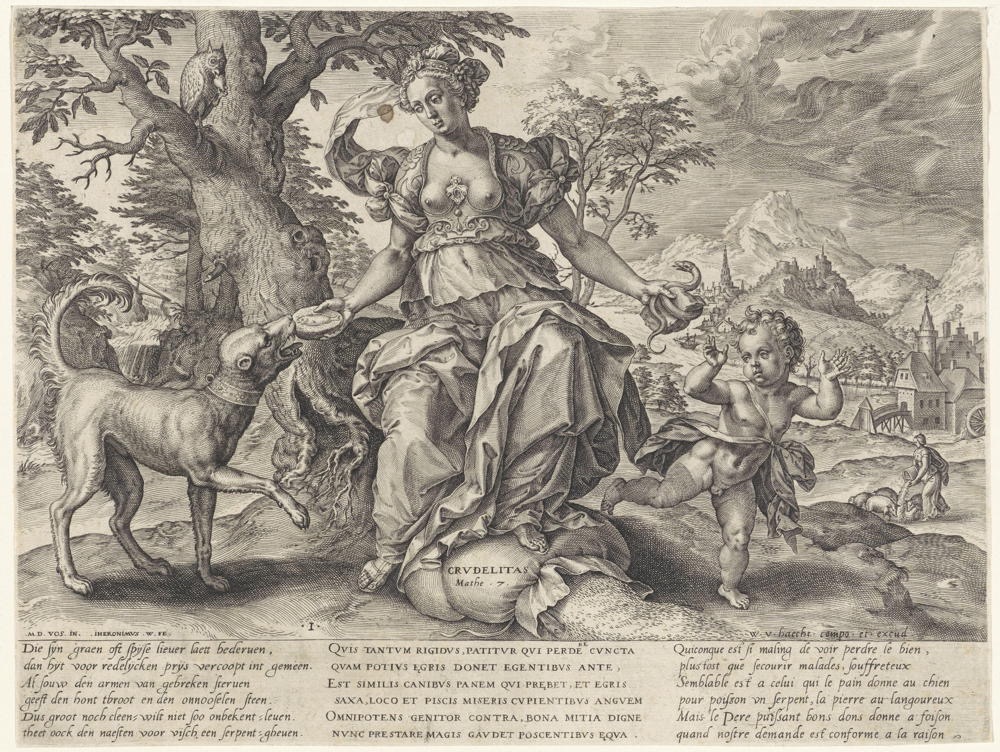
Hieronymus Wierix: Cruelty (1577)
Gallery Notes:
The female personification of Cruelty (Crudelitas) sits on a bag where the collected grain flows out. She hands a bread with a fish to a dog, and a stone with a snake to a young child. In the tree behind her sits an owl with a burning heart in its beak. On the left in the background a river with a current acceleration. On the right in the background a face on a village. On a field, a woman sprinkles food for the pigs. In the margin, a six-line exlanatory poem in Dutch, Latin and French.
— — —
"Under certain uncertain conditions, a two-by-four to the side of the head could be considered an intervention of Decency."
Varying intensities are permitted when deploying Decency. It needn’t always seem gentle or even necessarily kind. As with most things, tough love equivalents unquestionably exist, though one must usually deploy them circumspectly lest motive be interpreted differently than intended. In business, for instance, certain otherwise unseemly intensities seem permitted under the self-referential rubric that “business is business,” a multi-purpose excuse intended to cover every possible variation. It seems as though nobody can call “violation” regardless of the intensity of the application if it’s done in the pursuit of profits.
I’ve also noticed a certain erosion of what used to pass for decorum, allowing for some rather coarse words to be injected into otherwise benign conversation. Some of what had previously been considered first-class violations gets ascribed to simple cultural variation, as if someone’s background might justify employing shocking language and manners even at a grandmother’s table. I intend my point here to remain rather more fuzzy than clear because the lines delimiting the boundary between acceptable and unacceptable no longer seem clear. I do not intend to resolve that ambiguity here, just to note its often unwelcome presence.
I cannot judge this book by its cover. Delivery might easily belie the underlying Decency. I might not suspect. It might pay me to attempt to be unoffendable, accepting experiences as something other than necessarily value-laden. Whether one employs the F-bomb or not does not necessarily tell a listener very much. There’s much more at play than whatever merely offends the ear. The rules at play remain first the listener’s, who might frequently feel challenged these days to find the Decency lurking in the messaging they’re commonly exposed to. Like I was exploring yesterday, when asking how Decency and insanity might play together, the questioning mind seems more likely to find something meaningful lurking in what initially might have seemed offensive.
Rules of engagement shift with context. I have returned to this principle again and again as I’ve explored what underpins Decency. Decency seems to be something inside me, perhaps nothing any meatier than a vague intention. I tried to find a helpful definition for it, but failed. I still insist that I will know it when I encounter it, even though I know for sure that I won’t always. I find it helpful to remain mindful of a few of the more common exceptions to any more general rule. Decency can sometimes seem like a rabid lamb, appearing soft and cuddly but potentially deadly, especially to some of the more fragile states. Some Decencies serve to utterly undermine a deeply held conviction. A kindness given to a mean old man or a seemingly mean old comment given to a stuck young person. Under certain uncertain conditions, a two-by-four to the side of the head could be considered an intervention of Decency.
Decency must be more than merely a choice. It must also represent a relationship. Who could be Decent in the absence of another? Even when treating myself Decently, where it’s just me, I seem to be filling two distinct roles. I am the nursemaid and the patient, one extending while the other accepts. It’s possible to inflict Decency on somebody, but even that seemingly independent action relies upon the unwitting receiver. Decency must be a choice affecting another, even when that other is just another part of oneself. The delivery matters, but not always overwhelmingly. Sometimes Decency slips out of its carefully tended cage to slap another in the face. These experiences can serve as the basis for exploring some places ordinary experience rarely invites us to visit. We might blurt out our most significant contributions, only to understand later how fortunate we were to have violated a limitation. Decency seems destined to remain a mystery, even after I’ve finished writing this explanatory series.
©2025 by David A. Schmaltz - all rights reserved

Good For A Goose

Comeuppance (10)
Decency (90)
Decency Unscrolling (1)
EndDays (92)
Exiled (90)
Fambly (93)
FollowingChapters (93)
Grace (92)
Humor (2)
iAlogue (1)
Letters to the Editor (1)
NextWorld (91)
Personal (18)
Prosperity (94)
Steam Festival (4)
Unscrolling (89)
Vaporized (6)
Work (16)
September 2026
August 2026
July 2026
June 2026
May 2026
April 2026
March 2026
February 2026
January 2026
December 2025
November 2025
October 2025
September 2025
August 2025
July 2025
June 2025
May 2025
April 2025
March 2025
February 2025
January 2025
December 2024
November 2024
October 2024
September 2024
August 2024
July 2024
June 2024
May 2024
April 2024
March 2024
November 2006
October 2006
September 2006
August 2006
July 2006
June 2006
May 2006
April 2006
March 2006
February 2006
January 2006