InPractice
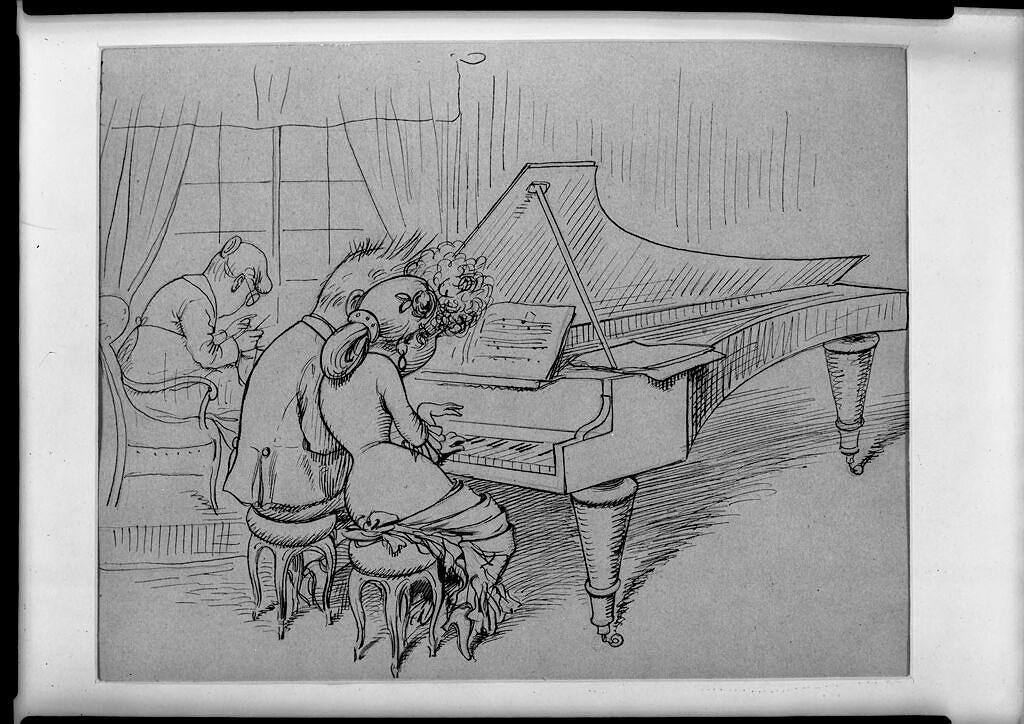
Adolf Oberlaender: The Piano's Revenge: Practice (1882)
"I might have initiated this enquiry only to continue it ad infinitum, InPractice."
I should not feel so surprised when I stumble upon the discovery that Decency, like every other concept, only manifests InPractice. In theory, it seems to contradict itself. Only InPractice does it exhibit its underlying nature, which proves to be indescribable. The description clearly ain’t the thing. InPractice, Decency seems to exhibit little if any ‘thingness.’ Not natively being either person, place, or thing, it steadfastly sidesteps all attempts at facile description, let alone definition. I suppose its dictionary definition performs as well as any dictionary definition might aspire to, though, as I believe I’ve shown in this series so far, much variation swirls around the concept’s central core. Decency can never manifest contextlessly. In fact, Decency seems unusually dependent upon well-formed context to exhibit much of any meaning at all.
You might not notice it when it exhibits. Contrary to popular misconceptions, none of us really shares a reality. We exist within at best fuzzy approximations of genuine perceptions, each missing some part of some broader theoretical whole. Decency, having been taken from the Latin ‘decentia’, “being fitting,” requires comparison to even come into focus. Fitness has always been notorious for its innate fuzziness, being utterly dependent on a raft of similarly fuzzy conditions, such as purpose and intention. It’s a wonder anyone ever agrees upon what constitutes Decency InPractice, even when some theories seemed to have shaved off much of its innate fuzziness.
I spent much of my career failing to teach people better ways to engage in project work. The first stage of such activities usually requires the creation of something to serve as a description of the content of the theories behind the professed practice. What could be more obvious? Prospective students wanted to know what they would learn should we engage in a workshop together. I complied as best I could, only to discover that each prospective student apparently read a different description than the one I had written. Much was apparently sacrificed to interpretation, which depended upon each prospective student’s context. In this, as in most cultures, people spend very little time concerning themselves with their context. We’re too focused on the outcome to get overly interested in where we’re coming from, though, when embarking on anything, the point of departure proves critical to arriving. Most of what I’d tried to propose was ultimately lost in failed translation.
I learned, though I proposed to be the teacher, that what I aspired to teach could only be taught by each participant to themself. My presence served as little more than a catalyst. I’d propose some exercise within which some discovery might occur. Those discoveries utterly depended upon the student’s aspirations, not mine. Project work turned out to amount to a deeply personal practice. To adopt another’s process undermined the purpose. I never once successfully described what any student would get from attending my workshop. I rarely ever knew what they discovered, so personal was the experience, and necessarily so. Project work, too, turned out to disclose its significance only in Practice. The underlying theory seemed meaningless in comparison. The project practice-certifying agency turned itself into a Change Prevention Operation, enforcing a backward vision while intending to light the way forward. I eventually just got out of the business. Bad money eventually drives out better.
I stand before you as a wounded optimist. My optimism remains surprisingly intact, given what it’s encountered over the years. I still gambol out like a Spring lamb when faced with another challenge. I hope never to learn to more accurately predict the inevitable outcome of any of my proposed enquiries, even though I might manage to sidestep some crushing realizations by so doing. Decency for me demands that I embody a certain uncertain innocence when enquiring. I do not need to pretend ignorance, for I easily forget my prior insights when pursuing fresh ones. I am a heavily modified verb InPractice, not a noun, whatever form each enquiry takes. I have so far more or less steadfastly refused to draw much in the way of conclusions. I do not enquire to put a concept to rest, but apparently to further animate it. Decency seems no different. I might have initiated this enquiry only to continue it ad infinitum, InPractice.
©2025 by David A. Schmaltz - all rights reserved

Good For A Goose

Comeuppance (31)
Decency (90)
Decency Unscrolling (1)
EndDays (92)
Exiled (90)
Fambly (93)
FollowingChapters (93)
Grace (92)
Humor (2)
iAlogue (1)
Letters to the Editor (1)
NextWorld (91)
Personal (18)
Prosperity (94)
Steam Festival (4)
Unscrolling (89)
Vaporized (6)
Work (16)
September 2026
August 2026
July 2026
June 2026
May 2026
April 2026
March 2026
February 2026
January 2026
December 2025
November 2025
October 2025
September 2025
August 2025
July 2025
June 2025
May 2025
April 2025
March 2025
February 2025
January 2025
December 2024
November 2024
October 2024
September 2024
August 2024
July 2024
June 2024
May 2024
April 2024
March 2024
November 2006
October 2006
September 2006
August 2006
July 2006
June 2006
May 2006
April 2006
March 2006
February 2006
January 2006