OnBeingDecent...
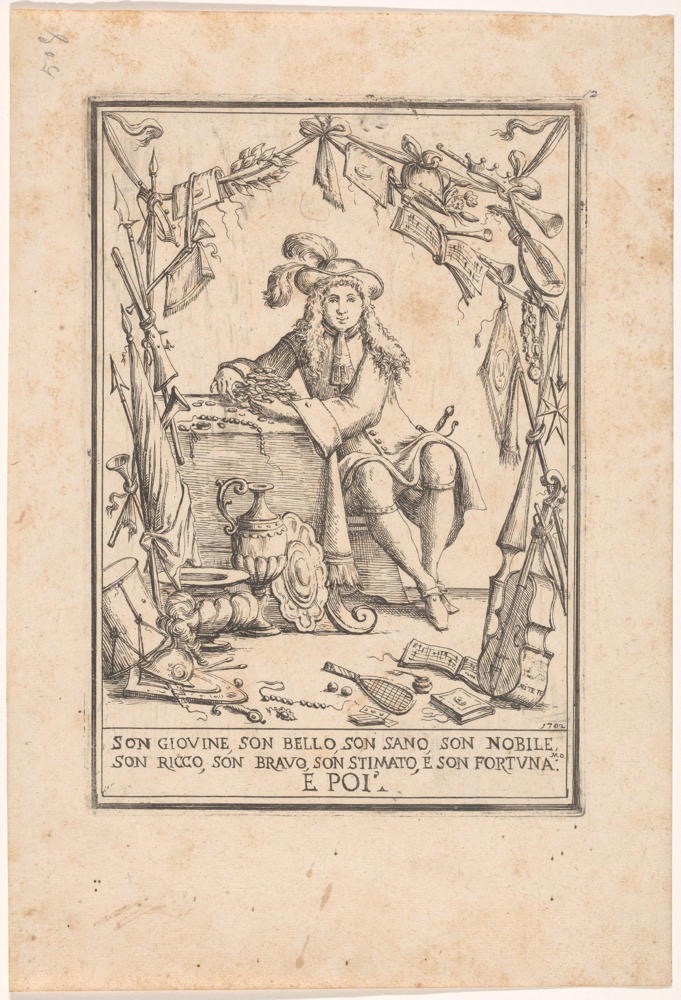
Giuseppe Maria Mitelli Allegory of the Lightness of Being (1702)
Gallery Notes: This elegantly attired nobleman – who is young (giovine), handsome (bello) and rich (ricco) – flaunts his possessions. His affluence is emphasized by the pile of gold coins on the table and the many costly attributes of art, gaming, and diversions that literally surround him. Yet apparently this is not enough. Amid all this opulence, he looks disillusioned and unsatisfied. Is this all there is?
"Decency's question is rarely what but when."
On Being Decent … In Indecent Places
I can speak with authority only about my personal experiences, and even that ability seems limited. I have nothing to teach anyone else, except by example, often by bad example. I am no paragon of anything except not being a paragon of anything. This context says nothing about the content of whatever I consider here, for I consider here to present an example of considering, not necessarily to conclude anything. That said, I have been writing Decency Stories for eighty-two consecutive days, discovering more than declaiming, sometimes seemingly shaming myself in the process. I have stumbled into contradictions and many tenacious misconceptions, realizing how little I understood the topic of my efforts. As I near the end of this series, I realize that I probably won’t be offering any crisp summarization of my subject at the end. I didn’t intend this effort to reduce understanding into a spare handful, but to expand it. It has proven more expansive than I could have imagined when I began.
One prominent subtext, though, that many of these stories have shown, involves one of the more common yet perplexing situations: On Being Decent In Indecent Places, not How To Be Decent In Indecent Places, but “merely” On Being Decent. I’ve convinced myself that no practical instruction manual could ever exist detailing how to be Decent. As my prior Decency Stories have shown me, the how-to of Decency seems to be far too sensitive and varied a topic to lend itself to` such summarization. Yet, the dilemma clearly exists and needs to be addressed. Much Decency seems to need to be expressed in seemingly indecent places. Indeed, many of my own most Decent experiences have been curiously encouraged by the presence of some intimidating indecency. Such situations do not always bring out the best in me. Often, just indecency’s contextual pressure seemingly prevents me from engaging as Decently as I know myself capable of behaving. I’m troublingly apt to go silent, invisible in the presence of a clear and all-too-present danger. Indecency often seems to hold authority over me.
I think of indecency as a bully capable of discouraging. Decency doesn’t always require courage to deploy, but to the extent indecency seems present, Decency does seem to demand the consequent courage to engage. The pressure easily enrages and seems to automatically disengage one’s better angels. The context does not seem nearly safe enough to expose Decency’s soft white underbelly. It often appears as though displaying Decency might get me disembowled, gutted, and left for dead, so I play dead instead, or might just as well have. I censor myself more thoroughly than any enemy could ever quiet me. Worse, I watch myself betray my better intentions and sense myself becoming complicit in precisely what I didn’t want. I rarely commit any greater infraction. My inaction serves as infraction enough. I become the potential difference that chose not to act. I leave myself abandoned in the field.
This act makes chickening out seem like an Olympic medal performance in comparison. To be guilty of inaction seems exponentially worse than engaging in the present indecency myself. To have seen the opportunity to make a difference but choose not to act is far worse than engaging in some actual forbidden act. Engaging in indecency might always be a forgivable sin, while choosing not to make a difference seems an act without possible recompense. The opportunity for forgiveness evaporates the second I make such choices. Do overs demand the presence of at least a crime scene. Roads not chosen never come into being, leaving only regrets in their wake. However fully justified such choices seem in that critical second they’re selected, their wake remains eternally present and irreparably broken.
The lesson I’m learning seems to be that Decency might be something capable of providing its own context. Whatever other influences seem to be dominating a situation, Decency might always create space for its deployment. It shouldn’t require any invitation, engraved or merely implied. It knows its course and possesses permission adequate to justify itself at all times. The anticipated criticism that indecency might inflict remains merely projection until it hits, and Decency most often serves as an effective shield against even the worst of that. Decency seems to require a tad more faith in itself than any odd mustard seed might prove capable of providing. A faith bordering on foolhardiness most often seems essential, but it is foolhardiness set against another unending regret. Weighed up like this, Decency doesn’t seem nearly as expensive as its alternative.
Decency seems as if it’s usually deployed in indecent places. It reliably appears as though it might upset some overly delicate balance. It aches to go along, not to have to make such a spectacle of itself this time, yet it knows it only ever exists when it must make that spectacle. It feels embarrassed in those moments, as if inconvenienced. Decency feels different when it wants to fit in. It leads when it might strongly prefer to follow. It rarely sleeps. It seemingly always knows the difference. Decency’s question is rarely what but when. Now is always the time. Now never wasn’t.
©2025 by David A. Schmaltz - all rights reserved

Good For A Goose

Comeuppance (31)
Decency (90)
Decency Unscrolling (1)
EndDays (92)
Exiled (90)
Fambly (93)
FollowingChapters (93)
Grace (92)
Humor (2)
iAlogue (1)
Letters to the Editor (1)
NextWorld (91)
Personal (18)
Prosperity (94)
Steam Festival (4)
Unscrolling (89)
Vaporized (6)
Work (16)
September 2026
August 2026
July 2026
June 2026
May 2026
April 2026
March 2026
February 2026
January 2026
December 2025
November 2025
October 2025
September 2025
August 2025
July 2025
June 2025
May 2025
April 2025
March 2025
February 2025
January 2025
December 2024
November 2024
October 2024
September 2024
August 2024
July 2024
June 2024
May 2024
April 2024
March 2024
November 2006
October 2006
September 2006
August 2006
July 2006
June 2006
May 2006
April 2006
March 2006
February 2006
January 2006