OpeningStatements
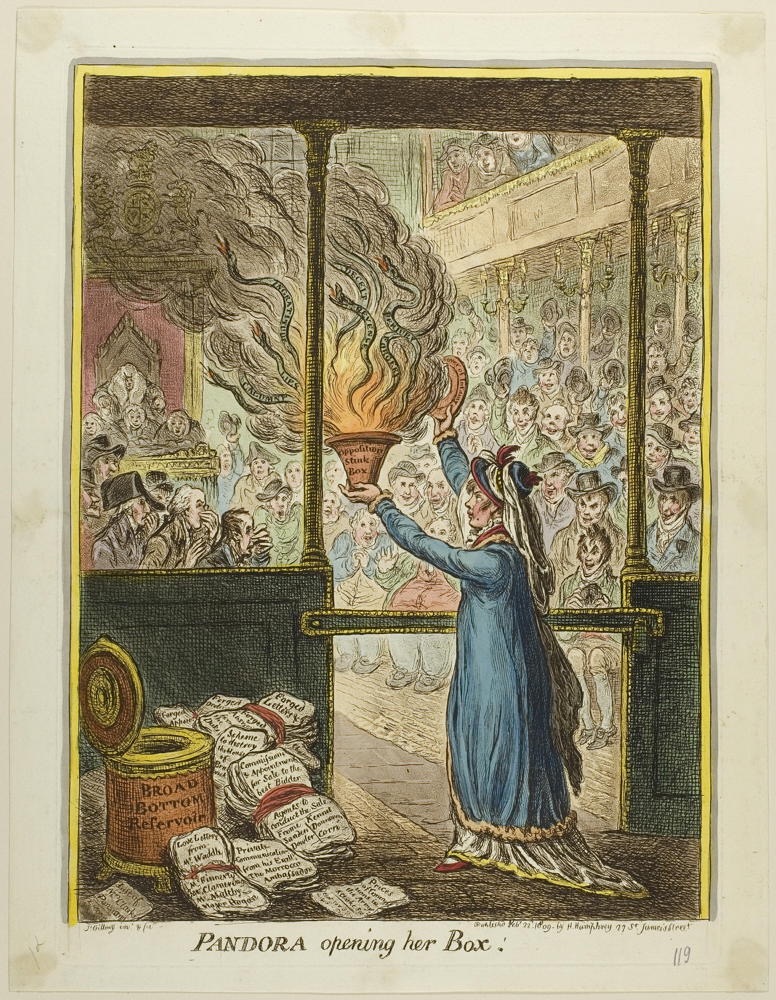
James Gillray: Pandora Opening her Box (published February 22, 1809)
published by Hannah Humphrey
"Progress moves more slowly than molasses."
The attorney for the plaintiffs delivered his opening statement in what PBS described as “a lively display.” He asserted that the case is “easy as ABC,” which he said stands for “Addicting the Brains of Children.” Simple as his case might be, he was nonetheless unable to complete his OpeningStatements before the lunch break. The defense, of course, denied every allegation, and so the process began. This is how we determine reality in the twenty-first century, just the way we did it in the prior centuries, for we demand proof, not necessarily beyond any reasonable doubt, but enough to compel the checkbooks to come out and cough up. Two of the wealthiest corporations in the history of corporations stand accused of deliberately engineering dependence in adolescents. I suspect they’ll be found guilty as charged.
We have always been cranky when it came to protecting consumers. Through the nineteen-sixties, one state after another followed Wisconsin’s example, mandating that seatbelts be installed in the front seats of new cars. By the end of that decade, Federal regulations made that mandate applicable in all states, but it wasn’t until after New York made seat belt use mandatory in 1984, and California followed suit in 1989, that seat belt use became required in all states, circa 2021. It took fifty years for such a non-controversial regulation to pass into actual law. How much longer might it take to meaningfully regulate social media for children, let alone adults, who, by most measures, seem every bit as vulnerable as the kids?
Controversy seems to be easily amplified whenever the ox that might be gored has deep pockets. Tobacco companies stiff-armed meaningful regulation for decades while steadfastly poisoning their target demographic. Smokers were unsurprisingly militant when faced with the erasure of their beloved habit. Clutches of disaffected smokers congregated twenty-six feet from every public entrance to every building, continuing to blow smoke long after the judges and juries had made their terminal ruling. It took a few following decades before the kids stopped dabbling, though they found ready replacements in vaping and Zin. Some percentage of all corporations depend upon encouraging some sort of dependence from their customers. Those who don’t, sure wish they could, for there’s no better marketing strategy than one that ensures the customer feels compelled to continue returning.
Back in the 1920s, modern public relations and advertising were created. Their stated objective was to engineer consent, and one of Freud’s nephews was perhaps the principal contributor to the founding of this now dominant enterprise. We’re subjected to scores of prompts each day. Seemingly everywhere we go, we see attempts to persuade us. In essence, each advertisement tries to hypnotise everyone it touches, to persuade them to do something the advertiser wants them to do, regardless of the individual’s desires. Of course, the advertisers insist that they’re “just” satisfying their potential customers’ wants by informing them of a choice they might have overlooked. That explanation’s the cover. They actually desire to instill a need that only they can satisfy, whether it be created by inventing some quality or by promising more than anyone could ever deliver. Those pops were never actually sweeter, and their taste was never new, and nobody could explain what it might mean for them to have been “shot with sugar, through and through.” Sugar Corn Pops® were an imaginary commodity created by engineers and sold by cynical advertisers to innocent children and their placating parents by a paragon of the modern corporation. They made billions marketing corn deliberately made LESS nutritious.
Our economy seems to float in a sea of just this sort of misrepresentation. Why should social media be any different? The advertisers used to drool over the dream of one day convincing every potential consumer to carry the medium for delivering proven hypnotic advertising on their person 24/7. Technology has now delivered, sweetened, and colored by various pretexts like social media apps. What started as a more convenient telephone became everybody’s surrogate home. I need no more evidence than the fact that these “phones” have somehow hypnotized almost everyone to type with their freaking thumbs! Most do this unselfconsciously, too! The technology seems to have been designed to continuously erode our innate impulse control. We’re now one click away from virtually anything any heart could be convinced to desire, even the usurious financing required. We have almost become our nearly perfect enemy. Our kids must be even more vulnerable.
So it makes good sense that we regulate social media from the bottom up. I do not doubt that the billionaire class will be found more or less guilty as charged, though they will appeal to higher courts, which will likely find some procedural errors that will further delay any significant change. France has scheduled the implementation of severe restrictions on adolescent social media use for this September, following Australia, which has already outlawed use by anyone younger than sixteen. One day, we each might find ourselves huddled like soon-to-be ex-smokers, sucking the final few ignorantly satisfying lungfuls of our long-preferred poisonous social media habit, while a new generation comprised of those who never experienced the addiction engages in some new and innovative self-destructive behaviors. Progress moves more slowly than molasses.
©2026 by David A. Schmaltz - all rights reserved

Good For A Goose

Comeuppance (31)
Decency (90)
Decency Unscrolling (1)
EndDays (92)
Exiled (90)
Fambly (93)
FollowingChapters (93)
Grace (92)
Humor (2)
iAlogue (1)
Letters to the Editor (1)
NextWorld (91)
Personal (18)
Prosperity (94)
Steam Festival (4)
Unscrolling (89)
Vaporized (6)
Work (16)
September 2026
August 2026
July 2026
June 2026
May 2026
April 2026
March 2026
February 2026
January 2026
December 2025
November 2025
October 2025
September 2025
August 2025
July 2025
June 2025
May 2025
April 2025
March 2025
February 2025
January 2025
December 2024
November 2024
October 2024
September 2024
August 2024
July 2024
June 2024
May 2024
April 2024
March 2024
November 2006
October 2006
September 2006
August 2006
July 2006
June 2006
May 2006
April 2006
March 2006
February 2006
January 2006