Weekly Writing Summary For The Week Ending 01/29/2026
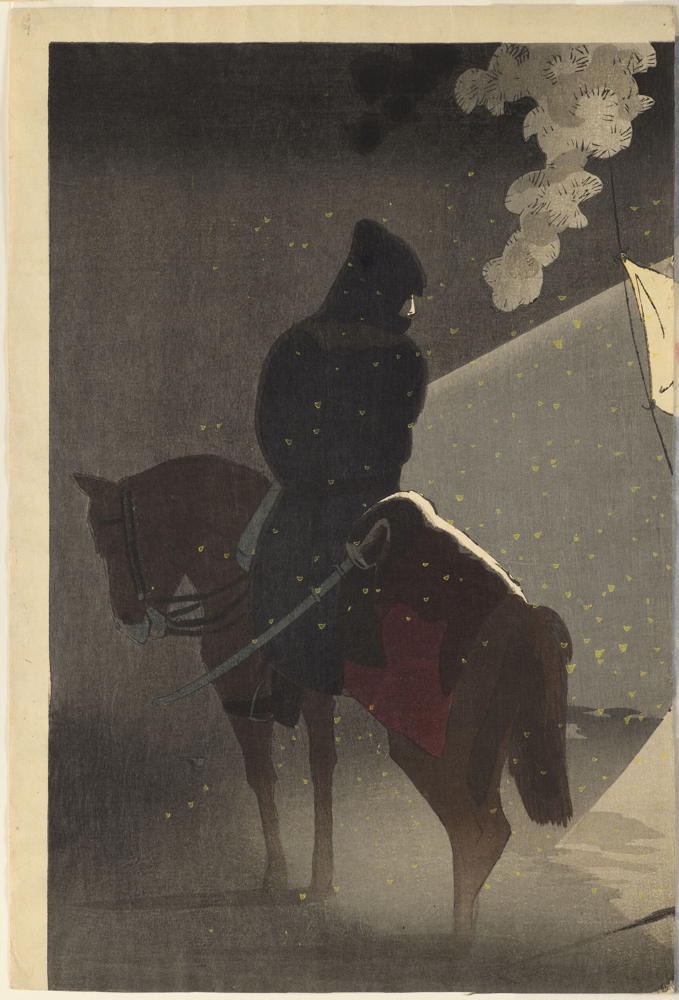
Kobayashi Kiyochika 小林清親: Braving the Bitter Cold,
Our Troops Set Up Camp at Yingkou (1895)
Published by Matsuki Heikichi 松木平吉 (1836 - 1891)
I wish every writing week would leave me feeling as though I’d discovered as much as I managed to stumble upon this writing week. I troll for insight, but I’m not always rewarded for my efforts. Writing this series feels very much like fishing. Some streams, some weeks, hold many fish, while others prove to be fallow. I’m not quite foolish enough to think of myself as a masterful fish attractor. I show up, mustering some hope for the best, and I feel genuinely blessed when my gumption’s rewarded. This week seemed a mother lode in comparison to most.
I sense my originating presumptions shifting, as any originating presumption should. As I’ve delved more deeply into the notion of Unscrolling, I’ve discovered as many redeeming qualities as damning ones. Unscrolling seems like a one-sided objective now, perhaps a part of a resolution, but very likely not anything like the full resolution for anything. I cannot just cease scrolling and expect to advance much, just like with every negative-space objective I’ve adopted before this one.
I began this writing week appreciating the postmodern Jungle Telegraph that social media provides. I noticed that scrolling fiddles with and fuzzes my InHere/OutThere boundary, sometimes replacing me with some alluring, masquerading projection of me. I reported on A Curious Case … of social media denying my requests, an increasingly common if unsettling experience for me. I questioned whether I really need to accept the incivility that social media induces in me and others, and I started to imagine an alternative I call OutCivility as a present possibility for how I might choose to engage. I caught myself labeling the social media context as one that keeps me enmired in endless Dooming, even though I know there’s room in me for more generous and hopeful interpretations. I ended this writing week reporting on what I see as the first of probably dozens of Civil-Liability lawsuits that I expect will be brought against social media purveyors for dealing in addictive products.
I’m grateful you’ve followed along with me as I’ve been feeling my way through all of this.
Weekly Writing Summary
JungleTelegraph
“What harm could it possibly do to learn that Tarzan’s on the move again?”
This Unscrolling Story characterizes scrolling as just a current form of Tarzan’s old JungleTelegraph.
I compare Tarzan’s jungle uproar—a web of animal warnings only he can fully decode—to today’s social media storm feeds. My modern JungleTelegraph is a blur of StormTracker clips, weather maps, and familiar images of empty shelves and salt trucks. I’m captivated by it, even when the storm won’t affect me, because it revives my old thrill of feeling prepared and slightly smug. In my constant scrolling, I recognize a primal hunger for information and take comfort in feeling wired into this vast, mysterious chorus—reassured simply by knowing that, somewhere, Tarzan’s on the move again.
Israhel van Meckenem the Younger: Wild Men Climbing to the Flower of Love (15th-16th century)
——
InHereOutThere
“I seem satisfied to accomplish no more than to gape at shadows playing on some utterly imaginary wall.”
“I seem satisfied to accomplish no more than to gape at shadows playing on some utterly imaginary wall.”
I’ve realized that social media can trick me into feeling more present in the virtual world than in my own real life. When I get absorbed in scrolling, I neglect everyday responsibilities and avoid genuine self-reflection, comforting myself with a shared, superficial sense of connection. Stepping away to do something physical and tangible—like cleaning up my driveway—reminds me what it feels like to truly inhabit my own life. When I stay anchored in my inner self instead of mistaking the online world for my real one, I feel more grounded, capable, and present.
Thomas Nast: Out of the ruins... (10-18-1873)
——
TheCuriousCase...
“A marriage created in purgatory.”
This Unscrolling Story finds me fruitlessly searching for stories I know were posted, but which social media renders inaccessible. A Curious Case...
During the pandemic, I came to depend on Heather Cox Richardson’s daily posts for calm, historically grounded explanations of political chaos. As her influence grew and her voice felt ever more essential, Facebook made her—and even my own posts—harder to reliably find, hiding current content behind a confusing, seemingly arbitrary feed.
I don’t know whether this behavior is intentional or just “the algorithm,” but it’s maddening. Even alternatives like Substack don’t restore the immediacy I once had. I’ve started to see this as a kind of social media Stockholm Syndrome: I keep returning to platforms that frustrate and obscure what I’m looking for, endlessly posting and scrolling in search of a completeness that never really comes.
Honoré-Victorin Daumier: The Print Amateur [L’Amateur de Gravures / Les Curieux à l’Etalage…] Alternate Title: The Curious at the Display (c. 1855)
——
OutCivility
“Civility can only be meaningfully measured in eons. It inescapably tries our patience.”
This Unscrolling Story describes what happens when civility outs itself in social media contexts seemingly built to transmit outrage. OutCivility results, though others might not notice its presence at first
I’ve realized that social media doesn’t create incivility; it magnifies the impulse I already have to lash out, judge, and spread outrage. Simply leaving Facebook wouldn’t solve this, because the real issue is how people—including me—behave in crowds and echo chambers.
My response is to practice what I call OutCivility: quietly choosing restraint, decency, and the decision not to pile on, even when I feel provoked or justified. Often that means not commenting at all and remembering I’m here more to witness than to reform everyone else.
I’m still outraged by what I see, but I refuse to give up my civility. Social media anger burns out in moments; genuine civility works slowly, over the long term. By holding onto it, I feel I’m doing my part to keep things from sliding even further out of balance.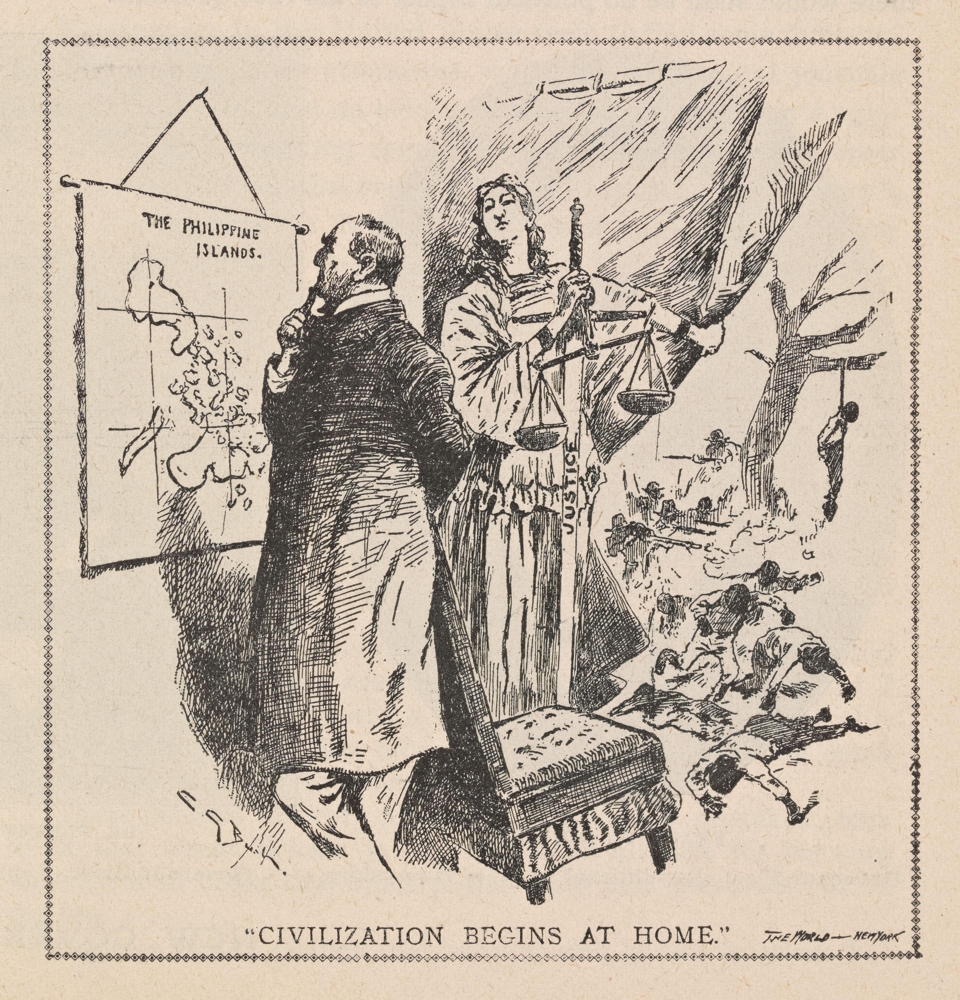
Charles Green Bush: “Civilization begins at home.” (11-26-1898)
General Research Division, The New York Public Library. (1898 - 1938). “Civilization begins at home.” Retrieved from (https://digitalcollections.nypl.org/items/baced180-c607-012f-777f-58d385a7bc34)
——
Dooming
“Dooming seems to inevitably become self-fulfilling.”
This Unscrolling Story reports on the ever-burgeoning Dooming industry, seemingly the only part of our economy thriving under this administration that steadfastly refuses to administer anything.
I’ve watched a thriving Doom Industry grow alongside the internet, where rumor, innuendo, and partisan misinformation—especially from conservative media—have turned ordinary social media use into nonstop doomposting and doomscrolling. Platforms like X and Trump’s Truth Social pump out lies and conspiracies that dominate the tone of online communication, making it feel like we’re inevitably headed for disaster.
Even though scrolling could, in theory, be neutral, the constant flood of apocalyptic content traps me in a doom loop where simply checking in leaves me feeling anxious and hopeless. It’s getting harder to see anything positive online or to justify trying to spread joy when the medium itself feels like a killjoy. I say I want to “unscroll” and step back, and I long for a virtual world where I can safely connect with others without being hammered by doomsaying that risks becoming self-fulfilling.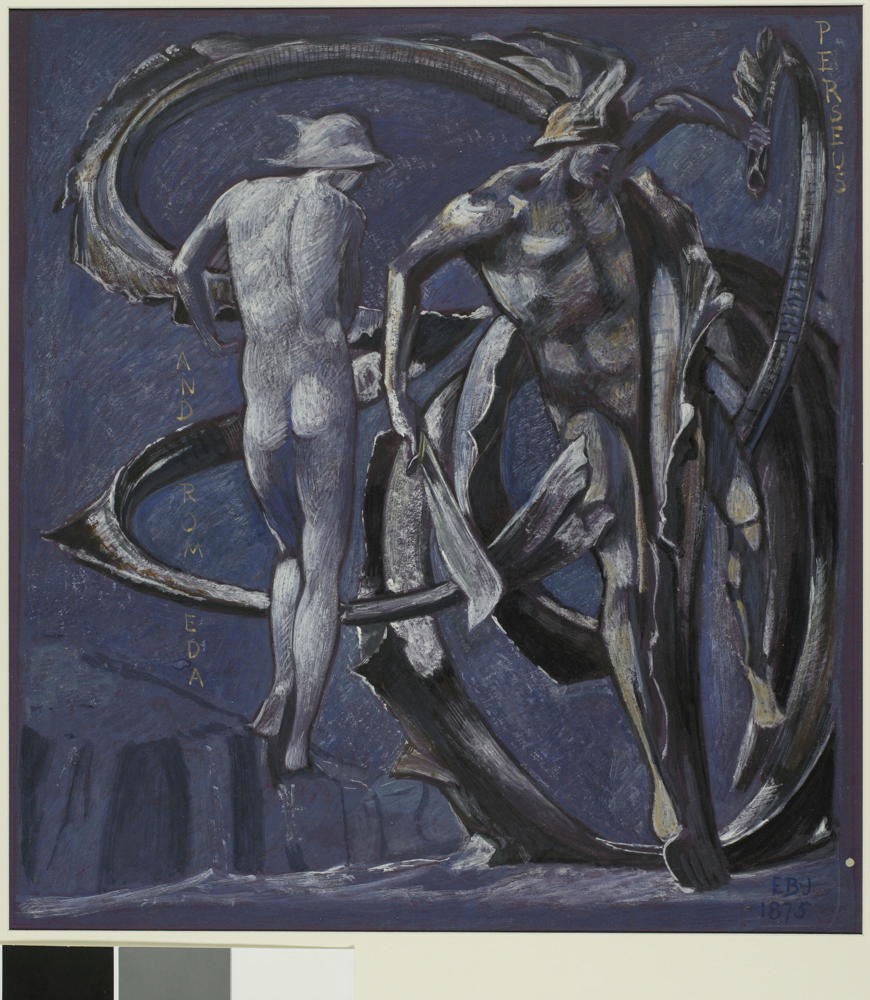
Sir Edward Burne-Jones: Perseus and Andromeda, study for The Doom Fulfilled (1875)
——
Civil-Liability
“Stay tuned. We all might end up on the payday side of some future class action.”
This Unscrolling Story reports on what might mark the start of a new social media era, with a Civil Liability suit going to court in California. Will Zuckerberg ultimately go the way of Big Tobacco?
I’m watching what could be a turning point for social media: a young woman, who started using major platforms as a child, is suing tech giants, claiming their apps addicted her and caused severe mental health and body-image problems. Her case is being framed like the Big Tobacco lawsuits, with internal documents suggesting companies knew their products were harmful and addictive for kids but pushed them anyway. Some platforms have already settled, while others hide behind Section 230.
Schools, governments, and even my granddaughter’s district are responding with restrictions and potential lawsuits of their own. I’m struck by how children already know terms like “body dysmorphia,” while the platforms insist their products aren’t harmful—despite evidence to the contrary.
I can’t quite picture what life after addictive social media might look like, but I’m reminded of how radically smoking changed once courts held tobacco companies liable. If juries start awarding big damages here, our relationship with social media—and the products themselves—could shift just as dramatically. Part of me hopes we might one day be ex-scrollers, more reflective and less compulsively distracted, if cases like K.G.M.’s really gain traction. 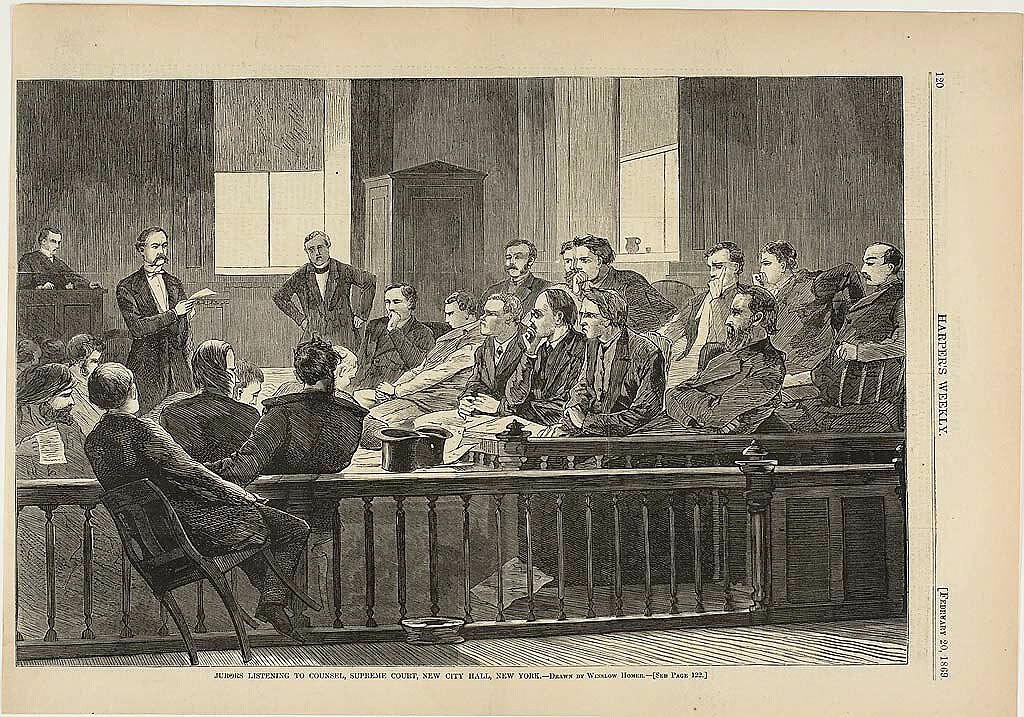
Winslow Homer: Jurors Listening to Counsel, Supreme Court, New City Hall, New York (published February 20, 1869)
——
I Enjoy Being Suprised
As winter descended into parts of this country more accustomed to spring in January, my corner continued to experience drought and spring-like weather. Roses and magnolias started budding before experiencing anything even distantly resembling a hard freeze. This world has proven herself more fickle than anyone imagined, threatening to deny simple water to a small, beautiful valley completely dependent upon snowfall. Aren’t we all dependent upon some sort of snowfall? We thrive on undeserved gifts. We live as what the Bible called birds of the field. We thrive on the unlikely, sometimes on the utterly impossible. We die that way, too, and incorrectly anticipate much more than we ever improperly project. We imagine the end of worlds with which we’re not yet fully acquainted. We fear what we likely won’t sense, even in the unlikely event that the worst happens. These experiences might argue for something resembling courage, but more likely amount to innocence. Not one of us has ever proven to be omniscient, though our social media seems to insist that some of us can predict what has never yet happened before. What’s the solution? Someone, please, save us from seeking solutions! We’re more than adequately prepared, like those proverbial birds of the field, to adapt to whatever whims nature inflicts. I wish I could know what comes next until I more deeply consider how much I enjoy being surprised.
I employed Grammarly, a commercial AI-powered text editor, to create the above story summaries, prompting with: “Please briefly summarize this story in the first person while retaining the original voice.” I manually copy-edited each result.
©2026 by David A. Schmaltz - all rights reserved
Good For A Goose

Comeuppance (31)
Decency (90)
Decency Unscrolling (1)
EndDays (92)
Exiled (90)
Fambly (93)
FollowingChapters (93)
Grace (92)
Humor (2)
iAlogue (1)
Letters to the Editor (1)
NextWorld (91)
Personal (18)
Prosperity (94)
Steam Festival (4)
Unscrolling (89)
Vaporized (6)
Work (16)
September 2026
August 2026
July 2026
June 2026
May 2026
April 2026
March 2026
February 2026
January 2026
December 2025
November 2025
October 2025
September 2025
August 2025
July 2025
June 2025
May 2025
April 2025
March 2025
February 2025
January 2025
December 2024
November 2024
October 2024
September 2024
August 2024
July 2024
June 2024
May 2024
April 2024
March 2024
November 2006
October 2006
September 2006
August 2006
July 2006
June 2006
May 2006
April 2006
March 2006
February 2006
January 2006