AayEye
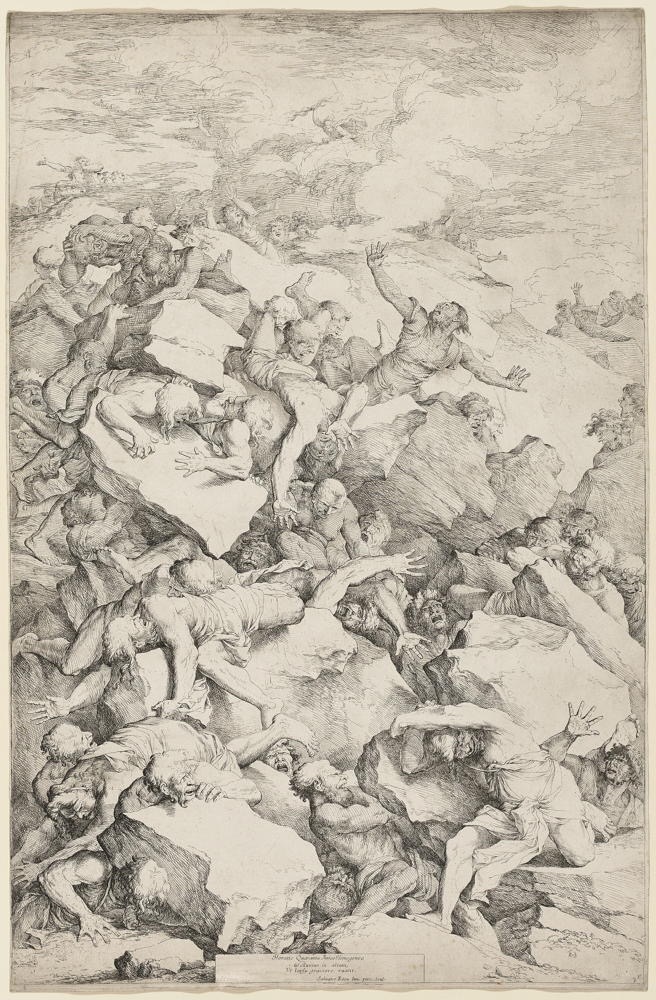
Salvator Rosa: The Fall of the Giants (1663)
"We're stuck in some middle."
The artificial seems to underpin much of what passes for Social Media, most prominently, the curiosity called Artificial Intelligence, or AayEye. As a concept, AayEye has been attracting interest since nobody remembers when, with perhaps more insistence that it always was and still remains impossible because we believe intelligence to be a solely human capability. Some controversy seems understandable, though, because as machines have acquired abilities that used to be considered evidence of intelligence, those abilities have been removed from the list of evidence of intelligence, if only because the very fact that a machine can perform them must mean by definition that they cannot be evidence of intelligence. Our definition of intelligence has perhaps been the greatest change brought about by advances in AayEye.
We seem to better understand what intelligence isn’t than whatever it might actually be. We would prefer sentient machines, even though we can’t quite agree on what constitutes sentience. Even human intelligence doesn’t seem to be the property of any single individual, though some people sure seem to have more of it than others do. Nobody seems capable of outthinking a group of people. Of course, no single individual has proven capable of being stupider than some groups of people, either. Some insist that intelligence at least partially exists only within specific contexts, as exhibited by the apparent differences between ‘library smart’ and ‘auto shop smart.’ Some even argue that intelligence exists beyond the brain, that muscles and molecules exhibit kinds of intelligence, too.
In the early twentieth century, a gym teacher and amateur horse trainer exhibited a remarkable horse he called Clever Hans. Hans appeared to be able to count, perform mathematics, speak German, and perform several other activities usually associated only with human intelligence. After his owner died, a commission was mustered to consider whether Hans was truly as intelligent as he seemed or if the owner had somehow cued him into correct answers. Interestingly, Hans continued his remarkable performances without his original owner, but his success evaporated when he wore blinders. The commission concluded that Hans had been especially gifted at reading cues so subtle that not even his owner likely knew he was passing tells. The Clever Hans Effect has become a part of AayEyE research, too, as models have become so massive that influences between various variables become untraceable.
What better facility to produce Deepfakes than an artificial intelligence? I’ve already concluded that the usual Social Media base isn’t biased toward authenticity, but quite the opposite. Its authors retain the desire to appear credible, then perhaps artificial truths better serve the underlying purpose of encouraging engagement. AayEye queries can sure seem prescient, and no amount of argument to the contrary can really blunt the satisfying sensation of having one’s mind read, even if it’s Clever Hans reading it. There might be as many kinds of intelligence as there are artifices, which might explain why the very meaning of the term intelligence continues to evolve as our machines seem to grow smarter. We probably are in the business of out-smarting each other, and I can’t convincingly argue that this won’t ultimately turn out to be a very good thing, indeed. Intelligence might be the only commodity other than artificiality capable of simultaneously being both too much and too little. We’re stuck in some middle.
©2026 by David A. Schmaltz - all rights reserved

Good For A Goose

Comeuppance (31)
Decency (90)
Decency Unscrolling (1)
EndDays (92)
Exiled (90)
Fambly (93)
FollowingChapters (93)
Grace (92)
Humor (2)
iAlogue (1)
Letters to the Editor (1)
NextWorld (91)
Personal (18)
Prosperity (94)
Steam Festival (4)
Unscrolling (89)
Vaporized (6)
Work (16)
September 2026
August 2026
July 2026
June 2026
May 2026
April 2026
March 2026
February 2026
January 2026
December 2025
November 2025
October 2025
September 2025
August 2025
July 2025
June 2025
May 2025
April 2025
March 2025
February 2025
January 2025
December 2024
November 2024
October 2024
September 2024
August 2024
July 2024
June 2024
May 2024
April 2024
March 2024
November 2006
October 2006
September 2006
August 2006
July 2006
June 2006
May 2006
April 2006
March 2006
February 2006
January 2006