Affording
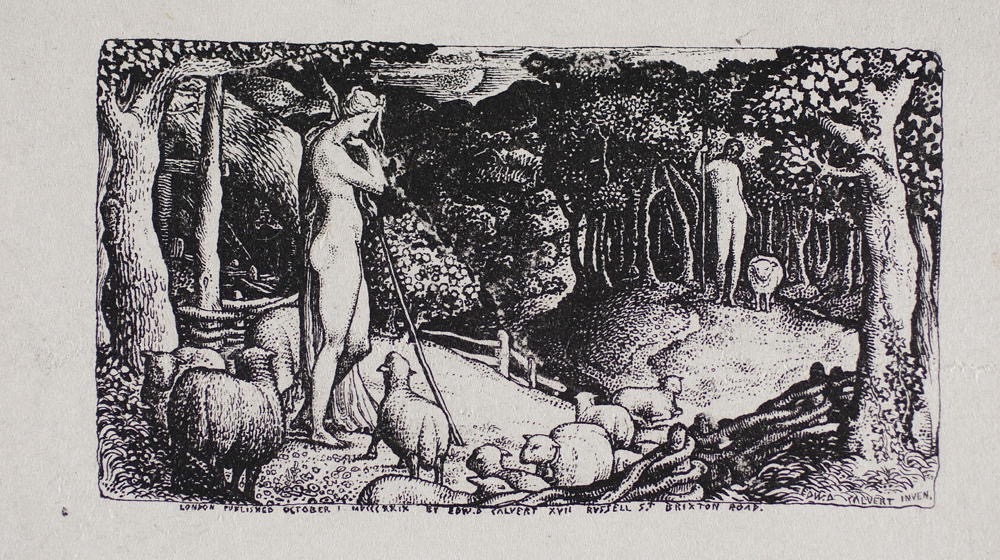
Edward Calvert
Ideal Pastoral Life
(1845)
"It threatens the notion that anyone might be an island unto themselves…"
Having grown up in a family with five kids, I learned early and often what we could not afford. I developed a mindset, a sort of radar capable of discerning whether or not I could afford something by coming into proximity with it, or by just imagining it. I could mostly tell by looking. I constructed a partitioned world, one composed of stuff I could afford and one with stuff I couldn’t. The world I could not afford initially seemed alluring and vast. The one I believed I could afford seemed dank and narrow in comparison. Over time, I learned how to want what I could afford, and, over even more time, grew snobbish about what I felt I could not afford. I first felt excluded before I came to feel somehow special because of my limitations. I experienced few disappointments or discouragements because I came to not want what I so obviously couldn’t have, anyway. Rather than grow up with anything like a vast sense of possibility, I inherited more of a certainty. I never really wanted whatever my circumstances denied me, or whatever my mindset denied myself.
Prosperity never seemed achievable, so it fell well within the territory denied me. I felt that I adapted well. I learned to live both lean and rough, and felt them fine lifestyles. I had no experience with feeling prosperous, so Prosperity seemed like an imaginary reality, anyway, and certainly not anything resembling a personally achievable state. I felt that I had been born too late to satisfy the probable preconditions. College had not, after all, fallen into the area that held what I felt I could afford. I worked casual labor, accepting that I could perform manual labor and would forever be incapable of earning a living by any other means, except perhaps by writing and performing my songs. The barriers to entry to becoming a songwriter and singer were minimal. I just needed to write songs and sing them, something I had been able to afford to do since I’d been in grade school. My first career was completely defined by what I felt I could afford at the time.
I was not chasing down some dream when I chose to become a singer/songwriter. I was merely accepting what I felt I could afford. I accepted the humilities such a choice naturally demanded of me, for what alternative did I possess? I couldn’t afford better. I accepted the hand-to-mouth and, often, the hand-to-forehead existence my chosen profession naturally afforded me, for I had been raised well, by masters who had honed their skills to perfection in the lap of The Great Depression. I had it very good in comparison. It wasn’t until my to-be first wife, Betsy, graduated from university and took her first professional job that I began to live in proximity to what I later learned might represent Prosperity. We ate out occasionally. We had a car. I took a job washing pots in the basement of what I thought to be a snazzy hotel. These proximities to Prosperity started influencing me.
I came to believe that I could afford college. I even found a part-time professional job before graduation that led me into the start of a white-collar career. The universe of what I felt I could afford expanded, the earliest years, not necessarily withstanding, and my boundaries progressively enlarged, eventually exponentially, and I began to inhabit a universe with far fewer boundaries than the one I’d been born into. Prosperity allowed me to engage in at first tentative and, later, more whole-hearted Affording behaviors. No longer pinching pennies, I expanded my boundaries or, my redrawn boundaries expanded me. I started possessing greater possibilities. I still parse my personal universe into what I feel I can afford and what I feel I can’t, and I rely upon The Muse to jangle me into a reality more like hers than mine, but I feel less constrained.
Prosperity, even when it’s no more than a prosperous mindset, enables Affording behaviors. One can become a net contributor rather than merely a consumer. One can participate rather than just watch from the sidelines. It enables fuller engagement. It’s not necessarily that anyone gets to purchase entry into this orthogonal universe. It’s more than one comes to allow themself to feel as if they might belong there. Not excluded, but a member, more or less in decent standing; one becomes a peer. This role seems separate and distinct from the wealthy nobility, who seem to belong to a whole other and even more separate society than I first learned to belong to. I speak of a polity, not one defined by their relative poverty, by what they can’t or don’t possess, but by their relative potential, their sense of possibility. Prosperity expands one’s sense of potential. It enables expansive engagement. It encourages broader connections. It threatens the notion that anyone might be an island unto themselves, unable to afford to join in the play.
©2026 by David A. Schmaltz - all rights reserved

Good For A Goose

Comeuppance (9)
Decency (90)
Decency Unscrolling (1)
EndDays (92)
Exiled (90)
Fambly (93)
FollowingChapters (93)
Grace (92)
Humor (2)
iAlogue (1)
Letters to the Editor (1)
NextWorld (91)
Personal (18)
Prosperity (94)
Steam Festival (4)
Unscrolling (89)
Vaporized (6)
Work (16)
September 2026
August 2026
July 2026
June 2026
May 2026
April 2026
March 2026
February 2026
January 2026
December 2025
November 2025
October 2025
September 2025
August 2025
July 2025
June 2025
May 2025
April 2025
March 2025
February 2025
January 2025
December 2024
November 2024
October 2024
September 2024
August 2024
July 2024
June 2024
May 2024
April 2024
March 2024
November 2006
October 2006
September 2006
August 2006
July 2006
June 2006
May 2006
April 2006
March 2006
February 2006
January 2006