DickTracy
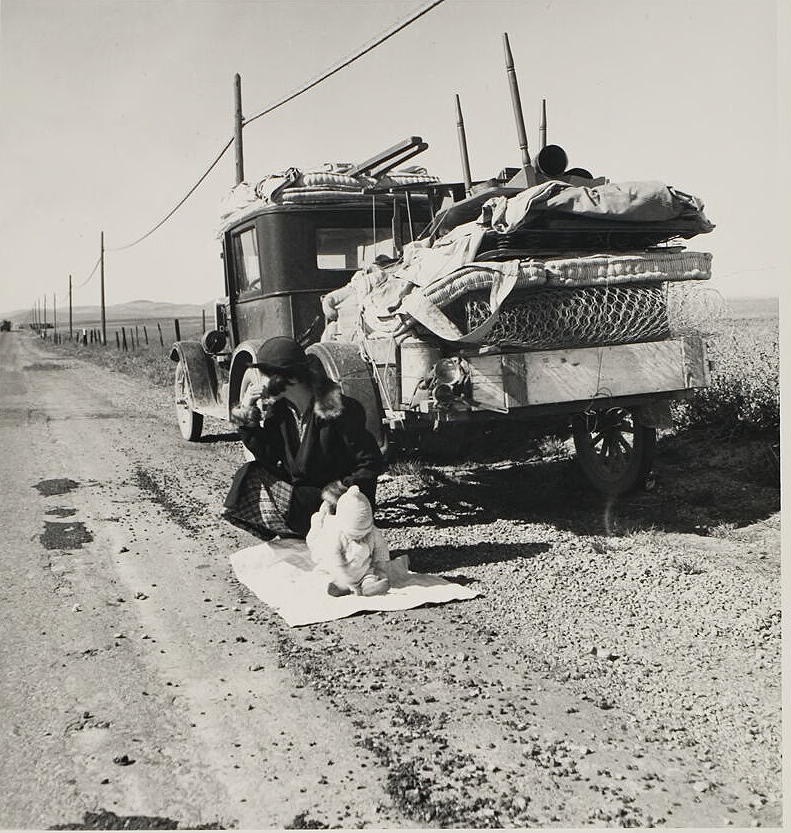
Dorothea Lange: Tracy (vicinity), California. Missouri family of five (1937)
"The human condition remains, perhaps improved but also little changed."
I remain amazed that my future has actually arrived. Dick Tracy’s two-way wrist radio, later TV, has caught up to me. It no longer qualifies as a distant fantasy, but my everyday lived reality. How could this be? Way back in the Dirty Thirties, when Chester Gould started creating Dick Tracy comics, long before I was born, my day-to-day existence today wasn’t even focused fantasy yet. Between Tracy and Buck Rogers, futures were endlessly projected, though those anticipations would prove to be far too modest to accurately represent the eventual actual technological progress, though two-way wrist radios contributed little to actual human progress. I’d contend that we seem little different, even if our lives today might not seem nearly as short and brutish. We remain contentious, maybe more so.
A careful reader of Dick Tracy would catch the character’s unshakeable faith in human goodness, though Tracy would often have to resort to violence to achieve a laudable end. His villains were tenacious, dedicated to the opposite of what he seemed to be committed to protecting. He was continually challenged and never managed to retire, however many evil-doers he retired. Instant communication promised more than it ultimately delivered, precisely like Social Media. Precisely like technology has always done, and probably always will do … or not do.
Much of my personal disappointment with Social Media lies in what I’d imagined it might become. It didn’t become what I’d imagined, so I seem to have caused my own disappointment. Had I imagined the future Social Media has brought, I wouldn’t feel abandoned or lost with what we have, and I had access to enough historical information to reach a more realistic conclusion about my future then, I just didn’t reach that conclusion. I chose delusion instead, and pinned my hopes on something different than any future has ever managed to deliver.
Part of imagining probably naturally involves dreaming away the difficulties of daily living. I certainly subscribe to transformative fantasies much more often than I engage in projecting probable realities. If the future isn’t going to utterly transform, my reasoning seems to go, why bother constructing a future at all? If that two-way wrist radio I imagine won’t do a whole lot more than enable simple two-way communication, what’s the attraction? The marginal improvement that more convenient distance communication might provide seems unlikely to change the content of any message or transform the life of any odd communicator. It’s a step change without transforming significance. Even the later addition of television communication added little to the lived experience of any detective. The world remains indifferent, as do the criminals. What fundamental difficulty of human existence had been technologically resolved?
Not every technology transforms. Some don’t even hardly improve. Even those that utterly transform often achieve that end invisibly, over lengthy stretches of time, so that we hardly notice any difference other than, curiously, an increasing disappointment when it arrives. After decades anticipating technological salvation, I’ve grown somewhat jaded with what has passed for realization. Even if we could somehow magically eliminate all the many negative externalities presently associated with Social Media, I struggle to imagine how that might change the way we live or the way we will undoubtedly continue to relate with each other then. The difficulties we face were never merely difficult, but genuinely hard, likely impossible. The human condition remains, perhaps improved but also little changed; change bringing little difference.
©2026 by David A. Schmaltz - all rights reserved

Good For A Goose

Comeuppance (9)
Decency (90)
Decency Unscrolling (1)
EndDays (92)
Exiled (90)
Fambly (93)
FollowingChapters (93)
Grace (92)
Humor (2)
iAlogue (1)
Letters to the Editor (1)
NextWorld (91)
Personal (18)
Prosperity (94)
Steam Festival (4)
Unscrolling (89)
Vaporized (6)
Work (16)
September 2026
August 2026
July 2026
June 2026
May 2026
April 2026
March 2026
February 2026
January 2026
December 2025
November 2025
October 2025
September 2025
August 2025
July 2025
June 2025
May 2025
April 2025
March 2025
February 2025
January 2025
December 2024
November 2024
October 2024
September 2024
August 2024
July 2024
June 2024
May 2024
April 2024
March 2024
November 2006
October 2006
September 2006
August 2006
July 2006
June 2006
May 2006
April 2006
March 2006
February 2006
January 2006