Episidiodic
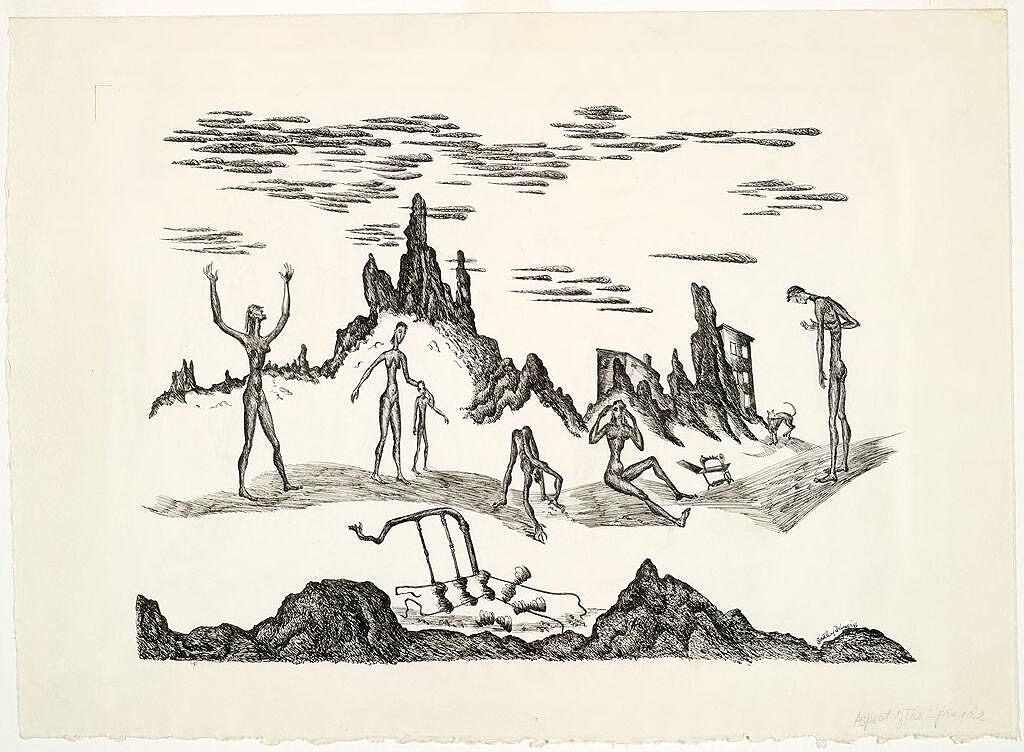
Dorothy Dehner: Damnation Series: Aspect of the Episode (1946)
"This creates a different context for living than I was expecting."
Either life mirrors art or art mirrors life. It might not matter which. I believe that both occur so that it might prove impossible to ever tell whether the chicken or the egg arrived first. Life certainly imitates art; otherwise, fashion would not influence any of us. It also seems obvious that art at least attempts to imitate art, however imperfectly. It used to be, or it certainly used to seem as though I lived within a rather grand narrative arc. I lived in the middle of some greater adventure, definitely heading somewhere, making history along the way. These days, my life seems less cinematographic, hardly a short story. I live rather like a Social Media stream, in a series of unrelated episodes without much in the way of any grander plotline.
Some thinkers have ascribed this sense, increasingly common, to simple aging. Once achieving some uncertain age, most of the striving that dominated younger ages has been resolved. One no longer aches to know who they are or what they will become, for those great mysteries were solved. Likewise, the passion and drama that commonly accompany such striving understandably settle down as one settles into their life well won. Then, a broader scope might well seem to be missing, and one sets their compass on narrower horizons. A certain cadence replaces grand adventure, and one focuses upon smaller scales. This can bring nostalgia for the grand adventure without necessarily degrading the present experience. Short stories suffice after one loses their epic novel attention span.
Serializations first became popular with the expanding popular press in the first half of the nineteenth century. Before then, one might read books, each of which necessarily carried more than a narrow perspective. They featured chapters that would build to complete some larger concepts than could be compressed into a handful of pages. Serializations enabled stories to dribble out a little over time. They necessarily separated their components into nibbles rather than meals. Much time might separate installments, rendering each piece both incomplete and distinct. Given the distribution difficulties of the times, any piece might be the last, so incompleteness became a feature of that form of entertainment. One left partially requited, with the desire for more, and wondering where the narrative might lead next. Anticipation became the expected product of the diversion rather than resolution.
Electronic media amplified the episodic nature of those earlier serializations. Their entertainment was intended to accompany rather than dominate the audience’s attention. It fostered a more casual relationship with its consumer. Before streaming, though, serializations were tightly timebound. If you missed the broadcast window, you lost the continuity radio and early television relied upon. While books and magazines could be consumed at the audience’s leisure, radio and television came with a regulating mechanism, or they did until streaming appeared over the horizon.
Streaming unshackled serials from time. What might have been a vast wasteland of content before streaming became trackless, featuring Do It Yourself schedules. Whatever regularity our radios and TVs used to provide, which served as an accompaniment to individual narrative arc, evaporated and left one drifting in purely episodic space. The urgency one once felt when trying to make it home in time to watch something important, a sprint that added to the narrative drama of existence, disappeared, leaving relative nothingness in its place. Last night, The Muse and I watched the 4th installment of a streaming television series only to learn that the subsequent installment wouldn’t be released until the following week. In the old days, we wouldn’t have expected otherwise, but streaming has rendered us dependent upon controlling our episodes in place of maintaining any broader narrative arc. We seem to be comprised now of eternally partially completed stories, forever unresolved. This creates a different context for living than I was expecting. (More coming on this subject.)
©2026 by David A. Schmaltz - all rights reserved

Good For A Goose

Comeuppance (31)
Decency (90)
Decency Unscrolling (1)
EndDays (92)
Exiled (90)
Fambly (93)
FollowingChapters (93)
Grace (92)
Humor (2)
iAlogue (1)
Letters to the Editor (1)
NextWorld (91)
Personal (18)
Prosperity (94)
Steam Festival (4)
Unscrolling (89)
Vaporized (6)
Work (16)
September 2026
August 2026
July 2026
June 2026
May 2026
April 2026
March 2026
February 2026
January 2026
December 2025
November 2025
October 2025
September 2025
August 2025
July 2025
June 2025
May 2025
April 2025
March 2025
February 2025
January 2025
December 2024
November 2024
October 2024
September 2024
August 2024
July 2024
June 2024
May 2024
April 2024
March 2024
November 2006
October 2006
September 2006
August 2006
July 2006
June 2006
May 2006
April 2006
March 2006
February 2006
January 2006