Opting
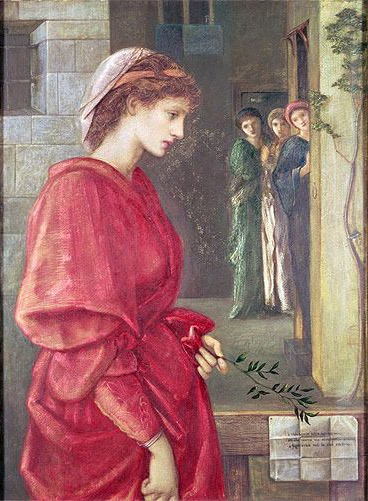
Sir Edward Coley Burne-Jones:
Beatrice: Io vidi donne co' la donna mia
(1870)
"We can't help but own our deliberate decision forever going forward."
The challenge for me comes from a continuing feeling that I can only observe, that a fool’s driving, and I have no control. If this feeling proves to be true, I’m left with few options. I can like it or lump it, and there’s absolutely nothing for me to like about those choices. Yes, a madman’s in charge, but I might usefully wonder what that madman might actually be in charge of. Yes, he formally controls our government, but he’s proven beyond even unreasonable doubts that he seems to be incapable of controlling himself, let alone anything as complicated as a government. So, essentially nobody’s in charge, other than a few uncoordinated, clueless actors. It’s as if randomness has taken over, with entropy playing the part of our guiding light. Corruption seems to have become the common denominator, that, and cruelty, the two horsemen of an inevitably most inept form of governance. Yes, they’re collectively stupid. Yes, some of their more short-sighted interventions do trickle down and into my shoes, but mostly their actions resolve into nothing more than just so many distant machinations, distractions, and odd attempts that resolve into nothingness.
Besides, I have options. I firmly believe, by which I mean, without the benefit of definitive proof, that I always have options. I might be utterly incapable of influencing the madman who fancies himself driving, but I can always influence my response to the madness. I can, for the most part, choose who I engage with, and where, and on what terms. I can largely still choose my adversaries and my friends. I retain the power to refuse to engage when I find the offered terms unworkable, though I feel continually goaded into argument and confrontation. Both the loyal and disloyal opposition hold some influence over my decisions, but I largely get to choose when, where, and whether I rise to their invitations. I remain capable of feeling offended, even enraged, but usually retain the ability to decline losing invitations. I said “usually” because, though I know I should be able to choose otherwise, I sometimes feel compelled. I can always (eventually) tell when I’ve felt compelled because I then forfeit most of my options. I rush in as fools have always rushed, and usually leave further humbled.
Last night, a data center opponent asked me where I’d parked my Corvette. I knew what he meant. He can’t seem to believe that The Muse and I didn’t take bribes for The Muse to vote, in her public role as a Port Commissioner, in favor of selling property to Amazon to build a data center on. The opponents have been increasingly vocal as the project moves into permitting and eventual approval. Last night, The Muse convened a presentation titled “Why I Voted For The Data Center” as part of the local Democratic Central Committee meeting. The room was almost standing-room-only, with many dialing in online. In a half hour, she laid out the reasoning behind her decision. Her logic seemed inescapable: a county economy slowly fading after peak wine, with alarming declines in jobs and tax revenues. A data center proposal from a reputable operator, one responsible for a third of the world’s data centers rather than a fly-by-night speculator looking to flip. An enviable environmental record across multiple similar projects, with independently verifiable results. I don’t believe she convinced anyone who attended already convinced the data center was a terrible idea, but her presentation represented a disarmingly honest appraisal of the personal process she followed to reach her public decision.
On Friday night, opponents of our data center will assemble to further organize their actions and recruit new followers. The Muse plans to attend, since it has been advertised as an open and public meeting. She informed the organizer that she planned to be there. I will feel compelled to accompany her. The Muse is playing the wide-open, honest card. She has invited every opponent she’s met to sit down and have a conversation about her decision, about her reasoning, which she’s convinced has been beyond reproach. Not that it hasn’t received more than its share of reproach, though the complaints seem unlikely to disrupt the well-defined, regulated process by which such industrial developments are approved in our state. No one’s permitted, for instance, to disrupt the permitting process without citing a reason with cause. Bad feelings about the developer won’t pass muster as cause. Opponents’ most common response has been, “I don’t believe that,” when The Muse provides some disquieting statement of verifiable fact. The absence of trust in the process might not seem like a choice so much as an imperative from an opponent who knows they hold no substantive complaint.
It seems certain that the data center will be approved. It will be decades before some of The Muse’s assertions about it will be verifiable. She assumes technology will continually improve, enabling Amazon to ultimately achieve its net-zero water-use goal. They’ve been making steady progress on other projects. The economic benefits will predictably trickle in before becoming inexorable, since it will require a decade just to build out the damned thing. By the time it comes fully online, The Muse and I will have become footnotes in the history of this valley. The projected economic salvation will either happen or it won’t. I pray that the social fraying will, over time, start healing itself, though it might not. We stand (or cower) along a leading edge, uncertain of our influence on anybody’s future, including our own. The Muse is Opting to stay open and reveal the details of her reasoning, believing it might help accelerate the healing. She might have rendered herself unelectable by Opting to attempt to make our economy less fragile and more sustainable. Her choice. Only the future will tell whether she succeeded, just as all futures and presents do. Those who can’t imagine us not taking bribes will forever wonder where we parked our utterly imaginary Corvettes. We encountered a fork in the road and took it together, actively Opting rather than becoming victims of a madman’s aimlessness. We can’t help but own our deliberate decision forever going forward.
©2026 by David A. Schmaltz - all rights reserved
Good For A Goose

Comeuppance (31)
Decency (90)
Decency Unscrolling (1)
EndDays (92)
Exiled (90)
Fambly (93)
FollowingChapters (93)
Grace (92)
Humor (2)
iAlogue (1)
Letters to the Editor (1)
NextWorld (91)
Personal (18)
Prosperity (94)
Steam Festival (4)
Unscrolling (89)
Vaporized (6)
Work (16)
September 2026
August 2026
July 2026
June 2026
May 2026
April 2026
March 2026
February 2026
January 2026
December 2025
November 2025
October 2025
September 2025
August 2025
July 2025
June 2025
May 2025
April 2025
March 2025
February 2025
January 2025
December 2024
November 2024
October 2024
September 2024
August 2024
July 2024
June 2024
May 2024
April 2024
March 2024
November 2006
October 2006
September 2006
August 2006
July 2006
June 2006
May 2006
April 2006
March 2006
February 2006
January 2006