Terrorized
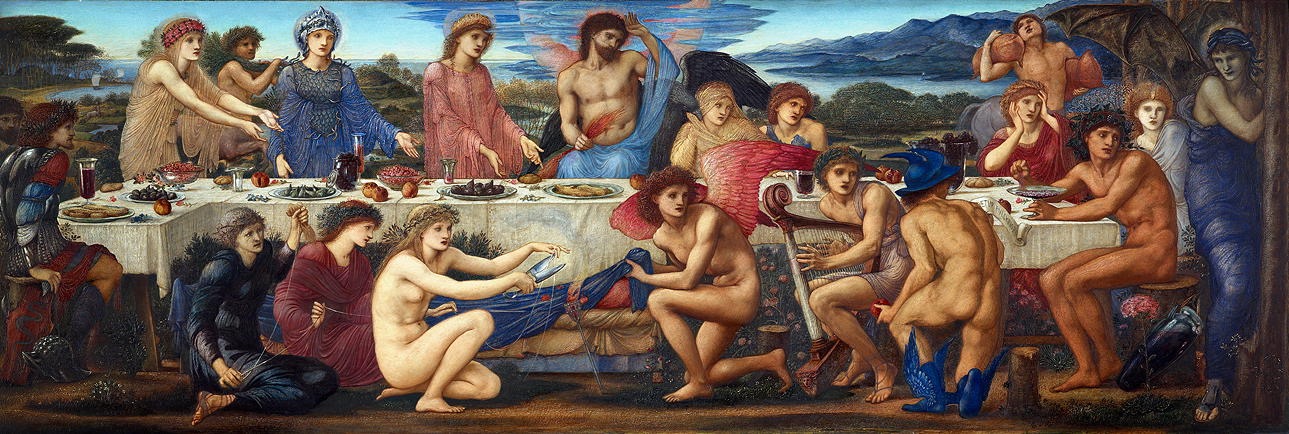
Sir Edward Coley Burne-Jones:
The Feast of Peleus
(between 1872 and 1881)
"Such small incremental improvements, even if only in acknowledgements, often produce great differences."
The Muse and I were invited earlier this Spring to participate in a group focused on trying to compensate for the terrorism our incumbent had been inflicting upon innocent immigrants. This effort would have been unnecessary, just as it had been under every previous administration, but this administration, which never really dedicated itself to competently administering anything, had taken a different tack. It had decided to attempt to send brown people back to what the administration undedicated to actually administering anything imagined might be their family’s country of origin, or, in lieu of that, even some country the brown person had maybe never even heard of before. Their policy had been to rid the country of immigrants, whether or not their legal status suggested they had a legal right to be here. Oh, this administration that couldn’t quite imagine itself administering anything denied those immigrants the due process guaranteed to everyone, even non-citizens, by our foundational Constitution.
Such was the context within which that first meeting, and three subsequent ones since, had taken place, yet that context had never been explicitly mentioned. The organizers of these meetings had reported early on that part of their motivation was that they had family who, in the eyes of those who were color-prejudiced, could be considered brown. Few in the room could claim that their families were any different. I have brown grandchildren and Hmong grand nieces, and we were never what any sentient person could have claimed to have been a white nation. The current administration, which never understood the subtleties of administering anything, has not been in any way subtle when reporting that they believe that this country was founded and built by an exclusively white aristocracy, not at all unlike the long-ago defeated for committing public obscenities and gratefully ill-fated Confederacy. The administration that administers as if it suffers from some serious psychiatric disorder has been explicitly racist in its messaging and its enforcement, so we, citizens, felt forced to organize a spirited defense, though we had never explicitly mentioned our actual underlying shared context.
I sat in last night’s session, wondering if my comments, making our shared context explicit, might be appreciated or misunderstood. The organizers seemed to have been bending over somewhat backward to avoid pointing fingers at any specific political party, for instance, for the circumstances under which we had convened, though blame had to be obvious, especially to those of us unfortunate enough to have somehow imprinted on that regrettable party to which the present administration who had been actively mangling the whole concept of administration since the current incumbent had taken office. I’d noticed that the avowed Republicans among us had been strangely mute, given that they had historically been the vocal majority in this county, and that the few more progressive voices had dominated the proceedings. Was it my imagination, or had Republican representation waned since the initial gathering? I finally raised my hand in frustration.
“We are presently occupied by a hostile and capricious power. Had we not been so occupied, we would have had no reason to gather to try to discover ideas to protect our immigrant family members and neighbors. If you do not feel paranoid, you are not paying close enough attention. I feel scared. I feel terrorized in this present context. Our Federal government is actively waging a war against decency, against you and me and our families, so we should be scared. I am not immune to their terror. Neither is the most powerful of those among us. I do not want to forget that this is the context within which we gather here. I remember the late sixties, when the Federals waged war against decency, and I feel afraid again, like I did then. I feel safer when I’m working together with others who are also terrorized and afraid.” I said something similar to that, committing a very public truth.
I had been ruminating: It has been my impression that this occupying force behaved rather like the Nazis. I know that similarity might have been overplayed in recent years, but the comparison seems inescapable. I remember when the Nazis overran Denmark. They tried their Nazi shenanigans there, but to less effect than they’d enjoyed in other countries they’d occupied. When they demanded that Danish Jews wear stars, every citizen showed up wearing stars. When threatened with punishment, the Danes continued wearing their stars. Those citizens might not have effected the terror those Nazis ultimately inflicted, but they had stood up and gotten themselves counted. I wanted to stand up and get myself counted, too. I want the decent people to be so insistent that the occupying indecency cannot belligerently terrorize. I want them to mistake me for an immigrant, like my not-so-distant forebears were immigrants. Count me as a Jew, too, you fucking Nazis!
I sat back down. Those at my table mouthed “Thank you for saying that.” And little more was mentioned on that subject for the balance of the meeting, though a few people referred back to that context I’d finally made explicit. How often, I wondered, do I move through this world without explicitly acknowledging the context with which I might be grappling? So focused upon content that I tend to forget where my real leverage so often lies. Especially when a context sucks, rendering it more explicit can do much to render it relatively toothless. Without such acknowledgment, context seems to hold me in invisible clutches, for context only rarely renders itself explicit. It must be my job to name that tune insistently, earworming its way into and through my sanity then. Once named, a context becomes somehow less onerous. Nothing might have changed, except that something significant shifted. The insidious implicit no longer reigns. Once named, it forfeits whatever authority it previously carried.
Making the implicit explicit rarely evaporates any implicit, it just renders it more visible and therefore, strangely more copeable with. Acknowledging how much something sucks rarely stops the sucking; it merely renders it less surprising. I can more reasonably anticipate the direction from which the next insult might be arriving. I admit that might not seem like much of a defense, but it might represent the very best offense possible, given the sucky conditions. Such small incremental improvements, even if only in acknowledgments, often produce great differences.
©2026 by David A. Schmaltz - all rights reserved

Good For A Goose

Comeuppance (31)
Decency (90)
Decency Unscrolling (1)
EndDays (92)
Exiled (90)
Fambly (93)
FollowingChapters (93)
Grace (92)
Humor (2)
iAlogue (1)
Letters to the Editor (1)
NextWorld (91)
Personal (18)
Prosperity (94)
Steam Festival (4)
Unscrolling (89)
Vaporized (6)
Work (16)
September 2026
August 2026
July 2026
June 2026
May 2026
April 2026
March 2026
February 2026
January 2026
December 2025
November 2025
October 2025
September 2025
August 2025
July 2025
June 2025
May 2025
April 2025
March 2025
February 2025
January 2025
December 2024
November 2024
October 2024
September 2024
August 2024
July 2024
June 2024
May 2024
April 2024
March 2024
November 2006
October 2006
September 2006
August 2006
July 2006
June 2006
May 2006
April 2006
March 2006
February 2006
January 2006