TheHeap
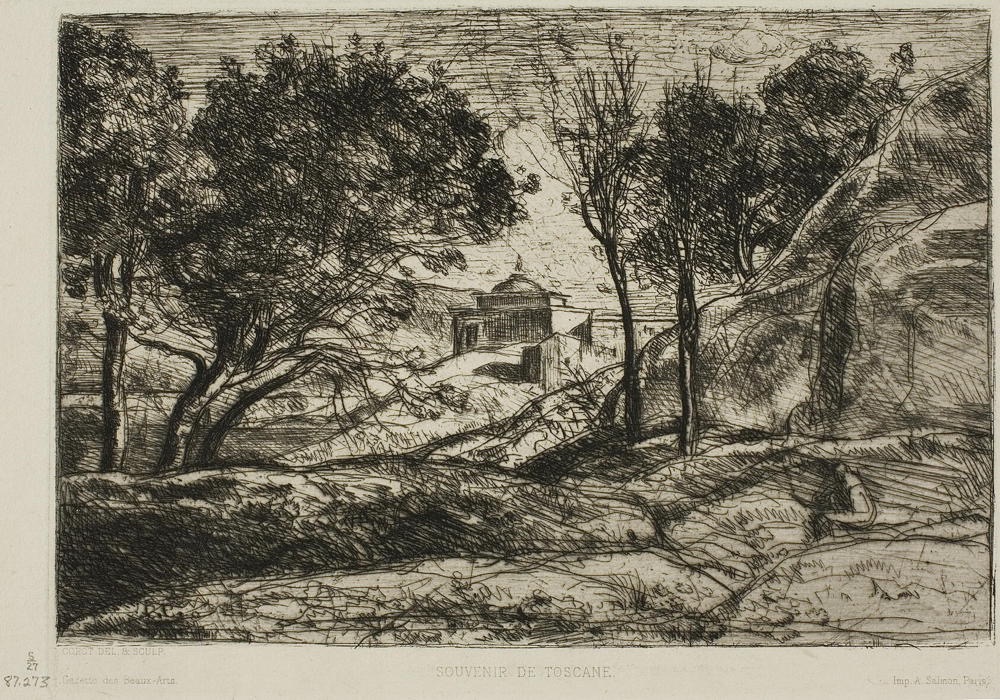
Jean-Baptiste-Camille Corot
Souvenir of Tuscany
(1845)
"If that's not an accurate portrait of Prosperity, I suppose nothing is, or could be, either."
When I look for external evidence of my Prosperity, I migrate toward what might appear to be a remote and under-appreciated corner of the yard. I do not dwell on the fine front porch we so recently remodeled or the lawn and gardens, though these certainly do seem to exude Prosperity’s usual and expected context markers. No, I head back behind the garage, beneath where the ornamental Elderberry bush is busily out-growing its assigned space, where my compost heap stands. Of all the improvements The Muse and I have made in the quarter century since we bought this place, my composter stands as the one of which I’m proudest. I swell with appreciation and, yes, pride every time my eye drifts across its now slightly deteriorating frame. I cut those boards. I fastened them together. The chicken wire that originally separated its compartments long ago corroded away, replaced by jute coffee bags until the Red Wiggler composting worms had their way with them. Now, the three sections get by with nothing more than seasonal boards separating them when I’m introducing autumn’s chopped leaves or summer’s apricot culls.
The rest of the yard holds clear evidence of that composter’s existence. Each bed features hollowed-out apricot pits and bits of other material reduced to soil amendment over the years. Some beds are more than fifty percent compost and should never need supplemental fertilizing for the next hundred years. Others, I have my eyes on, plotting their introduction to this Villa’s proudest tradition. I want every bed to feature friable soil, the kind that anybody can just grab a handful of and squeeze. I have been on a mission to eliminate hardpan and stones from the property, and I have largely been wildly successful. In front of the composter lies a generation of stones removed from their former homes in every corner of this place. It has been my mission and my sacred duty to dutifully remove every stone as I have discovered it, and accumulate them as the freeform pavement constituting the foreground to my Cadillac of a composter.
I am not naturally handy, a negative capability I probably inherited from my father. I am sometimes game to try to construct something, but rarely for pleasure, and even more rarely successfully. I have a long and spotted history of starting projects that either never end or end unfinished. I often find myself stymied near the middle of some what was supposed to have been simple construction, only to outrun my innate capabilities there. Often, the product proves so eccentric that not even The Muse, who was always at least five times the mechanic I ever was, could resolve the resulting mess. My workbenches resemble my desk top, all piled high with remnants from innumerable disremembered efforts. I once prided myself on my ability to immediately lay my finger on anything I was searching for in those tangles, but I no longer sing my own praises in this respect. Most of my possessions remain securely lost forever right under my nose. I know more about security, apparently, than does the freakin’ CIA.
This explains why I feel such pride and that swelling sense of Prosperity whenever I spot my composter. It stands, forever, apparently, as clear evidence that I at least once upon a time, if no other, completed something I’d envisioned, a thing that worked even better than expected. This would be the legacy I’d choose for this world to remember me by: that I successfully recycled every kitchen scrap into ultimate utility, in what has turned out to be an infinity machine. I put in spent stuff and transform it into everlasting, eternal elements. Compost never disappears. It will still be discernible there in a hundred years, thanks to me and my usual ten thumbs. Perhaps those thumbs are green.
I can see some improvements I might make if I ever get around to making them. They’re not really necessaries, merely nice-to-haves. I could replace that original chicken wire with fresh chicken wire. I could even pop for the vinyl-coated stuff that wouldn’t corrode. That would make my machine more formal again, but, again, remains completely optional. I figure that a composter, like Prosperity, is rightfully an eternally unfinished improvement, capable of contributing plenty even though it’s eternally only partially completed. It still amounts to an accomplishment. The compost it produces isn’t a finished product, either. It awaits some soil and roots, some moisture and sun, and time to improve whatever it comes into contact with. If that’s not an accurate portrait of Prosperity, I suppose nothing is, or could be, either.
©2026 by David A. Schmaltz - all rights reserved
Good For A Goose

Comeuppance (9)
Decency (90)
Decency Unscrolling (1)
EndDays (92)
Exiled (90)
Fambly (93)
FollowingChapters (93)
Grace (92)
Humor (2)
iAlogue (1)
Letters to the Editor (1)
NextWorld (91)
Personal (18)
Prosperity (94)
Steam Festival (4)
Unscrolling (89)
Vaporized (6)
Work (16)
September 2026
August 2026
July 2026
June 2026
May 2026
April 2026
March 2026
February 2026
January 2026
December 2025
November 2025
October 2025
September 2025
August 2025
July 2025
June 2025
May 2025
April 2025
March 2025
February 2025
January 2025
December 2024
November 2024
October 2024
September 2024
August 2024
July 2024
June 2024
May 2024
April 2024
March 2024
November 2006
October 2006
September 2006
August 2006
July 2006
June 2006
May 2006
April 2006
March 2006
February 2006
January 2006