VastWasteland
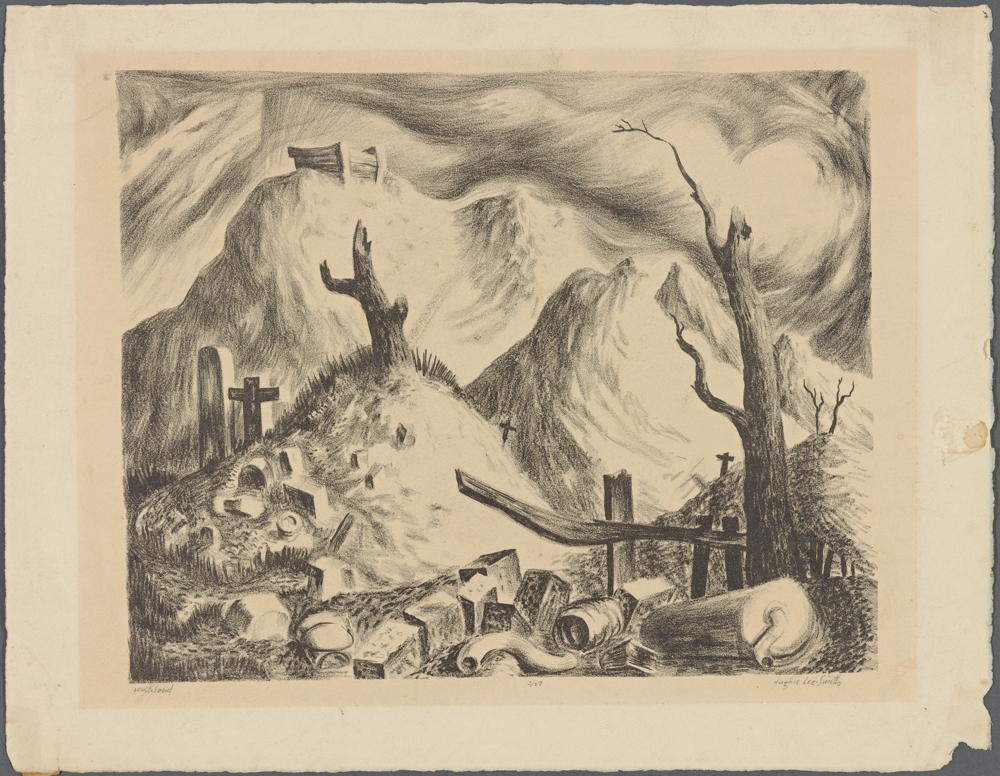
Hughie Lee-Smith: Wasteland
Works Progress Administration (WPA) Art
United States. Works Progress Administration (Sponsor)
(1939)
Schomburg Center for Research in Black Culture, Art and Artifacts Division, The New York Public Library. "Wasteland" New York Public Library Digital Collections. Accessed February 23, 2026. (https://digitalcollections.nypl.org/items/ccb33860-fe37-0131-598a-58d385a7b928)
“…probably damned whatever we choose to log into.”
The great American public has always strongly preferred VastWastelands as our sources of entertainment. We have never been all that high-minded. Sure, there have always been pockets of actual culture lurking around the margins of our society, but we’ve only rarely allowed that culture to dominate our leisure. In Frontier America, the tavern attracted more patrons than any theater, fistfights always had more witnesses than did concerts, and even public hangings were generally judged superior uses of time to any alternative. It was no surprise when the marvel of broadcast radio, then television, quickly turned into just another VastWasteland. We should express no less surprise as we realize that we’ve just gone and done it to ourselves again. Social media might be best understood and acknowledged to be the latest instantiation of humanity’s longest-lasting tradition, for we have also transformed what might have been the highest of high culture into another rather run-of-the-mill VastWasteland.
I won’t bemoan this outcome, but merely acknowledge it. Who would we have had to collectively become to create anything other than another in an infinite series of VastWastelands? Social media has and has had its higher points, but each attempted redeeming improvement quickly fell under seemingly pre-ordained debasement. Free speech becomes loose talk. Free expression becomes expensive obscenity. Wilderness becomes farmland, which becomes suburban tract homes, which are ultimately abandoned to become a more debased VastWilderness than it was when it began, but nonetheless still wilderness. In 1961, incoming FCC Chairman Newton Minow gave his famous VastWasteland Speech to a gathering of the National Association of Broadcasters. In it, he challenged members to spend a day watching their product. He predicted boredom for them, declaring their efforts to have successfully created a VastWasteland. He was not wrong.
He noted that children spent more time in front of the television than they spent at school, and that the three traditional sources of a child’s education: Home, School, and Church, had a fourth element now: Television. He challenged the assembled broadcasters to create something other than game shows, westerns, and fantastically unlikely family dramas. Minow went on to charter WETA, the first Public Broadcasting television station in the nation, and help sponsor Sesame Street, a more purposeful replacement for the Dialing For Dollars cheap old movie broadcasts that used to greet my enthusiastic after-school wasteland viewing. I was learning on the broadcast equivalent of backstreets then, before television developed what passed for a conscience. Our incumbent, of course, seems to be all for discarding broadcasting’s conscience in favor of strong-arming tactics. The VastWasteland stands eternally prepared to reclaim any previously ceded ground.
The boat that sank in the opening sequence of perhaps the best example of VastWasteland midcentury television programming, Gilligan’s Island, was named The Minow in back-handed homage to that FCC Chair who dared to suggest that the VastWasteland could do better if somebody insisted. Better emerged, though it remained a continually harassed meadow in an increasingly exploitative wilderness. In 1961, the larger cities had as many as three separate television channels. Now, of course, the number seems infinite, and might just as well be infinite, for there seem to be more channels than there are eyes to watch them. Ten thousand channels and still nothing really worth watching ever on.
So it should be no surprise that our lives seem even more distracted than they were in our youth. Entropy might be all anybody needs to explain why. Even high-minded fare seems more entertaining if viewed over the shoulders of the Mystery Science Theater smartasses. I personally find smart-assery more renewing than anything Beethoven ever produced. I have personal access to the products of the finest minds who have ever lived, but if I’m honest, I prefer the latter work of Sheldon Leanord. Why should my scrolling prove to be any different? We each pretend to maintain higher standards than we ever seem to manage to maintain in our actual lives, which we seem to prefer to live on a VastWasteland, probably damned whatever we choose to log into.
©2026 by David A. Schmaltz - all rights reserved
Good For A Goose

Comeuppance (31)
Decency (90)
Decency Unscrolling (1)
EndDays (92)
Exiled (90)
Fambly (93)
FollowingChapters (93)
Grace (92)
Humor (2)
iAlogue (1)
Letters to the Editor (1)
NextWorld (91)
Personal (18)
Prosperity (94)
Steam Festival (4)
Unscrolling (89)
Vaporized (6)
Work (16)
September 2026
August 2026
July 2026
June 2026
May 2026
April 2026
March 2026
February 2026
January 2026
December 2025
November 2025
October 2025
September 2025
August 2025
July 2025
June 2025
May 2025
April 2025
March 2025
February 2025
January 2025
December 2024
November 2024
October 2024
September 2024
August 2024
July 2024
June 2024
May 2024
April 2024
March 2024
November 2006
October 2006
September 2006
August 2006
July 2006
June 2006
May 2006
April 2006
March 2006
February 2006
January 2006