Advocacy
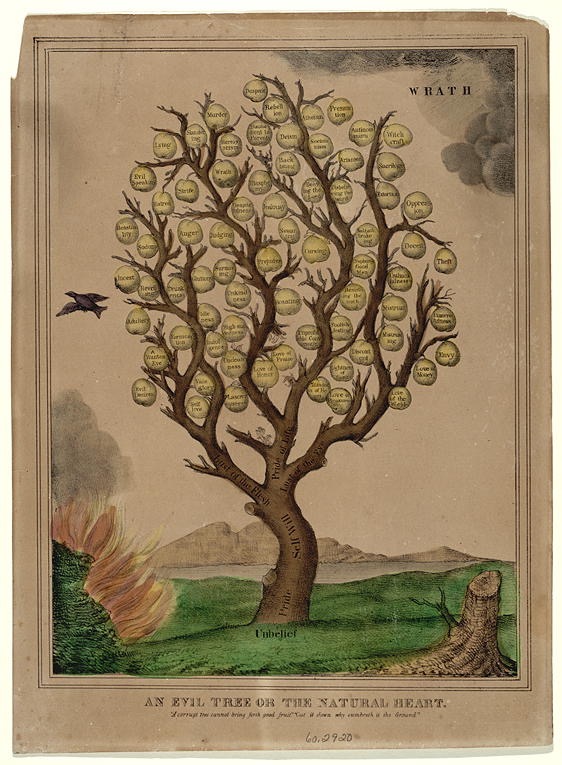
Harry T. Peters "America on Stone" Lithography Collection:
An Evil Tree or the Natural Heart
(c. 1830-40)
"Heaven or Edward Bernays, help us."
We seem to have become a society of partisans, endlessly arguing across an unfathomable abyss. The us-es and the thems, the for-s and against-s, discontents in frantic search of any cohering story, less E Pluribus Unum than Ex Uno Plura or, more likely, E Unum, Duobus, out of one, two, an eternal-seeming dichotomy. We have become the great either/or, the Janus-minded democracy, utterly dependent upon Advocacy, a popularly practiced form of blasphemy where everything’s considered fair, like in love and war. Any story promoting a favored policy seems automatically approved, regardless of its relative truthfulness. It’s judged by its ability to inspire and move hearts, minds, and butts—without any ifs, ands, or buts—not by adherence to any competing standard. Lies are always permitted, solely depending upon how effectively they sway. The ends always justify any means intended to advance the partisan position. Each advocate firmly believes that they, alone, enjoy God’s unconditional approval, and that they, alone or in close concert with cohorts, represent the higher righteousness regardless.
Advocacy does not debate. It insists. It will never be convinced otherwise, regardless of any superior truths or facts their opponent might deploy. They enjoy the righteousness of the blessed and steadfastly refuse to descend into acknowledging any underlying ambiguity. True Believers never split differences, but steadfastly stand behind theirs as curiously superior. Perhaps their certainty stems from the conviction that God was always on their side, or that God entrusted them to defend righteousness itself. They could never offer or accept any quarter. They exclusively play all-or-nothing games. They take these contests seriously, as if they were for keeps. They consequently often seem a tad hysterical, insisting, as they do, on some logical impossibility or historical improbability. They defend the status quo or oppose it, in turn, depending on whatever position they’ve been called to encourage with their Advocacy.
I see terrifying stereotypes between various, even competing, Advocacies. They tend to employ the self-same tactics regardless of the “side” they claim to represent. They typically engage in some form of theatrics, perhaps because people in our culture are well indoctrinated into performer and audience roles, so when a performer appears, people here tend to slip into the easily persuadable role of ‘audience.’ As a part of that mesmerized crowd, they can be easily cowed. They tend to believe anything the performer says if the stage has been properly set and the lights cast those alluring shadows. The content of the advocate’s message, then, depends less on whatever the messenger says and much more on this nearly invisible yet overwhelmingly influential context. Set a proper stage, and the audience can’t help but believe whatever the person in the spotlight says, even if what that person says cannot be parsed into anything even remotely coherent. Our incumbent, for instance, seems capable of spouting whatever he chooses, regardless of content or usage, and his partisans gratefully recognize that he’s saying what they would have said in his shoes. It’s a truly remarkable trance.
Before this, the Advocacy machinery was less advanced. Before the First World War, the Public Relations field was still in what we moderns call its infancy. Then, shame-faced public blasphemy had not yet gained such wide popularity and acceptance. It wasn’t then simply expected that any odd advocate would naturally feel little compunction about stretching the truth in any direction they deemed necessary to win an argument, especially one they had picked to begin with. Sure, ample flim-flam people existed even then, but they hadn’t yet organized into an acknowledged profession that enjoyed much public deference and respect. People recognized them as professional liars before and respected them as professional promoters afterward. Their deceptions became famous, even emulated for their cleverness. They showed that consent can be deliberately engineered, and that truth has nothing to do with effectiveness. Even Onward Christian Soldiers came to employ the Advocacy strategies and techniques the advertisers championed. Unsurprisingly, as media became increasingly social, we became a society utterly defined by its addiction to Advocacy. We didn’t dare choose our breakfast cereal without relying on Big Advertising to tell us what to choose, without us even acknowledging that we’d asked or that they’d told us.
Of course, this whole mess would eventually trend toward putrefaction. Anything so rotten to begin with couldn’t help but rot even further with broad, popular use. At first, I innocently thought the anti-data center advocacy was merely ill-informed. I later suspected they didn’t really want to know the truth, or even consider the ambiguity behind the easy-seeming conclusions they promoted. They were, after all, advocates. I complained about their MAGA tactics, and received an earful and more in return, for it’s in the nature of dedicated Advocacy that they all employ similar tactics without ever acknowledging even the more obvious similarities. It took me forever, and considerable coaching from The Muse, to acknowledge that they didn’t want to know better. True Advocates never do. Inherent ambiguity gums up the smooth functioning of any propaganda machine. Half-truths are the natural coin of that realm, never something that needs reform. The final judge of the goodness of any argument must, then, be its effectiveness. Did it convince? Did the conviction become unshakable? Will the freshly exposed also advocate, especially for policies that utterly undermine their own well-being?
Comeuppance might be coming. Heaven probably doesn’t even know from where it might emerge. When the self-proclaimed defenders of the Earth use the same tactics as Faux Snooze—wink, wink; nudge, nudge—and when popular opinion finally supersedes scientific certainty, we might find ourselves advocating for a kinder, gentler Stone Age. The society we Advocate for might always be the society we ditched’s Comeuppance. Heaven or Edward Bernays, help us.
©2026 by David A. Schmaltz - all rights reserved
Good For A Goose

Comeuppance (26)
Decency (90)
Decency Unscrolling (1)
EndDays (92)
Exiled (90)
Fambly (93)
FollowingChapters (93)
Grace (92)
Humor (2)
iAlogue (1)
Letters to the Editor (1)
NextWorld (91)
Personal (18)
Prosperity (94)
Steam Festival (4)
Unscrolling (89)
Vaporized (6)
Work (16)
September 2026
August 2026
July 2026
June 2026
May 2026
April 2026
March 2026
February 2026
January 2026
December 2025
November 2025
October 2025
September 2025
August 2025
July 2025
June 2025
May 2025
April 2025
March 2025
February 2025
January 2025
December 2024
November 2024
October 2024
September 2024
August 2024
July 2024
June 2024
May 2024
April 2024
March 2024
November 2006
October 2006
September 2006
August 2006
July 2006
June 2006
May 2006
April 2006
March 2006
February 2006
January 2006