JackSmith
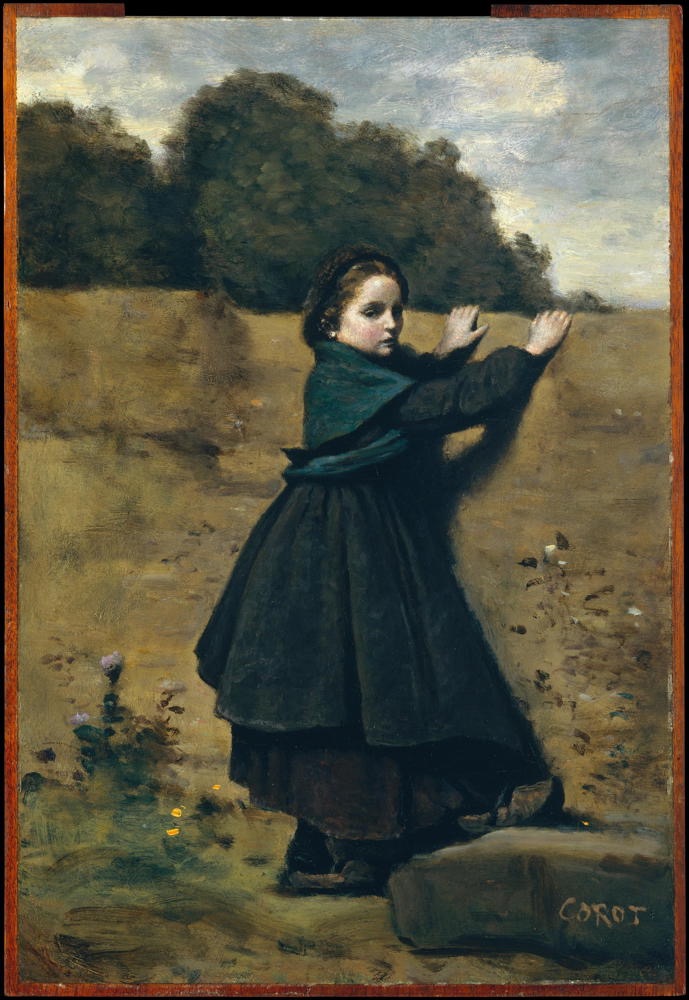
Camille Corot
The Curious Little Girl
(1860–64)
"Wait until he experiences what another focused, just prosecution feels like, with a conviction attached"
It would not surprise me even a little bit if our over-the-top flamboyant incumbent was done in by a humble civil servant named JackSmith. Anonymity incarnate, a career prosecutorial investigator, veteran of a long posting to The Hague. A man without a political axe to carry or grind, a relative innocent who never lost his faith in truth, justice, or even the recently beleaguered American Way. It will be a very cold day in Hell before anyone successfully tarnishes his reputation. He respectfully declines to be led to slaughter by a hapless Senator out to make a name for himself. He appears with gratitude to report that his investigation, the one that crooked judge in Florida sidelined on party lines, found clear evidence that our incumbent broke the law when trying to overturn a free and fair election, and that he was undoubtedly guilty of multiple felonies, including but not limited to the January 6th attacks on our Capitol. The rest is history.
His testimony came across as absolutely unimpeachable, unlike our incumbent, who appears to have committed more than a few additional impeachable offenses before he was even elected a second time.
CountryClubCulture
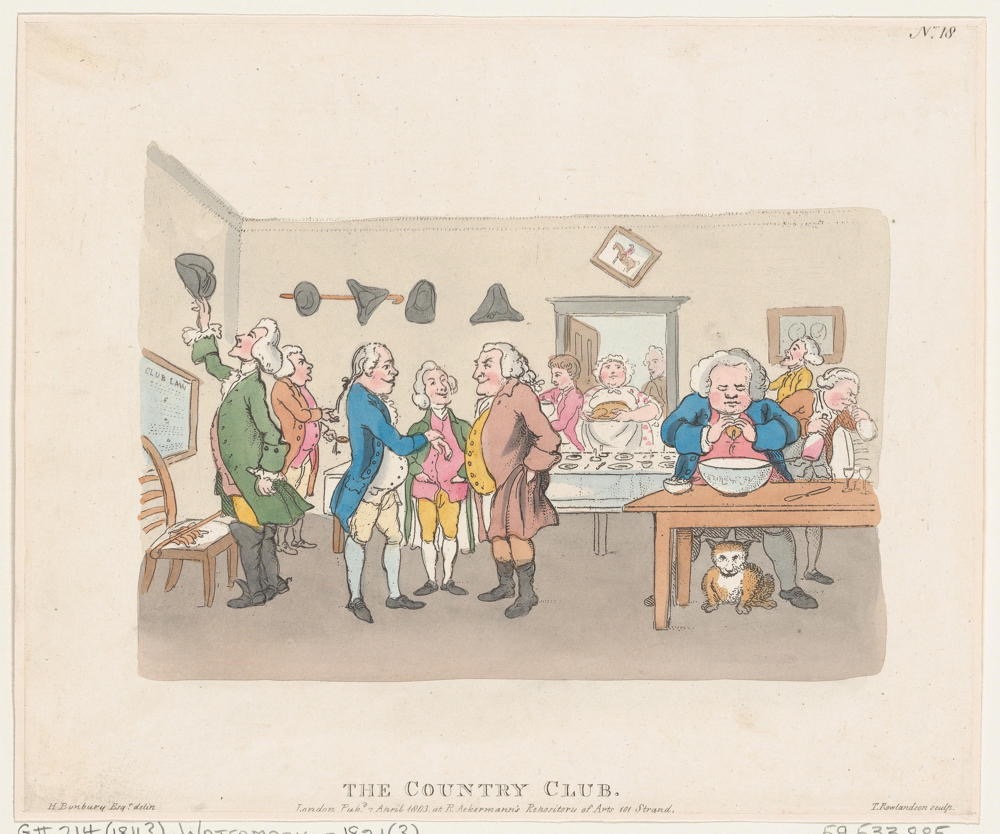
Thomas Rowlandson, Etcher
The Country Club
(April 7, 1803)
"Their Comeuppance has been stalking them for centuries."
The United States has always been divided by class, if by nothing else. As F. Scott Fitzgerald’s narrator stated in his 1926 short story The Rich Boy, “Let me tell you about the very rich. They are different from you and me.” Even if they aren’t really all that different, they certainly seem to want to be recognized as different, as exhibited by what appear to be their obviously exclusionary lifestyles. In every truly prosperous person’s portfolio lurks a country club membership, often treasured as validation of the difference they seem to need to assert so vehemently. Country clubs have storied histories as persistent bastions in overt opposition to any notion of E Pluribus Unum, for they were first and foremost exclusionary. Out of many, a select few were chosen, with a member typically inviting a desirable candidate, and the membership voting on whether to actually allow them in as a member. Historically, Jews, blacks, and other “undesirables” were excluded from consideration. These were originally white, male Christian institutions. Women could join as spouses of actual members. Fees were assessed based on each club’s status. Our local little version is not nearly as exclusionary as it once was, and relies upon self-selection to survive.
Today, anyone willing to cough up the $9,500 initiation fee and $440/month dues for a regular golf membership, with a $60/month food minimum, is welcomed.
Escalating
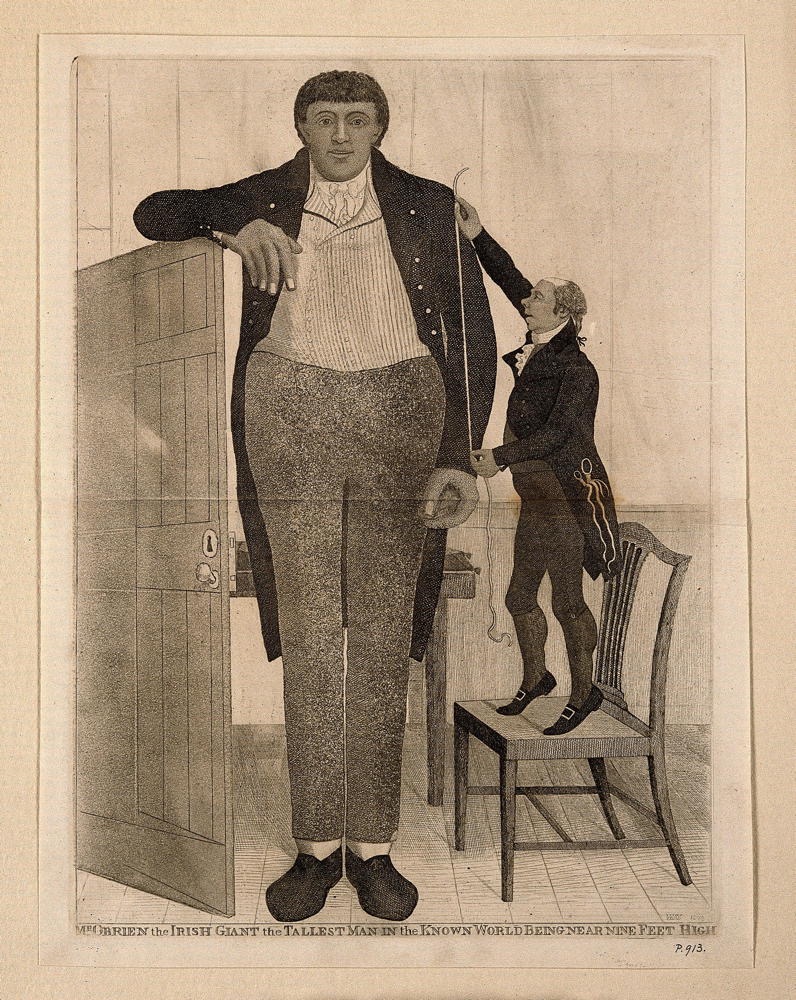
John Kay (caricaturist)
Mr. OBrien the Irish giant the tallest man in the known world being near nine feet high.
(1803)
"Maybe that means that he secretly wants to be sent there, too?"
Our incumbent’s Comeuppance seems inevitable because he possesses a single defense, or perhaps that defense possesses him. When faced with even a minor conflict, he always escalates. I do not mean to suggest, by mentioning this fact, that he has not amply lived up to his newly minted reputation as also always ultimately chickening out, but on his way to the henhouse, he tends to escalate whatever tempest he’s stumbled into this time. He seems especially blessed in his ability to attract tempests, so he’s forever producing headlines and sparking provocative commentary. “What’s he up to now?” Nobody seems the least bit surprised when (never if) another controversy emerges, for he spawns them as reliably as a low-pressure ridge produces tornadoes. He might go into business as Calamity, Incorporated if he weren’t already so damnably busy perverting the sacred office of our presidency.
I speak today of his Escalating nature, for his cure for whatever even distantly threatens him always involves escalation.
SelfSabotaging
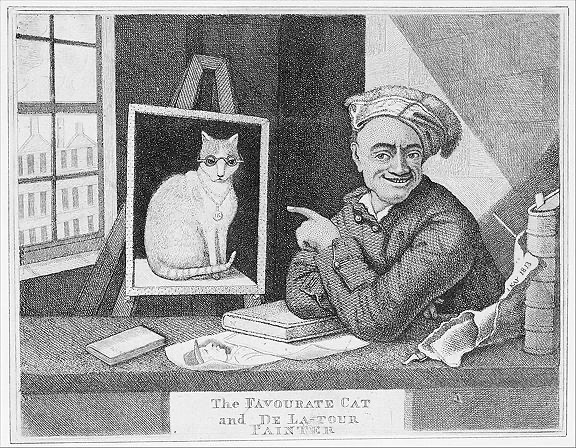
John Kay (caricaturist)
The Favourite Cat and De La-Tour Painter
(1813)
"Maybe his omniscience amounts to his Comeuppance."
At some indefinite point, our incumbent became a caricature of himself, an open running joke that he himself never suspected. Oh, his spider senses might have registered his growing unpopularity, but he had never developed the senses to accept such judgments. To him, he was a misunderstood genius, a wrongly maligned savior. He never stopped believing his own propaganda. Comeuppances work like any other experience. They ultimately demand acceptance, but like any difficult-to-swallow medicine, they often spark a process. Disbelief commonly accompanies initial twinges that something might be amiss. Anger might reasonably follow and precede some bargaining, which often feels like negotiating with an insistent demon. Acceptance might follow, but as a practicing malignant narcissist, our incumbent has been cycling through his disbelief, anger, and bargaining stages without seeming to come any closer to exiting into acceptance. His Comeuppance might manifest in just this cycling and end with him never even suspecting that he was never anything but the very soul of accepting.
Advisors and supportive followers eventually come to see the swirling, and they begin their own cycling toward their own unwished-for acceptance.
Irrelevancies
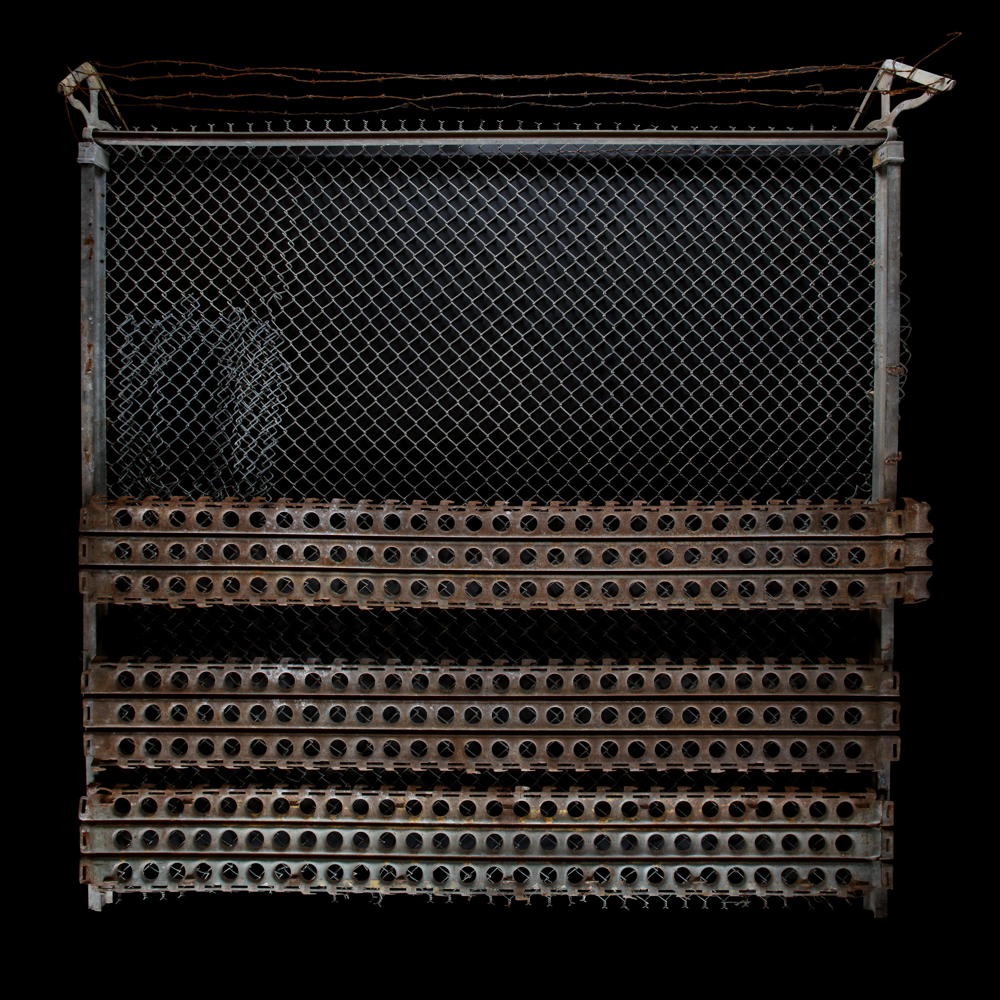
U. S. Government
30-foot-long section of border fence that separated
the Mexican city of Mexicali from the U.S. city of Calexico, California
(c. 1950s)
"Few will mourn what had already become just more Irrelevancies pretending they're dancing on that stage."
Most presidential acts are destined to become Irrelevancies. Heartfelt proposals meant to transform mostly fall far short of their promise. A few of the least obviously brilliant ideas might eventually morph enough to contribute to making a real difference, but these will largely go unnoticed. The first nuclear reactor accident was not the result of clever technology failing, but of a maintenance man accidentally dropping a wrench: an inadvertence. That innocent incident rendered all the clever safety mechanisms deliberately embedded in the technology irrelevant. Much of what we insist must exist for any society to thrive will likewise probably ultimately amount to simply more Irrelevancies. I might rail about people who wear their pajamas to shopping centers, but I suspect this practice will not ultimately cause the fall of anybody’s civilization. My youthful self would not have believed that I would one day voluntarily submit to vaccinations in the meat department of my local Safeway store, for that would have been unthinkable. When the unthinkable becomes commonplace, old insistences have already become Irrelevancies.
We’re entrained to believe that our President is the most powerful person in the world.
Weekly Writing Summary For The Week Ending 09/24/2026
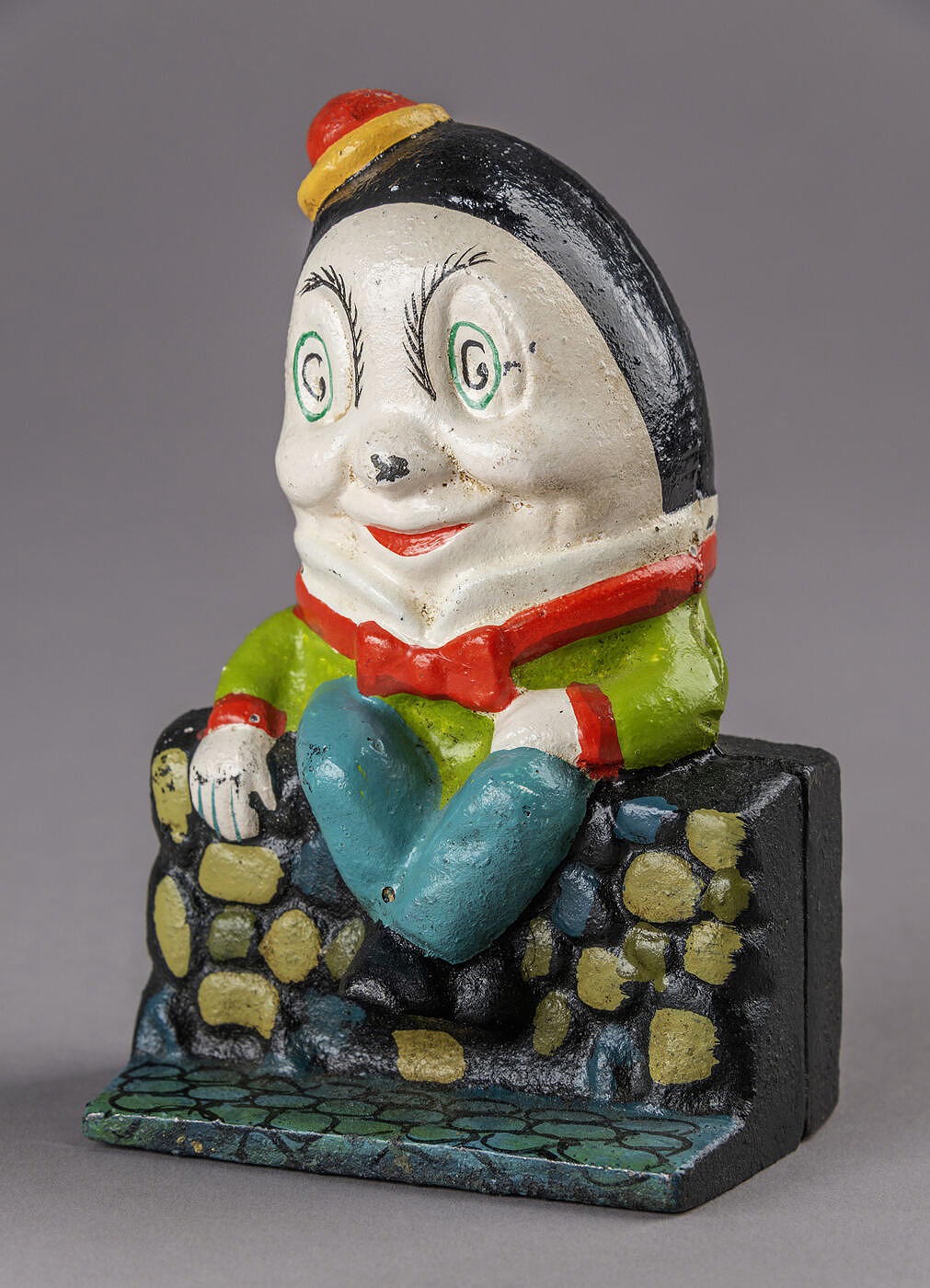
Unknown Lithuanian Artist
Taupyklė – Kliunkis Pliumpis („Humpty-Dumpty“)
""Piggy Bank — Klunk Plump""
(not dated)
This week's Prosperity dispatches completed the series. The writing moved from the paradox of NonBinaryProsperity through the machinery no sane person volunteers to work with, from the misconceptions I've been thriving on all along to the vengeance with which Prosperity always returns. Then Comeuppance began, arriving with a wanted poster and a fictional president ripening for his reckoning. The Prosperity series ended where it always had to: not with resolution, but with the recognition that Prosperity naturally expands beyond its originating boundaries, carrying its losses as credentials.
Thank you for following along!
MakeBelieve
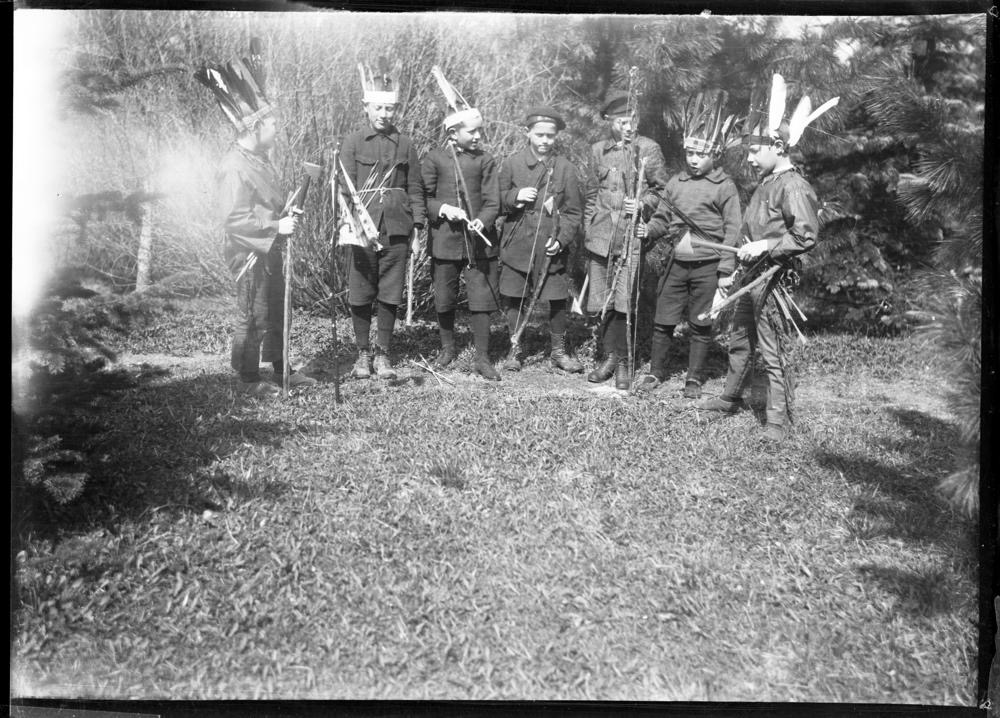
Bernhard Åström
Indianer i Masaby
(c. 1925)
"Our current president only exists in fictional form on some livestream that never was alive, ripening for his Comeuppance."
Donald J. Trump’s second term was almost entirely a fictional affair. This alone explains why it had no central theme beyond incoherence. It was not just that the incumbent was increasingly displaying the effects of his widely speculated prefrontal dementia, something he referred to as “fake news,” but that he lacked coherent purpose. He had no reason even to become president. No agenda. No motive, other than self-service, which had always stood in for his missing character. He recruited an equally unfocused cohort to populate his administration that, unsurprisingly, never once proved itself capable of administering anything. It would have been a complete joke had it not injured real people by inflicting actual damage, much of it inadvertent. It was as if we’d elected a chimp president. He could wear the uniform, albeit cut funny for his figure, but he couldn’t steer anything, much less our ship of state. Anybody could explain his track record by randomly sticking pins into something, drawing the resulting perimeter, and calling it a work of original art. It was all a fiction.
Much of whatever anything becomes results from our own more or less willing suspension of disbelief.
TheArc
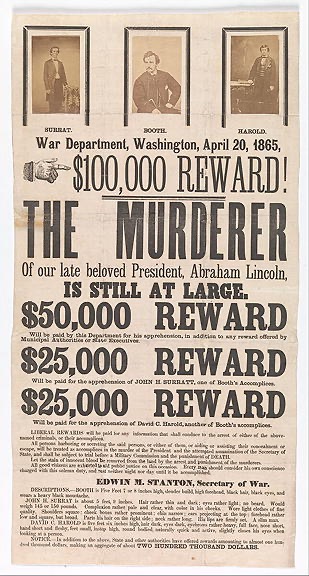
Multiple Artists/Makers
[Broadside for the Capture of John Wilkes Booth, John Surratt, and David Herold]
(April 20, 1865)
“The arc of the moral universe is long, but it bends toward justice”
Rev. Martin Luther King, Jr.
"That overlong Arc of Decency will perhaps this time finally inflict his Comeuppance."
Twenty-one months ago, on the Winter Solstice, anticipating the inauguration of who, I felt certain, would prove to be the worst President in the history of our country and probably in the history of this world, I began writing a series I entitled NextWorld. In it, I reviewed a few of my memories from his forgettable first term and speculated on how those patterns might manifest during his second. He seemed no less malignant than he had been through his first attempt, and I had no good reason to expect he wouldn’t be worse through his second. I needed reminding because I had reset into a contented complacency through Biden’s Presidency. I know that many seemed deeply dissatisfied with Biden’s performance, but their complaints seemed petty to me after observing his predecessor’s turn. I was preparing myself for an eclipse, where a reliable sun would be overshadowed by forces far more malignant than any moon.
I took no pleasure in this exercise.
ProsperityLost
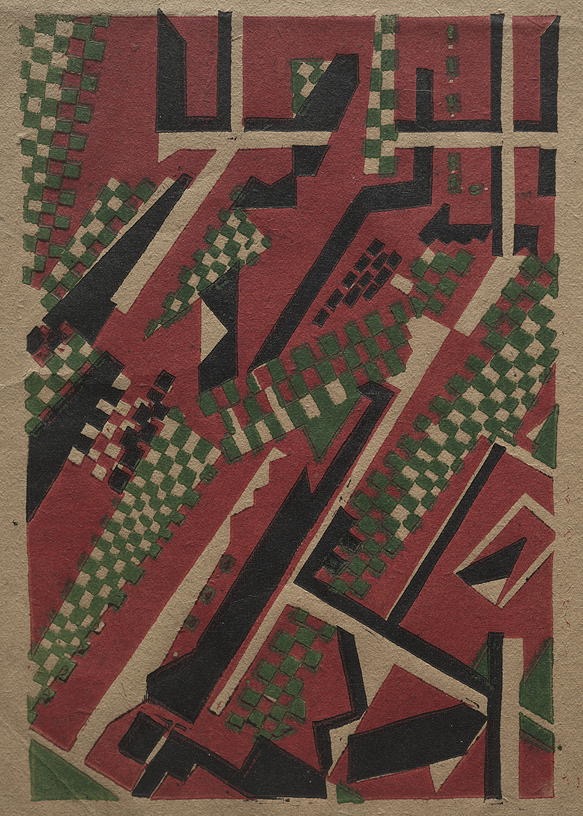
Edward Alexander Wadsworth
The Open Window
(c. 1914)
"Prosperity always returns with renewed vengeance."
I lost my Prosperity the same way Milton described Adam and Eve losing their paradise, for neither event ultimately amounted to much of a loss. I could consider them each a trade, and perhaps, even a fair one. Eve ate of the apple of the Tree of Knowledge, a decidedly good decision if only because it assured that she’d never be a dumb broad (excuse the pejorative). Adam, when confronted with the choice between abandoning his true love to lonely exile or accompanying her, chose to take a bite of Eve’s apple and trade his physical paradise for a more mobile emotional one. True, both traded infinite goodness for the vagaries of finite existence, but they gained considerable plot momentum in the process. Imagine where literature might have matured from a world consumed by unending sameness. In retrospect, if not in prospect, their ParadiseLost was an infinite emotional gain: true love.
When The Muse and I entered exile, seventeen years ago this year, we similarly forfeited our own hard-won paradise.
ProsperityMachinery
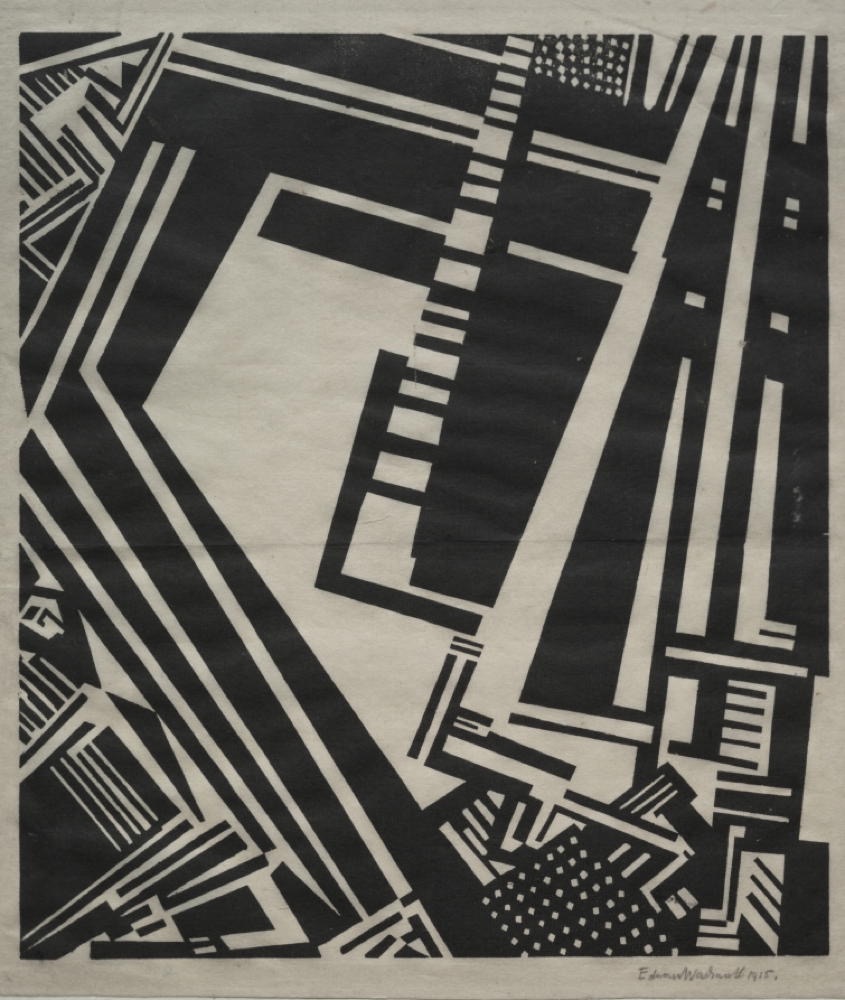
Edward Alexander Wadsworth
Illustration (Typhoon)
(1914–1915)
"…the least of what every Prosperity demanded in return."
Prosperity requires a vast company of supporting characters. It’s neither an island nor an isthmus, but an integrated element within recursive layers of ecosystem, some of which we’d really rather not acknowledge. If living requires some level of complicity, Prosperity seems to demand an even greater involvement in operations no sane person would ever volunteer for. Such seems to be Prosperity’s price. It’s not just laziness that insists we compromise ourselves in these ways, or convenience, for much of what our grandfathers never needed to consider has become essential to maintaining the Prosperity we’ve grown more than merely accustomed to. Many of these compromises—if, indeed, they can still be properly considered compromises—arise from genuine improvements which always bring along some number of unwanted externalities. The Villa Vatta Schmaltz had no indoor plumbing or electricity when it was built in 1907. This must be why the bathrooms are anything but spacious and inconveniently located. The upstairs bathrooms began their lives as a sleeping porch.
Much of the ProsperityMachinery we so utterly depend upon stays comfortably invisible to our daily lives.
Pwospwairatee

Guido Reni
Charity
(ca. 1630)
"… I might reasonably thrive on a few of my more reassuring misconceptions."
Now, after thirteen weeks spent considering Prosperity, I am realizing just how immature and generally juvenile my conception of the subject had been. I remain largely ignorant of it, since simple consideration rarely yields wisdom; more likely, dissatisfaction. Confessing my ignorance probably produced no more than negative knowledge, certain aversions as opposed to mature understandings. I might be little better for the effort, though I suspect I might possess a better appreciation of the depth of my former misunderstanding. It will likely be a life’s work to recover and construct much better than I’ve already grown too accustomed to. I don’t have all that much life left now.
At least I know that my Prosperity was never my possession.
NonBinaryProsperity

Andrew Wyeth
Maine Fisherman
(1936)
"…grateful we can actually employ our old, reliable Walla Walla Way."
True Prosperity might be NonBinary, defying specific classification. It seems to be anything but all-or-nothing, eschewing either/ors in favor of some flavor of both/ands. It tends to smother under clever definitions, and might sometimes even be mistaken for degradation. Environmentalists often get sideways with Prosperity because they treat externalities as if they define an entire context. They seem to entrap themselves too easily in impossible imperatives, casting themselves as the only noble ones and defending traditions nobody else seems to fully appreciate. They perceive change as degradation and stasis as somehow possible in a world that’s necessarily either economically expanding or contracting. Those pursuing Prosperity must remain mindful, too, of the environmental stewardship every development demands, though they risk being cast as an adversary to apple pie when they suggest that perhaps a diet of both butter and guns might be necessary and not impossible or necessarily degrading.
Our controversies devolve into strict dichotomies these days.
Weekly Writing Summary For The Week Ending 09/17/2026
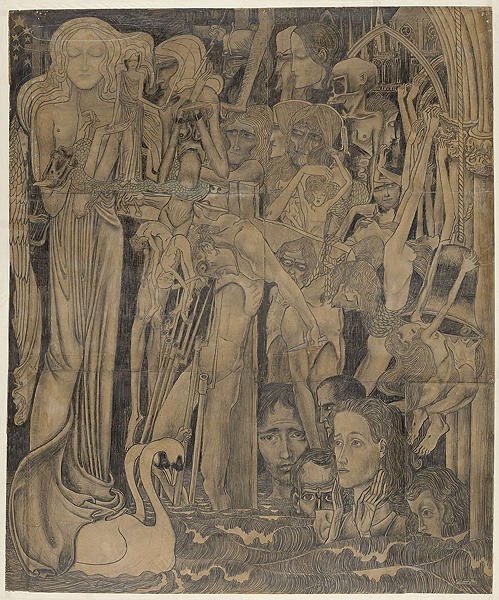
Jan Toorop
Loss of Faith
(1894)
This week’s Prosperity dispatches arrived as the series entered its final approach. The writing ranged from the historical accounting in Legacy to the nonlinear economics in Cascades, from the paradox in Unsecurity to the epistemological honesty in PresumptiveProsperity, from the anthem in ScaryProsperity to the quiet triumph in Restoring. The Muse walked back into her garden. The pickup toodled out to the farm market. The mechanic wouldn’t take a nickel. In these final installments, the series found that Prosperity naturally expands beyond its originating boundaries—and that might be all it ever does.
Thank you for following along!
Restoring
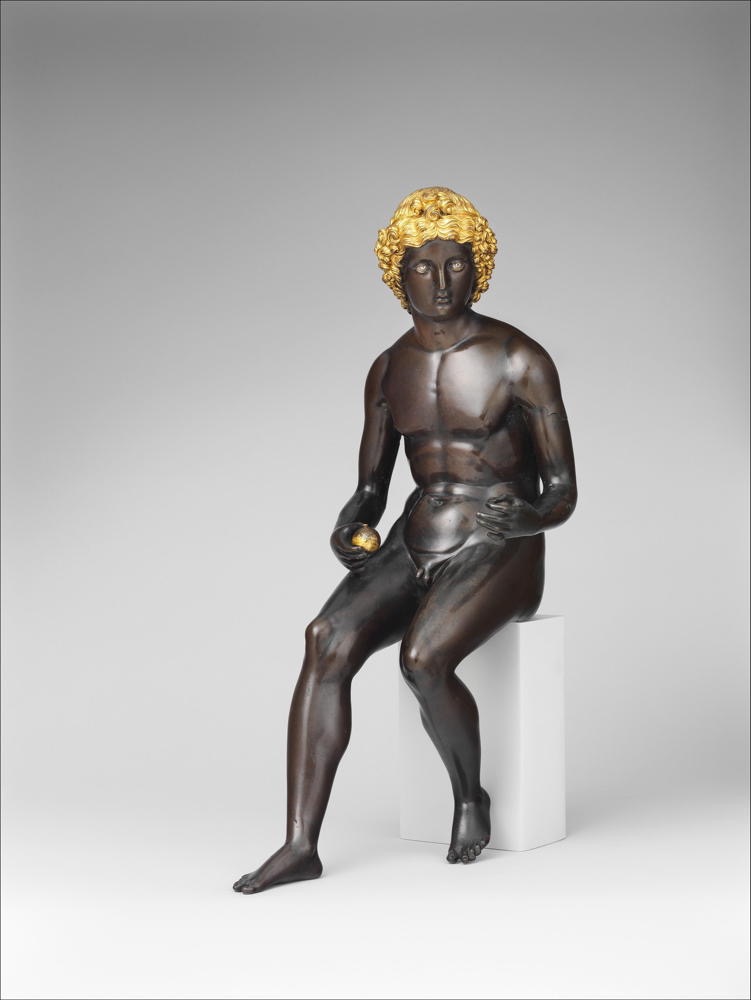
Antico (Pier Jacopo Alari Bonacolsi)
Paris
(ca. 1518–1524)
"Restoring Prosperity properly refocuses its inherent potential."
“Please return your tray tables to their full upright position.” This common command stands here as the simplest example of Restoring. What was undone might be redone. What seemed irrevocably lost might be capable of Restoring, if not itself, then, perhaps, a successor or substitute. ProsperityLost might serve as the first move in a cyclical pattern of Restoring Prosperity again. I will pine after an exact replica of whatever I lost, even though Restoring that might well shortchange me. I rarely imagine replacing it with something better than whatever I lost. This amounts to an aspirational affliction, perhaps due to a faulty imagination, or maybe I simply imprinted on that ProsperityLost so the loss became my Prosperity, at least temporarily; plenty of nothing beats nothing left at all.
Six weeks and change after The Muse broke both ankles, her osteopath released her from wearing the boots that stabilized the broken bones.
ScaryProsperity
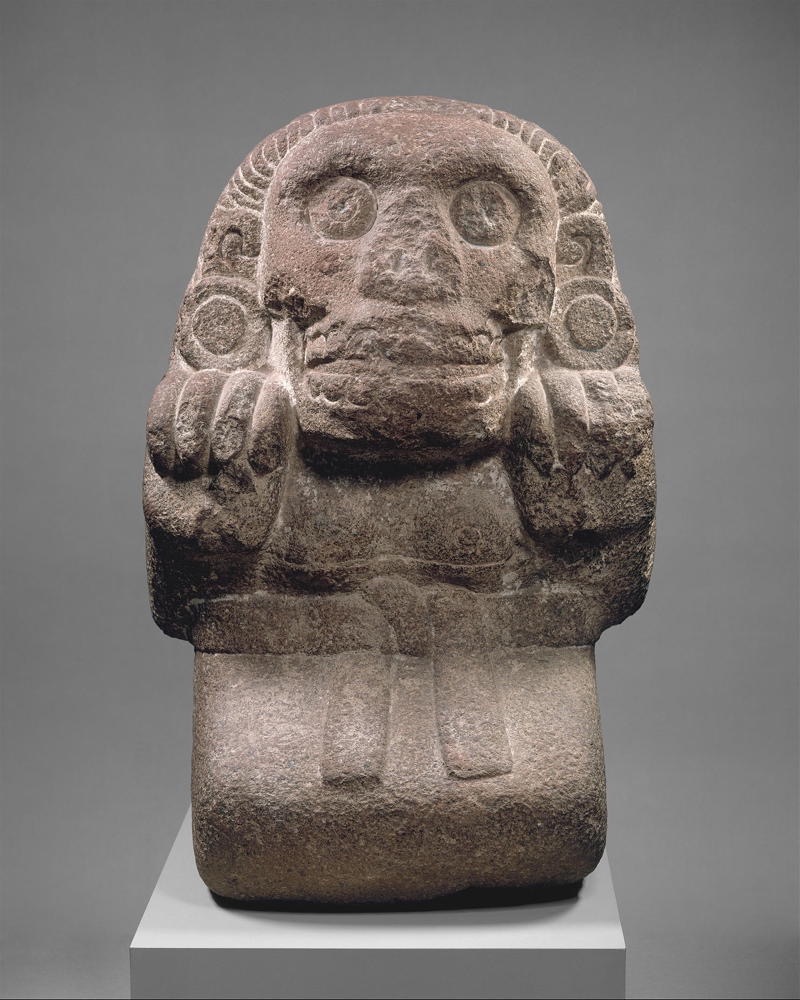
Unknown Mexica (Aztec) Artist Cihuateotl (15th–early 16th century)
We stand on the precipice of the greatest discoveries in the history of this world so far. How could it possibly be otherwise, as we stand here with all of human history receding behind us? This might be why every day seems so imperiled right now. With the promise of even modest Prosperity, externalities seem to become more prominent. We see mostly downsides and forget how fraught every prior radical improvement initially seemed. There were always naysayers; they often even dominated whatever discussions surrounded the emerging opportunity. Remember, most Americans were Tories during the Revolution. If people had been able to access their druthers, they would have probably passed up every opportunity to rewrite history, preferring to stay home, however uncomfortable, over dangerous exploring and potentially discovering great good fortune. Prosperity in the past has often come into its futures kicking and screaming bloody murder.
How embarrassing when the future dawns brighter than anyone ever imagined it could be again.
PresumptiveProsperity
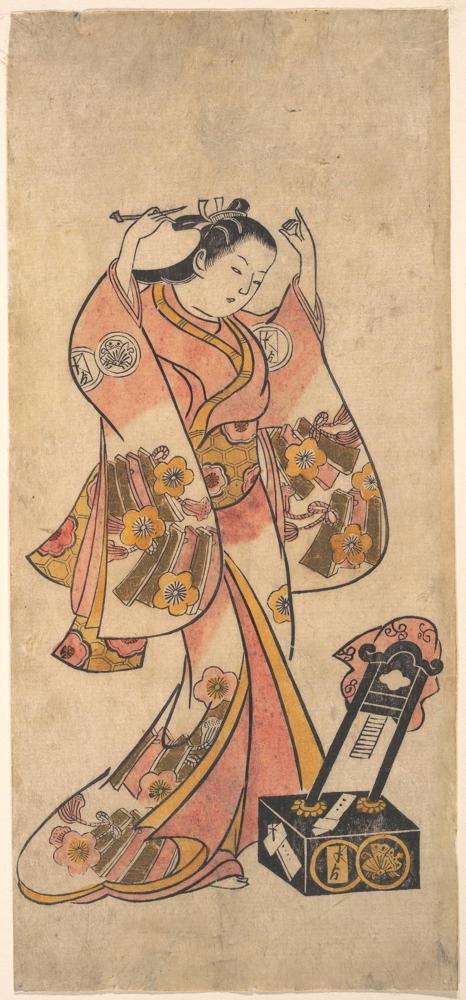
Torii Kiyomasu II
Sanjō Kantarō as a Woman Arranging Her Hair Before a Lacquer Mirror
(before 1763)
"…Prosperity stands in good company because of this."
I have a physicist friend who seems to hold vast amounts of arcane knowledge. He can pull full-blown proofs out of seemingly non-existent air. He often corrects my misconceptions, and I never fail to find fault with myself then for not having accumulated what he considers casual knowledge, but then we held different foci both in our choice of professions and in our personal lives. It was a wonder we ever encountered each other, given how different our worlds seem. We have each retained our grounding orientation, though we agree on more than either of us probably had any right to anticipate. We are vastly different and also quite disarmingly similar. As a result, we are quite compatible.
I remember the first time I encountered the kind of knowledge the world might expect me to retain.
UnSecurity
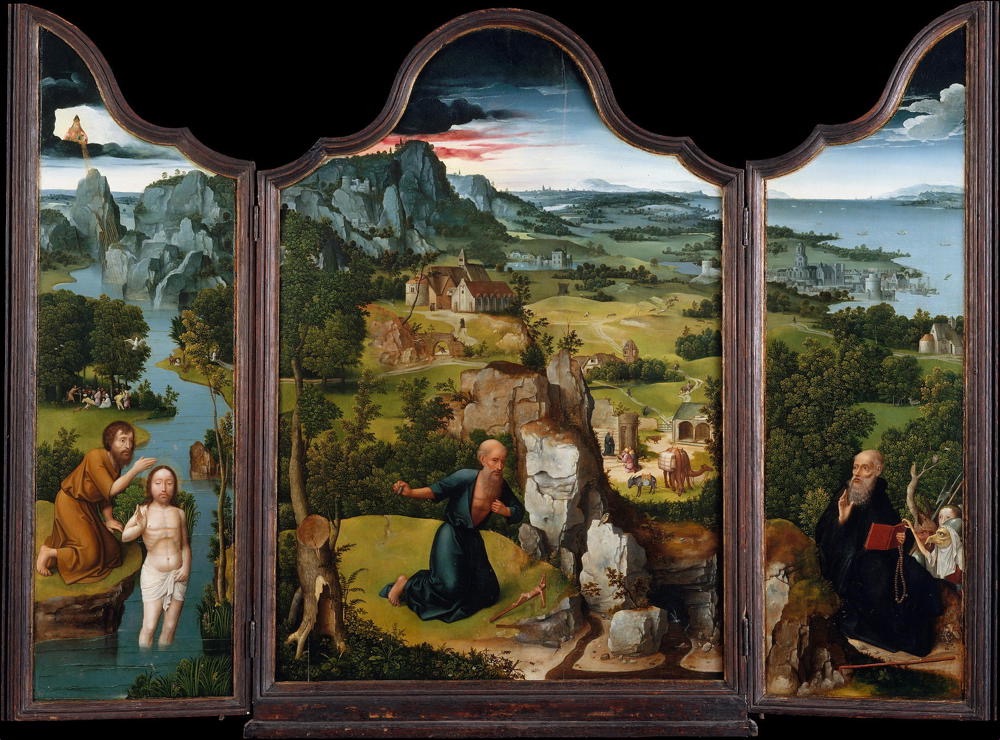
Joachim Patinir
The Penitence of Saint Jerome
(ca. 1515)
"… and they usually cost much more than Prosperity ever bargains for."
Our Prosperity was never really secure. Its security was usually merely presumed, for there could never have been an adequate defense against its many enemies, and it always had its enemies, many of them. It survived, while it survived, as a matter of apparent grace, without coherent explanation. It came, but was always capable of leaving or, more likely perhaps, of being snatched away for no apparent reason. There were always those who insisted upon assaulting any decency, as if their special gift was the superpower to sour others’ experience. They were always trouble, and everyone knew they were or would be real trouble before their story ended. They were often just jealous, envious of others’ apparently better circumstances, angry at themselves for where they landed, but also at least equally angry at others for prospering. It never made sense to assault themselves, though they were capable of severely wounding themselves and would wound themselves on occasion, but continuous self-destruction makes little sense, even to almost complete idiots. Regardless of the defense erected against such forces, Prosperity would often lose, especially on the first round or two, though it would always retain an ability to recover and renew. It mostly made no sense to maintain a robust defense, since it could eventually renew and recover infinitely as it wished. Prosperity was always persistent.
A piece of Prosperity’s perversion insisted that we needed to maintain a more active defense.
Cascades
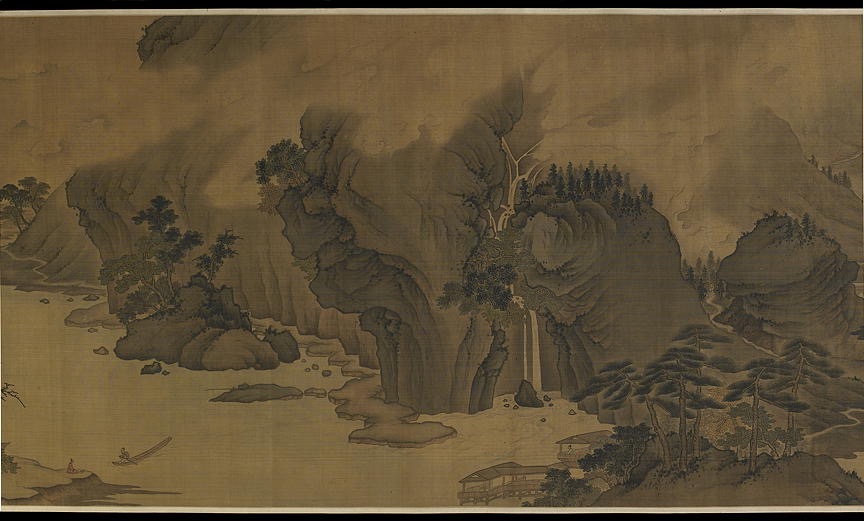
Formerly attributed to Xu Daoning (ca. 1000-after 1066)
Autumn river in the rain and clouds
(16th century- China)
"We seem at least obligated to deal with this world as it is,…"
Economics works in mysterious ways, and doesn’t always seem to work at all. Prosperities can rise and fall with startling speed, partly because they do not move linearly. Both Prosperity and penury can fool the eye that expects straight-line predictability. Both require systems thinking even to begin to comprehend, and even then they might still seem mysterious. Ruinous change can seem to occur faster than instantly, especially for those who can’t register nonlinear variation. Beneficial shifts can occur just as seemingly erratically, probably because both Prosperity and Penury tend to operate as Cascades. Their values do not travel via thin, straight wires, but through wilder splashes, as if they were water racing through a rocky ravine. So much apparently random variation litters their courses that accurate prediction seems unlikely, if not impossible. This might be why they both just seem to happen.
Accounting for both Prosperity and penury might be best attempted after the fact, once a period of insulating time has passed.
Legacy
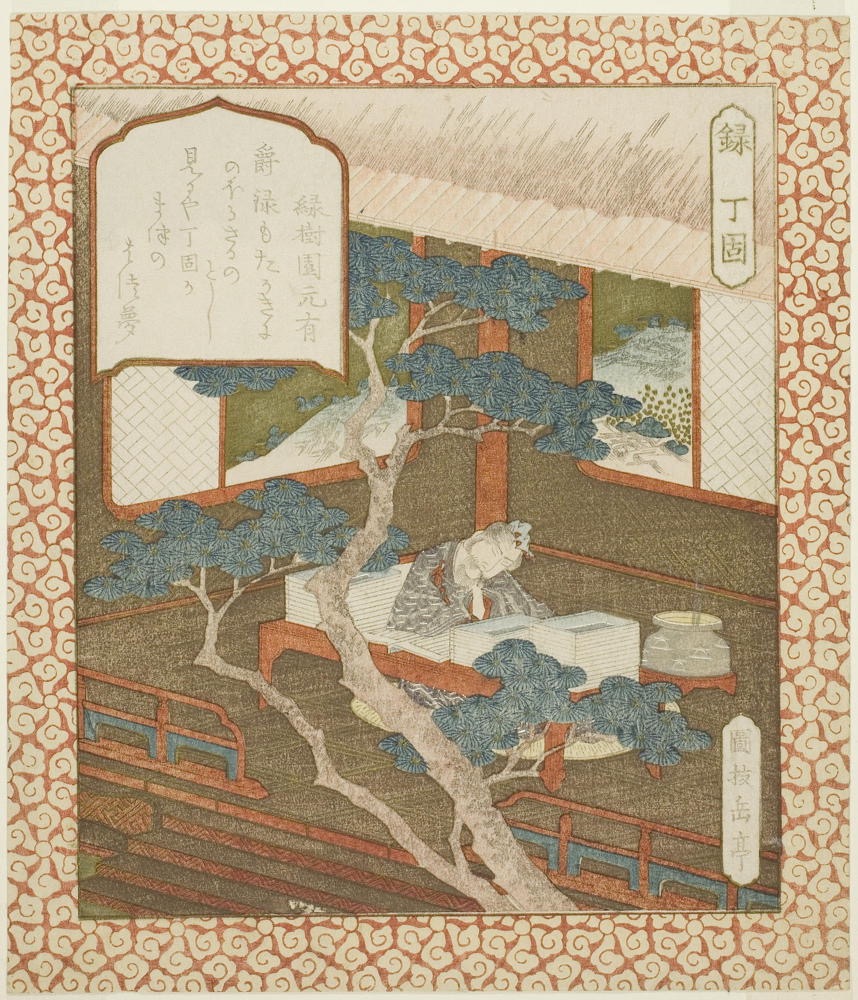
Yashima Gakutei
Prosperity: Ding Gu (Roku, Teiko),
from an untitled series of happiness, prosperity, and longevity
(c. 1824)
"This will be the work by which future generations will judge patriots."
With fewer than ten installments of this Prosperity series remaining, I start foreshadowing the ending here. I must have explained the process by which I intended to consider Prosperity in this series, a method I might label Dialogic. Rather than start with the ending in mind, I began with questions, honestly intending to inquire, then inquire again, following the story however it seemed to unfold. This tactic might explain the winding pathway this series must have seemed to have been taking. I began each writing session a little bit baffled about where the unfolding story might lead me next, for in this type of analysis, the subject guides the writer rather than the writer crafting the plot. The plot emerges, and the writer trusts that it must. This writer chose, day to day, so only in that way did I influence the resulting flow. The storyline has emerged from the process rather than the process or the author guiding it, so I have not employed foreboding until now, and not only because I couldn’t have known enough about where the Dialogic method would lead me, but also because foreboding couldn’t have served any possible purpose if my purpose was genuine discovery. But we both know an end seems near now, and we both wonder where this expose might be going.
It has been demonstrating its Legacy with every installment.
Weekly Writing Summary For The Week Ending 09/10/2026

Utagawa Hiroshige II (Shigenobu)
Dramatic Picture of Sakura
(Not Dated)
This week’s Prosperity dispatches arrived as our housemade Mirabelle wine began fermenting in the kitchen and a sleep clinic visit produced the series’ most unexpected installment. The writing ranged from the guitar-shaped Blooming of every Prosperity to the ancient ritual of CreatingWorlds, from the public policy failure of NotInsurance to the taxonomy of StickyProsperity, from the comic philosophy of TheApneas to the sleepless night that followed the loss of Innogrance. The kitchen smells like sweet yeasty bread. The Prosperity persists, wounded but present.
Thank you for following along!
Innogrance

Utagawa Hiroshige II (Shigenobu)
Calligrapher: Yokogawa Horitake
Memorial Portrait of Ichiryusai Hiroshige (1797–1858)
(1860)
"Who knows where this game of Prosperity goes next?"
My sense of Prosperity seems to depend upon two critical, if rarely deliberately acknowledged, resources: innocence and ignorance, in some proportionate mix: Innogrance. Some of my sense of Prosperity certainly stems from what I do not presently know or even suspect, an innocence. It just never occurred to me to consider that stuff. The rest of my sense of Prosperity might reasonably stem from my ignorance. Had I known how to create the Prosperity I presently enjoy, I doubt that I would have managed to produce anything close to what I have experienced. Prosperity seems to be one of those states that require some blind backing into rather than clever forward strategy. Sure, strategy, however clever, might well contribute its share, but Innogrance seems responsible for producing the balance.
This balance seems just as delicate as you might suspect.
TheApneas

Utagawa Hiroshige II (Shigenobu)
“America”: A Native American Woman on Horseback in the Snow
(1860)
"…the promise to be rid of something that's only present by the evidence of its absence."
As I recounted in my ADecentNight story, posted as a part of my Decency Series, both The Muse and my internist have been after me to volunteer for a sleep study at our local sleep center. They suspect, on scant evidence, that I might “suffer” from a condition they call Sleep Apnea, a condition in which I cannot quite muster a belief. I find TheApneas, as a class, to represent the most interesting category of human difficulty, because they are defined as the presence of the absence of something. This formulation makes my head ache, so I avoid thinking about it very much. Even when I think about it, I make no headway toward understanding or acceptance because its very definition seems entirely paradoxical. I’m left failing to interpret a calculus with nothing more powerfully interpretive than my usual meager long division. Further, if found to be “suffering” from this apparently imaginary disorder, the treatment involves being sentenced to wearing essentially a vacuum cleaner over my face, in lieu of sleeping. How such a nightmarish treatment might cure something that, by definition, exists only by not existing, deeply baffles me, and should.
I suspect that TheApneas qualify as first-world disorders.
SlipperyProsperity

Utagawa Hiroshige 歌川 広重
Shirasuka: Shiomi Slope,
no. 33 from the series Fifty-Three Stations of the Tokaido
(Tōkaidō gojūsan tsugi)
(1847-52)
"I tolerate working harder for it than it ever seems to work for me."
Prosperity seems to exist in two distinct forms: Slippery and sticky. Sticky seems to be the more noun-like of the Prosperities. These might serve as outward manifestations of Prosperity possessed, though they can be misleading, as appearances are not always what they seem. Many of the Prosperities seem slipperier, either because they have no physical presence or because their presence simply seems far less apparent than their sticky counterparts. The art we display on our walls, and the books we so proudly exhibit on our shelves, serve as prominent examples of our sticky Prosperity. Indeed, our very home, The VillaVattaSchmaltz, represents probably the stickiest Prosperity we possess, though, yes, it sometimes seems as if The Villa possesses us more than we possess it. Either way, its presence seems inescapably sticky.
Much of The Muse and my Prosperity was never reducible to mere possessions, however grand those might appear, for our underlying Prosperity seems decidedly less sticky than art, books, or address.
NotInsurance

Torii Kiyomasu II
Susano-o no Mikoto Killing the Eight-headed Dragon
(1748)
"…Prosperity is NotInsurance, and never will be."
Prosperity spawns predators and pretenders. As medical insurance became more available, so-called “medical cards” emerged to serve those still frozen out of insurance markets, especially for prescriptions and dental services, which are often the most difficult kinds of insurance to afford. To this day, Medicare offers nothing to cover dental expenses, which often peak after one retires. Prescription drug plans have also become notorious for becoming worthless just at the time someone might actually need to rely on them. So, a ready market always awaits some latest scam. Our conservative friends and enemies have been most active in this shadow market, pushing plans that appear to supplement missing elements of seniors’ coverage, but which tend to promise more lavishly than they ever deliver. In recent years, states, which regulate insurance markets, have begun demanding that these alternatives to insurance coverage be clearly labeled, “This Is NotInsurance,” though these warnings make little difference to those without viable alternatives.
Make no mistake, this is not an insurance company problem, but a public policy one.
CreatingWorlds

Utagawa Hiroshige II (Shigenobu)
French Woman, Her Child and Pet Dog
(10th month, 1860)
"…inevitable complications always present when CreatingWorlds."
The kitchen smells yeasty, like bread dough with a distinctive fruity backdrop. The scent hovers below overwhelming, still subtle but inescapable, reminiscent of the underlying fruit, but distinctly different. I mentioned to The Muse, as we stirred the pots containing fermenting Mirabelle plums, that I felt as though I was getting to know this fruit far better than I ever had before. Before, we’d rendered it into jam or tarts, or simply consumed it fresh; we saw only its very narrowest representation. After picking it this year, I pitted the fruit and set it out to slowly and quite deliberately rot, rendering its sweetness into alcohol and thereby Creating Worlds that didn’t exist before. This ritual might be as old as civilization, for Mirabelle plums have probably always produced exponentially more fruit than anybody could consume fresh. Ruled by the inexorable laws of Late Summer, the fruit’s natural yeasts and sweetness would set it to festering without any human intervention. Over millennia, a process of sorts has emerged that we can use to do what nature, left to her own devices, could have accomplished unassisted.
I suppose that just these sorts of activities once regulated the civilized world.
Blooming

Utagawa Hiroshige II (Shigenobu)
Entrance to the Gankirō Tea House in the Miyozaki District,
Yokohama, Bushu
(3rd month, 1859)
"…to identify an opportunity to prosper when it inevitably presents itself as a different-shaped guitar."
Prosperity seems to come and go on something akin to Sandberg’s little cat feet, though everyone who ever owned a cat, little or otherwise, knows just how loud their arrivals and departures can sound. Our cats, Max and Molly, hit the floor with a distinct plop so far from stealthy that nobody can smell stealthy from there. They proceed to march down the upstairs hall, for they most often come and go via a second-story window they access by climbing up the back trellis and storming up the kitchen roof. I hear each footfall as they “creep” down the stairs, and can audibly follow their progress through the front hall and the dining room, even though both rooms’ floors are covered with shock-absorbing vinyl planking, before taking their final launch up and onto the kitchen table, where they hope I’ve left them some kitty treats. I usually have. These cats have learned that their Prosperity reliably exists on the kitchen table, and they are not the least bit shy about directly pursuing it there.
My Prosperities do not seem to come so reliably or noisily.
Weekly Writing Summary For The Week Ending 09/03/2026
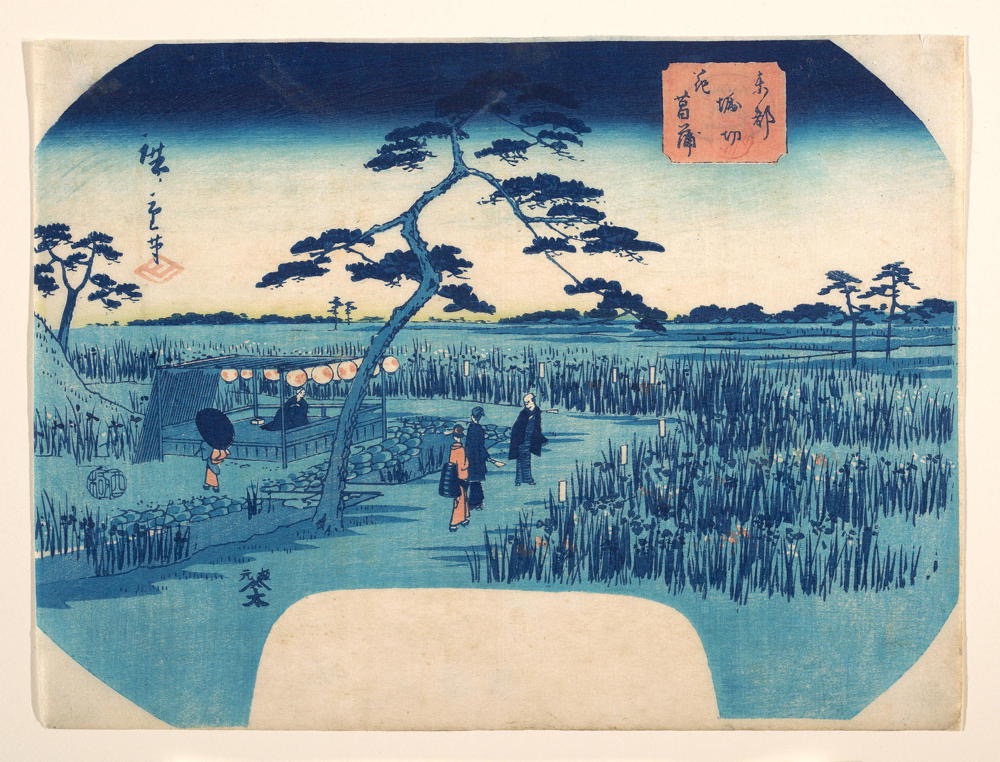
Utagawa Hiroshige II (Shigenobu)
View of Iris Gardens at Horikiri
(1861)
This week’s Prosperity dispatches arrived in the shadow of ExistentialDread and emerged into AutumnRains. The writing ranged from the clinical precision of CTSD to the paralyzing honesty of ExistentialDread, from the epic sermon of ReClaiming to the procrastinating wisdom of WithoutHeadlights, from the philosophical revelation of Thawing to the portrait of Prosperity as AutumnRains. The AutumnRains arrived. The Mirabelle wine processing began. The Muse showered and then slept in her own bed for the first time in six weeks. The series found, at last, that Prosperity might be a more or less continuous Thawing — neither liquid nor solid, but mist.
Thank you for following along!
AutumnRains
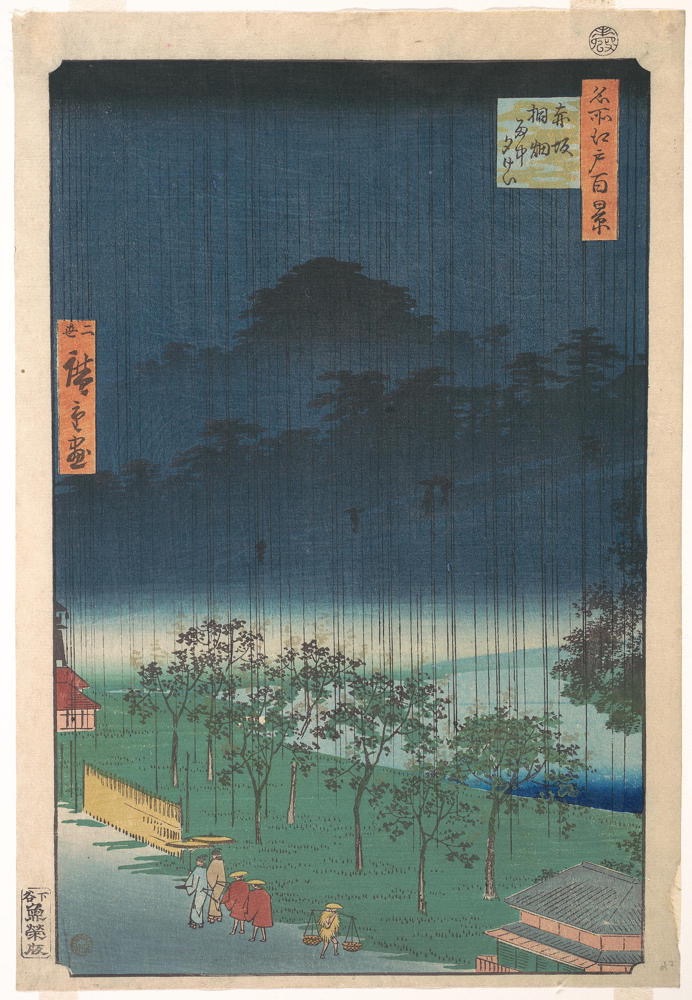
Utagawa Hiroshige II (Shigenobu)
Paulownia Trees at Akasaka in the Evening Rain
(1859)
"I revel in my AutumnRains' reappearance."
Moisture well represents our Prosperity here in this desert steppeland, now trying to pass for Middle American town and pasture. It is beautiful here in springtime when this valley could pass for Ireland, after the Winter and Spring wheat conspire with the Canola to turn the late summer beige stubblefields into a checkerboard of Prosperity after the Winter rains, fogs, and snows have left our soils saturated. This country fasts through its Summers, often seeing no more than passing hints of its Prosperity through June, July, and August. It always feels dicey, as if we might not make it through to the AutumnRains each year. My friend Randal reports that he measured the driest August in at least the prior ten years, with only +.07 inches of SummerRain registered against -4.94 inches of evaporation. Through summers, we typically lose more moisture than we gain, straining our conviction that we didn’t really choose to live on the edge of a freaking desert. I keep my yard Middle American New England emerald, just the way God never once intended.
The AutumnRains return— if not precisely reliably, then inevitably—and they arrive like Prosperity returning from another harrowing Hero’s Journey.
Thawing
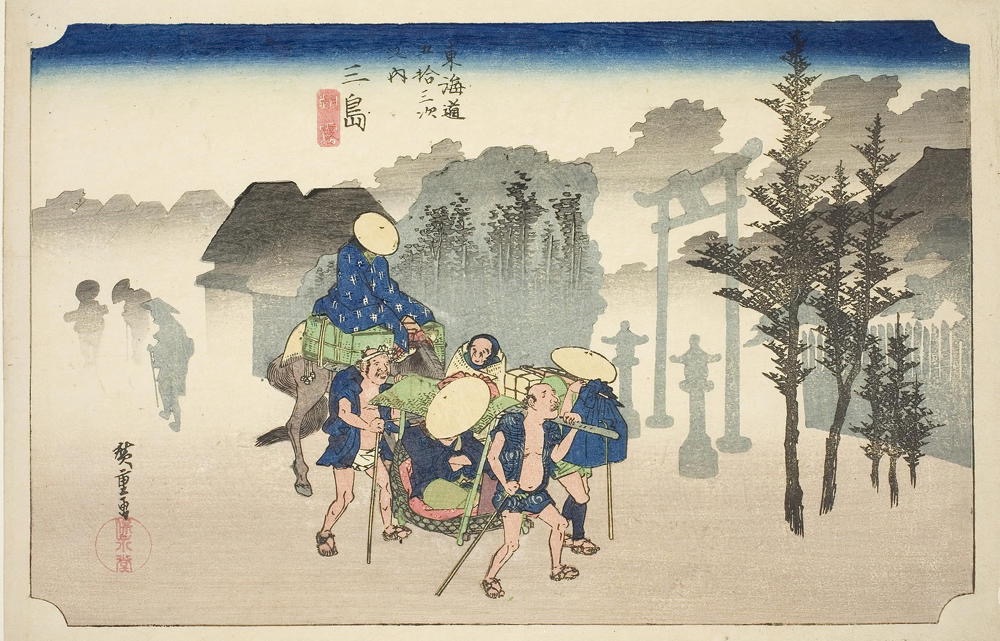
Utagawa Hiroshige 歌川 広重
Mishima: Morning Mist (Mishima, asagiri),
from the series “Fifty-three Stations of the Tokaido Road
(Tokaido gojusan tsugi no uchi),” also known as the Hoeido Tokaido
(c. 1833/34)
"…neither liquid nor solid, but mist."
A surprising period of Thawing typically follows one of my frozen-in-the-headlights-without-the-benefit-of-headlights experiences. Whatever had so effectively inhibited me from engaging dissipates. Not all at once, and never quite completely, but a few openings appear out of what had previously seemed like blinding, inhibiting, frozen mist. I climbed the ladder. I harvested the fruit I’d feared I’d left to rot. My world seemed to right itself, or at least start moving in that general direction. Moving! I accomplished something! I once again sense that I possess actual latitude for action. I feel capable of choosing, at least on a limited basis. I can choose, then I can choose again, and I recognize the fundamental cycling that underpins my Prosperity; for what was Prosperity if not the sense that I might choose more or less freely, that I was less imprisoned in my world than I was an intermittent master of it?
I first sense a loss of Prosperity as a limiting of choices.
WithoutHeadlights
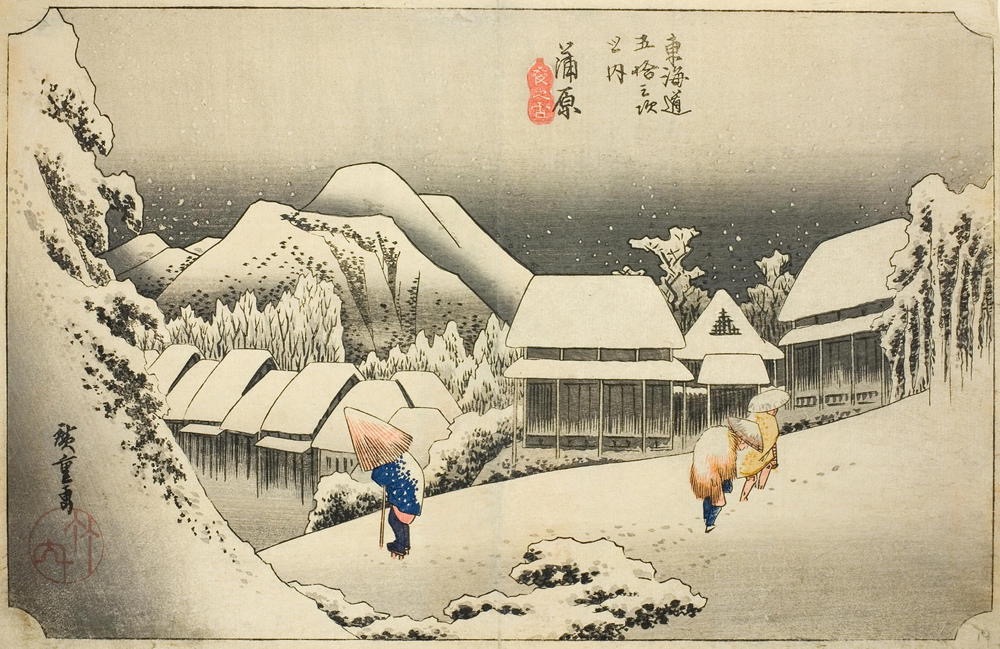
Utagawa Hiroshige[a] (歌川 広重) or Andō Hiroshige[b] (安藤 広重)
Kanbara: Evening Snow (Kanbara, yoru no yuki),
from the series “Fifty-three Stations of the Tokaido
(Tokaido gojusan tsugi no uchi),” also known as the Hoeido Tokaido
(c. 1833/34)
"…teetering on the edge of some tragic change in fortune if I cannot get this tendency under better control."
I heard myself proclaiming that I have been doing that fabled deer-in-the-headlights reaction one better, for I’ve been frozen as if caught in headlights on a dark forest road WithoutHeadlights present. I suspect that this reaction might not be classified as a talent, though I also imagine that it might, like deer’s reaction to bright lights, offer some evolutionary benefit, or used to offer one, before cars made such interactions dangerously commonplace. I can’t tell which of my native responses to such perturbations are positive ones and which might be more dangerous, though I carry opinions. I usually feel guilty when I notice that I’m frozen WithoutHeadlights again, as this must be a snowflake’s response signifying something shameful. I imagine myself more powerful, and capable of shrugging off most threats, though in real life, my vulnerabilities continually surprise me. I occasionally qualify as a superhero, but fleetingly, and only ever in my own mind.
This passing summer has been a struggle for me.
Good For A Goose

Comeuppance (20)
Decency (90)
Decency Unscrolling (1)
EndDays (92)
Exiled (90)
Fambly (93)
FollowingChapters (93)
Grace (92)
Humor (2)
iAlogue (1)
Letters to the Editor (1)
NextWorld (91)
Personal (18)
Prosperity (94)
Steam Festival (4)
Unscrolling (89)
Vaporized (6)
Work (16)
September 2026
August 2026
July 2026
June 2026
May 2026
April 2026
March 2026
February 2026
January 2026
December 2025
November 2025
October 2025
September 2025
August 2025
July 2025
June 2025
May 2025
April 2025
March 2025
February 2025
January 2025
December 2024
November 2024
October 2024
September 2024
August 2024
July 2024
June 2024
May 2024
April 2024
March 2024
November 2006
October 2006
September 2006
August 2006
July 2006
June 2006
May 2006
April 2006
March 2006
February 2006
January 2006