Charity
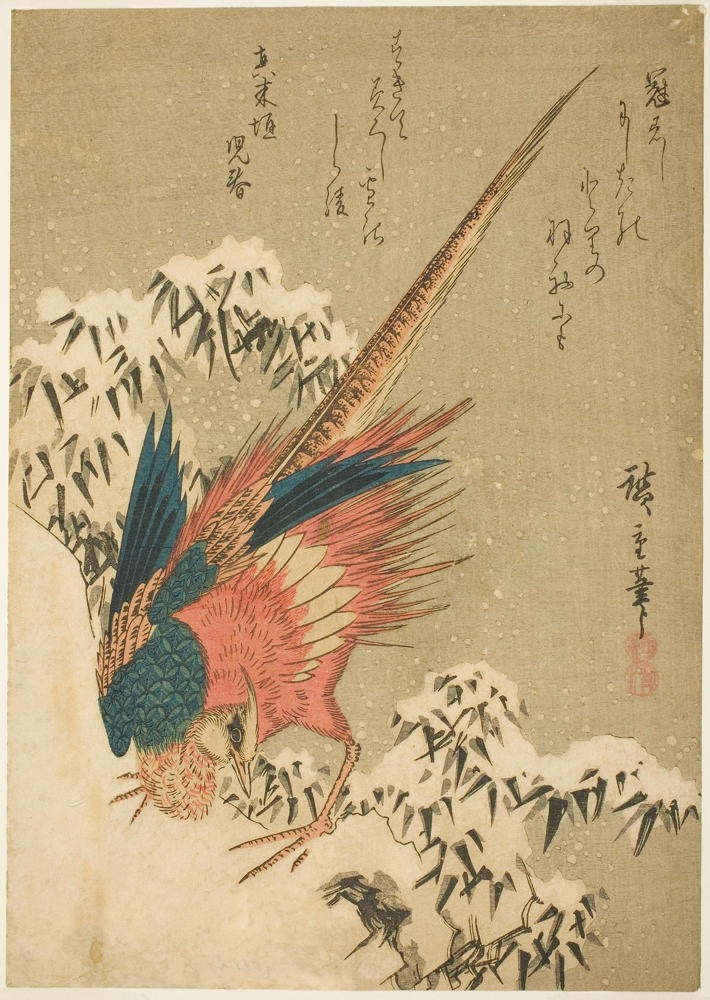
Utagawa Hiroshige 歌川 広重
A Golden Pheasant amid Snow-Covered Bamboo on a Steep Hillside
(c. 1840)
"Charity always begins at home, but it rarely ends anywhere near there."
Charity begins at home, but it never ends there. Charity seems to be the consistent means by which the Prosperous attempt to share their good fortune, however modest. This seems to be the ironclad principle universally practiced among the Prosperous. Some insist that they’re just giving back, but regardless of the underlying motive, the Prosperous give. They give “of” their time as well as their treasure. Each holds a few charities as well-deserved, and they act to preserve their missions. Some of these claim to be Christian, but increasingly, it seems, secular organizations have entered the charity business, and not for profit, though I suppose there are those charities who are in it for the money. These milk the government for subsidies, then spend less than they’re subsidized to provide their services, or they extract hefty handling charges that do more than reinvest in the advertised mission. But even the charlatans sing the same tunes in the same keys. Real or pretend, they extend assistance to the “less fortunate.”
A Prosperous person’s chosen charities are in many ways their identity. A peek at their contribution records provides a fairly accurate self-portrait of the person’s belief system and political leanings. Those who also volunteer might find themselves immersed in operations to a greater extent than they were ever engaged in their careers, for such effort revolves around personal passion rather than any absolute necessity. These people are sometimes derisively referred to as “Do Gooders,” but they do not engage for the sole purpose of doing good. The good seems more like a byproduct than the purpose. The purpose tends toward the deeply personal, and even the more committed souls might never disclose their underlying justification for volunteering to engage in what sometimes seems like little more than unadulterated frustration. Nobody can complicate anything as well as a conference table surrounded by passionate do-gooders.
My birth family never really considered itself Prosperous, at least not until most of us kids had grown up and out, with one exception. My folks supported a Korean War orphan even though they couldn’t really afford the expense. They received many blessings as a result. They were thrilled to receive periodic letters reporting the orphan’s progress. Once empty, our old nest encouraged even my folks to volunteer. My dad delivered Meals On Wheels. My mom “took in” her aging relatives, uncles and cousins, and guided them through their final transitions. These people never actually moved in, but my mom would drop by a few times each week in her rattly little VW Bug to check in and up on them. She held their papers and would negotiate with the VA or the County when necessary. She saw that they were decently buried. She also ran a little renter referral business, which she sometimes treated as her own personal charity. She well remembered when she showed up in this town a young mother with four kids under the age of five and utterly reliant on the kindness of not always perfect strangers. She’d befriend those she recognized and offer them special privileges they couldn’t afford and probably wouldn’t have purchased even if they could have. She worked as a mostly invisible angel. She saw these charities as necessary elements of her unlikely Prosperity.
The Muse grew up in a Prosperous South Dakota farming family. Let me calibrate Prosperity for those unfamiliar with farm family accountancy. The Muse’s dad reported that his operation made money about every seventh year. His operation, like all of his neighbor’s, was an exercise in clever leverage. They were thrifty, often to a fault, but didn’t starve themselves of their necessities. Their credit was good at the local Ford dealer, and they scrutinized requests for assistance before contributing relatively lavishly, but only because it was the right thing to do and they believed they would be rewarded for their generosity, which they always were. These were devout people, good Catholics who supported their church and its workings. The Muse’s mom refurbished their town’s little pioneer cemetery, righting stones, leveling ground, and replanting sod. It remains, thirty years later, tidy and uncluttered, the very soul of the spirit of Prosperity that resurrected it. She’s buried there, too, next to her frugal husband.
The Muse has been very good for my Prosperity, for she inherited the charity gene that might have otherwise gone missing in my generation. It’s absolutely true that the baby boomers were never quite as Prosperous as their parents’ generation. The erosion of the social contract under the succession of Repuglican administrations succeeded in slashing much of the support once thought essential to good governance. Food pantries were unknown in my youth. As I approach my dotage, their necessity has been increasing annually by double digits. Those who have profited by characterizing those in need as bums have just about come full circle. The economy that was the envy of the world just eighteen short months ago is now incapable of providing baseline necessities to an increasing percentage of our population, mostly vulnerable children. It would be worse if all those who were illegally deported were still here, for their once Prosperous absence further upset the balance. We’re all benefactors now, by necessity rather than necessarily by choice. I acknowledge the inconvenience such realities lay on most of us. I had not retired thinking that I would be contributing an ever-increasing percentage of my fixed income helping those even less fortunate, but that’s how this world is now. As I said at the beginning of this story, Charity always begins at home, but it rarely ends anywhere near there.
©2026 by David A. Schmaltz - all rights reserved
Good For A Goose

Comeuppance (9)
Decency (90)
Decency Unscrolling (1)
EndDays (92)
Exiled (90)
Fambly (93)
FollowingChapters (93)
Grace (92)
Humor (2)
iAlogue (1)
Letters to the Editor (1)
NextWorld (91)
Personal (18)
Prosperity (94)
Steam Festival (4)
Unscrolling (89)
Vaporized (6)
Work (16)
September 2026
August 2026
July 2026
June 2026
May 2026
April 2026
March 2026
February 2026
January 2026
December 2025
November 2025
October 2025
September 2025
August 2025
July 2025
June 2025
May 2025
April 2025
March 2025
February 2025
January 2025
December 2024
November 2024
October 2024
September 2024
August 2024
July 2024
June 2024
May 2024
April 2024
March 2024
November 2006
October 2006
September 2006
August 2006
July 2006
June 2006
May 2006
April 2006
March 2006
February 2006
January 2006