ProsperityLost
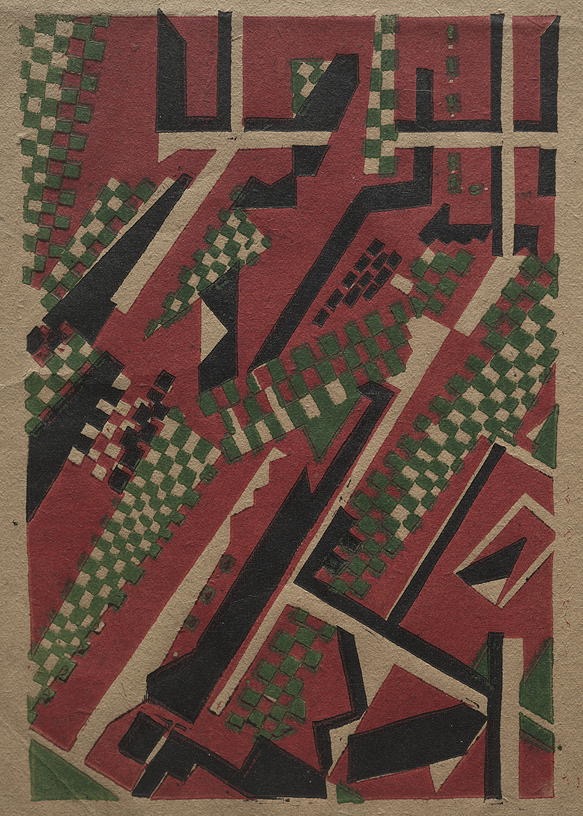
Edward Alexander Wadsworth
The Open Window
(c. 1914)
"Prosperity always returns with renewed vengeance."
I lost my Prosperity the same way Milton described Adam and Eve losing their paradise, for neither event ultimately amounted to much of a loss. I could consider them each a trade, and perhaps, even a fair one. Eve ate of the apple of the Tree of Knowledge, a decidedly good decision if only because it assured that she’d never be a dumb broad (excuse the pejorative). Adam, when confronted with the choice between abandoning his true love to lonely exile or accompanying her, chose to take a bite of Eve’s apple and trade his physical paradise for a more mobile emotional one. True, both traded infinite goodness for the vagaries of finite existence, but they gained considerable plot momentum in the process. Imagine where literature might have matured from a world consumed by unending sameness. In retrospect, if not in prospect, their ParadiseLost was an infinite emotional gain: true love.
When The Muse and I entered exile, seventeen years ago this year, we similarly forfeited our own hard-won paradise. We’d gone bust in an economy that had grown uncommonly hostile toward people doing our kind of work. We, too, were rudely escorted from our garden and traded the trappings of our former Prosperity for an emotional alternative, one barely physically supported for a while. We entered a suddenly cash-based economy. Had The Muse not found a secure government job, we would have moved into barrels, but even then, we would have inherited a context similar to Eve and Adam’s. Eve took the lead as that pair left paradise, for her act initiated the shift, and Adam had perhaps unintentionally volunteered to follow her lead forever after. Similarly, I became the housekeeper and took on my earliest role as emotional support animal, shuttling The Muse to The Metro and ensuring she could return to supper every evening. Our relationship deepened as our former Prosperity seemed to shrivel. New Prosperities emerged.
Prosperity, we have come to understand through ninety-three installments in this series, comes in many guises. Its disappearances, its lostnesses, must also appear in at least as many forms, each utterly devastating in its own surprisingly ununique way. There might be ten thousand different possible tragedies, but each appears as also utterly similar, little different on the basest emotional level. One experiences loss, varying only in intensity or degree, but ultimately nearly identical. These inevitably seem emotional, for it’s the attachment that gets swiped, even if one also loses their Prosperity’s trappings. Prosperity was apparently only rather distantly represented by anything physical, but that physical presence proves to be the tip of a profoundly proverbial iceberg. The bulk of the most debilitating aspects of my ProsperityLost experiences have tended to be emotional, so it makes sense that any recovery might best be undertaken on that same plane. Finding a replacement house, whether rented or bought, never completely neutralizes the ProsperityLost in the process. Even returning home, like The Muse and I were ultimately fortunate enough to accomplish, didn’t erase the memory of the ProsperityLost experience. ProsperityLost can never be recovered. Fortunately, it doesn’t have to be recovered to be regained.
When I look back at before this latest sensation of ProsperityLost overtook me, it was the Biden administration, days when I felt reassured that a decent man held that highest office again. Most of the drama emanated from Mar-A-Lago then, in the form of various criminal indictments and invectives, seemingly teapot tempests being routinely dispatched. I did not awaken every morning with any overwhelming notion of Prosperity, for, as it should have been, I lived well within a reassuring baseline. Prosperity has a way of remaining invisible until threatened, unremarkable, if only due to this singularly remarkable aspect. I sensed it slipping away only after the impossible seemed likely, that the idiot we reelected as chief executive managed to spin his poisonous spell over a plurality of the people again. My sanguinity turned to desperation as I felt my casual grip slipping. My faith took the first few hits, and, in retrospect, it was always my faith that suffered the most damage. Sure, my dread exponentially increased, but perhaps mostly due to my inexorably decreasing faith in myself and in my previously supportive world. I felt betrayed.
Of course, betrayal was the centerpiece of the whole strategy. I can now see this much more clearly. If I had maintained more unshakable faith in myself and my underlying Prosperity, I would have felt much less vulnerable. As it was, I fell as certainly as any Eve or Adam fell from their Garden of Eden. I existed in limbo for a while before I began focusing on regaining a Prosperity I’d hardly known before it became my latest ProsperityLost. As with all things here on this mortal plane, the surest way to find anything first requires losing something valuable. The resulting search, in the realest possible sense, by which I mean the deepest imaginable emotional sense, represents the success, even before stumbling upon the lost. It feels as if Prosperity first exists as just that sort of wish that fuels forward searches. Once focused on finding, the objective might just as well be considered found, for the foreground, so recently filled with an overwhelming sense of loss, betrayal, and dread, suddenly seems to be filling with a refreshing sense of possibility again. That’s ProsperityRegained. This occurs, as it did here, on a deep emotional level that might not initially register, because it’s incredibly subtle. But repeated, even as a habit, it works its emotional magic, and Prosperity, seemingly magically, unambiguously manifests again. It was, as usual, a victim of some wicked sorcery, a snake in a tree, but the snake never suspected the emotional reservoir that lurked just beneath an ultimately reassuring surface. Prosperity always returns with renewed vengeance.
©2026 by David A. Schmaltz - all rights reserved

Good For A Goose

Comeuppance (20)
Decency (90)
Decency Unscrolling (1)
EndDays (92)
Exiled (90)
Fambly (93)
FollowingChapters (93)
Grace (92)
Humor (2)
iAlogue (1)
Letters to the Editor (1)
NextWorld (91)
Personal (18)
Prosperity (94)
Steam Festival (4)
Unscrolling (89)
Vaporized (6)
Work (16)
September 2026
August 2026
July 2026
June 2026
May 2026
April 2026
March 2026
February 2026
January 2026
December 2025
November 2025
October 2025
September 2025
August 2025
July 2025
June 2025
May 2025
April 2025
March 2025
February 2025
January 2025
December 2024
November 2024
October 2024
September 2024
August 2024
July 2024
June 2024
May 2024
April 2024
March 2024
November 2006
October 2006
September 2006
August 2006
July 2006
June 2006
May 2006
April 2006
March 2006
February 2006
January 2006