Seeking
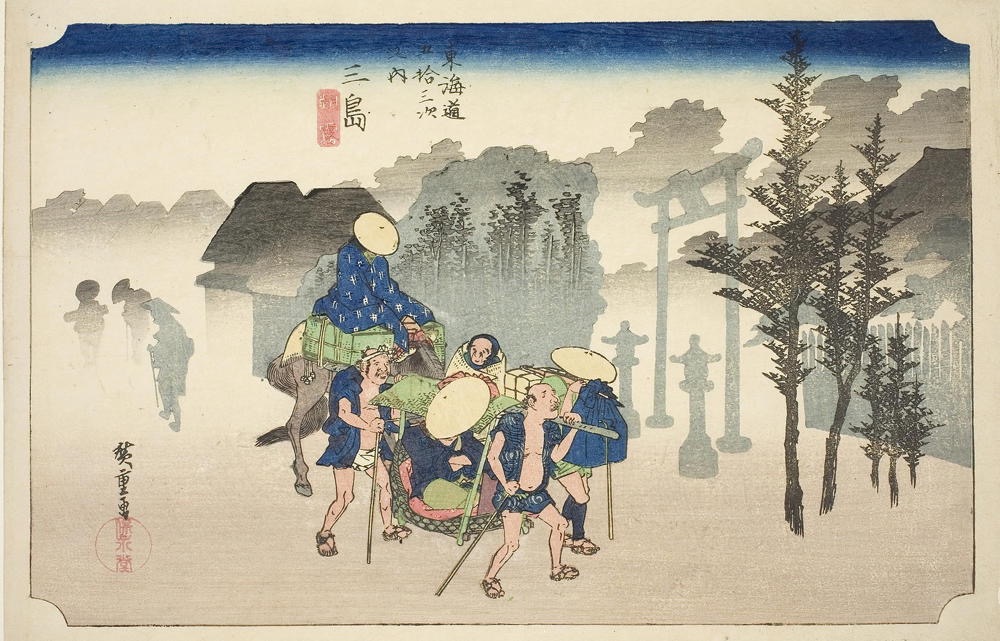
Utagawa Hiroshige 歌川 広重
Mishima: Morning Mist (Mishima, asagiri),
from the series “Fifty-three Stations of the Tokaido Road
(Tokaido gojusan tsugi no uchi),” also known as the Hoeido Tokaido
(c.1833/34)
"Finding it might forfeit its prize."
Prosperity doesn’t necessarily breed complacency. As a colleague confided to me, “I believe that most who are prosperous become quickly committed to the belief in being entitled and are driven to fear that someone will take away their prosperity. Of course, as with most beliefs, this is unprovable.” Nor does Prosperity necessarily breed defensiveness. The Prosperous might remain less than perfectly free to choose what to do, whatever their motive. I propose that Prosperity alone might hardly influence choice. The heart still wants whatever the heart wants, though it might be that Prosperity renders some of those wants to seem more achievable than poverty might, for instance. Prosperity might open possibilities without necessarily guaranteeing achieving anything. In my personal experience, Prosperity encouraged me into Seeking what had previously seemed out of my reach. This, too, qualifies as belief, and as such, proves nothing conclusively, other than accurately representing my personal experience.
The Muse might be a better example, for she’s definitely a seeker. She continues to develop fresh skills, seemingly encouraged by each opportunity to learn. Her relationship with learning has been generally reinforcing. She only rarely encounters a subject that she cannot rather quickly master. Each success seems to encourage even more inquiry, since each represents another opportunity to experience a fresh mastery. As her masteries expand, they seem to merge into a reassuring Prosperity that encourages even more inquiry. Her Prosperity has motive force, nudging her ever forward. I won’t claim that she’s necessarily a poster child for how Prosperity works in most folks, but she might be more of an example for many, for Prosperity seems only rarely a steady state. What fueled that sense yesterday might not necessarily last overnight. Fresh fuel seems necessary to maintain Prosperity’s presence.
I serve as the counterexample in the family. I rarely find a field of study that doesn’t ultimately baffle me. The pattern began in middle school, when my native intuition collided with the dominant expectation that successful learning involved memorizing stuff. I can barely remember my own name, and that’s on good days. I can describe things in great, flowery detail, but I cannot for the life of me remember the name of the famous scientist who proposed the theory he popularized, and recalling it was what constituted learning in my middle school. I tested poorly. I consequently avoided science classes, since they seemed to emphasize what I’d learned I couldn’t succeed at. I learned that if I passed a single general science class in ninth grade, I could be excused from further science study through high school. You can believe that I studied harder than I ever had before to ensure that I passed that class. I never did learn how to test well, though, and I still tend to cower when faced with an opportunity to learn a new skill. I assume, in what might be a self-fulfilling prophecy, that I won’t succeed and, indeed, I rarely have.
I became Prosperous by unconventional means. This might suggest that everyone becomes Prosperous in their own unique way. If so, this brings into serious question whether the popular myths about where Prosperity comes from amount to fiction. I’ve always subscribed to the belief—which, according to my friend, still doesn’t constitute proof—that everyone becomes Prosperous in an utterly unique way, often essentially by accident. I might not learn in the same clear way The Muse acquires skills, but I manage to acquire them by means more amenable to my beliefs and preferences. What might constitute such means must remain a mystery until I stumble upon them. I stumbled into Prosperity and, by the grace of something or nothing at all, I continue stumbling, Seeking as the primary means for preserving and extending a Prosperity I never properly achieved. I slipped in through the bathroom window. Maybe you did, too.
My writing about Prosperity has become another form of Seeking. Because I didn’t know beforehand what might constitute an explanation of the phenomenon, I began most mornings with a question. Some mornings, I struggled to even find a germane question to ask myself. I seem to be backing into an understanding, or maybe I’m only constructing a deeper appreciation of how complicated even something as seemingly simple as Prosperity might actually be. Seeking isn’t knowing beforehand. It’s learning, often long after, though it sometimes seems to entail little learning, though it’s not necessarily aimless wandering, either. The mere act of Seeking creates a target, a future state regardless of whether it’s ever achieved. Since we’ve already established that Prosperity must be a verb, it cannot stand static and must be Seeking its next iteration, and the ones following that. Prosperity might, in this way, never be conventionally achievable. Seeking it reliably produces it. Finding it might forfeit its prize.
©2026 by David A. Schmaltz - all rights reserved

Good For A Goose

Comeuppance (9)
Decency (90)
Decency Unscrolling (1)
EndDays (92)
Exiled (90)
Fambly (93)
FollowingChapters (93)
Grace (92)
Humor (2)
iAlogue (1)
Letters to the Editor (1)
NextWorld (91)
Personal (18)
Prosperity (94)
Steam Festival (4)
Unscrolling (89)
Vaporized (6)
Work (16)
September 2026
August 2026
July 2026
June 2026
May 2026
April 2026
March 2026
February 2026
January 2026
December 2025
November 2025
October 2025
September 2025
August 2025
July 2025
June 2025
May 2025
April 2025
March 2025
February 2025
January 2025
December 2024
November 2024
October 2024
September 2024
August 2024
July 2024
June 2024
May 2024
April 2024
March 2024
November 2006
October 2006
September 2006
August 2006
July 2006
June 2006
May 2006
April 2006
March 2006
February 2006
January 2006