ThePeople
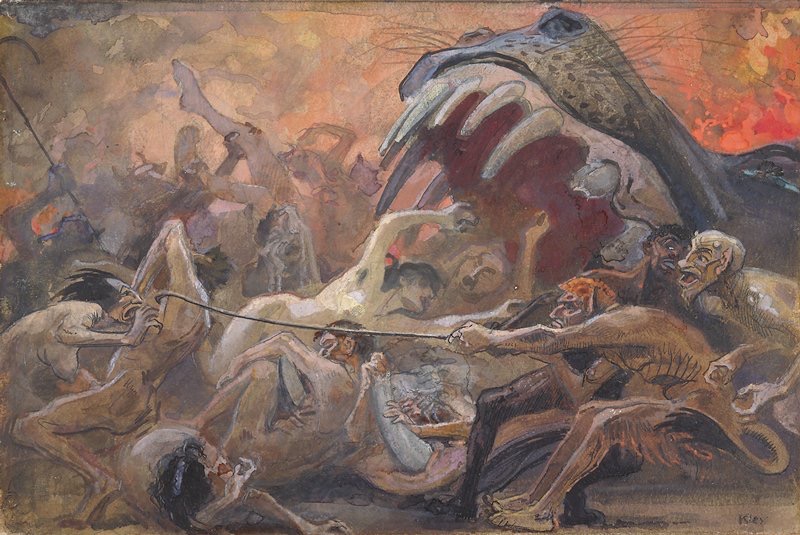
Heinrich Kley:
Demons Pulling People into the Jaws of Hell
(c. 1910–15)
"We nonetheless insist that this behavior represents a more perfect union."
The Founders wisely designated the supreme law of the land they founded as being of and by “We, ThePeople.” Individuals had previously signed the Declaration of Independence, but our Constitution addressed its contents in the name of a more amorphous presence. ThePeople suggests a majority opinion without hinting at any underlying dissent, though we know from personal experience that every law, every statute, was the product of disagreement and debate before ever being approved. Agreement was never the native state of even these United States. We rely on this studied misrepresentation to project a necessary sense of union. Dissent might better describe the advocacy we practice, though every minority, no matter how marginal their actual position, insists that their parochial perspective most accurately represents the opinion and will of We, ThePeople, echoing our founding and preserving ambiguity.
We, ThePeople probably serves as our most enduring virtue signal, for it designates the side where righteousness exclusively resides. It’s We, ThePeople who elect our officials, not some despot with parochial interests appointing them. It’s also ThePeople that those elected officials are supposed to serve, not special interests. The founding ambiguity embodied in the mythical We, ThePeople has sometimes gotten us, as citizens, into serious trouble. We each believe, as a matter of our highest principles, that we represent an authentic embodiment of We, ThePeople rather than Them, The Others, though not every perspective arrayed around an issue can actually represent the opinion of We, ThePeople. We don’t even have a way to determine the majority, short of holding an election or using polling projections. It remains a matter of opinion, not fact, who’s We, ThePeople and who’s Them, The Other on each and every issue.
Any aggrieved minority must dust off their We, ThePeople credentials, though, or forfeit that sense of authority only the ultimate majority ever possesses. Civil disobedience virtually always represents a numerical minority, though some issues might be supported with the assistance of that ever-present yet inevitably silent majority, another handy ambiguity anybody might invoke to counterbalance an absence. It would be a fool’s mission to start a protest knowing for certain that your opinion represents barely a countable minority, righteous indignation notwithstanding. Plenty of windmill tilting has come from passionate advocates, and some have even sparked what eventually matured into a majority opinion and then into law. More often, though, the noise and feathers reinforce at most the protestors, and little changes in this disarmingly indifferent-seeming world. None of any of that ever really convinces that dedicated minority that they did not actually represent the We, ThePeople majority. To forfeit that identity must be to agree to assume irrelevance.
Elected officials face impossible choices. Each constituency insists that they actually represent the We, ThePeople majority, and each of them actually might, on some issue, on some day. No official can even accurately assess who represents the majority of those who will vote in the next election cycle. It’s a genuine fool’s mission, then, to try to cater to whoever might emerge as representing the eventual We, ThePeople. Nor could it be prudent to insist too much on acknowledging the inescapably minority opinion every constituent brings when pleading their case. Each insists they represent the true will of We, ThePeople, though even the dimmer elected official will readily recognize they’re being presented with endless paradoxes. No, the elected official must use their personal judgment when choosing how to act to represent ThePeople, since nobody, especially not the elected official, has the first clue what We, ThePeople might actually choose if they ever existed outside a ballot box.
A certain psychosis overtakes those engaging in unacknowledged paradox. True Believers must inevitably believe falsehoods and be incapable of seeing it. A cargo cult mentality pervades every We, ThePeople majority, because they’re actually a We, ThePeople minority. Members judge others too easily by their apparent adherence to the collective catechism. Certain beliefs seem self-evident, and certain behaviors cannot be reasonably tolerated. Those outside the We, ThePeople Venn Diagram bubble represent The Enemy, and almost everything seems fair when trying to counter their insidious influence. Life-or-death debates occur over issues that wouldn’t otherwise raise an odd eyebrow. Defensive barricades rise along otherwise placid walkways. Snipers aim at obviously feckless opponents. Elected officials seem to confirm why so many distrust their judgment. Few within the We, ThePeople surreality seem to recognize that they’re the true source of their discontent. They believe themselves to be the sole defenders of some way of life or, worse, of our sacred environment that those elected sons-a-bitches don’t even care enough about to properly steward. We nonetheless insist that this behavior represents a more perfect union.
©2026 by David A. Schmaltz - all rights reserved
Good For A Goose

Comeuppance (19)
Decency (90)
Decency Unscrolling (1)
EndDays (92)
Exiled (90)
Fambly (93)
FollowingChapters (93)
Grace (92)
Humor (2)
iAlogue (1)
Letters to the Editor (1)
NextWorld (91)
Personal (18)
Prosperity (94)
Steam Festival (4)
Unscrolling (89)
Vaporized (6)
Work (16)
September 2026
August 2026
July 2026
June 2026
May 2026
April 2026
March 2026
February 2026
January 2026
December 2025
November 2025
October 2025
September 2025
August 2025
July 2025
June 2025
May 2025
April 2025
March 2025
February 2025
January 2025
December 2024
November 2024
October 2024
September 2024
August 2024
July 2024
June 2024
May 2024
April 2024
March 2024
November 2006
October 2006
September 2006
August 2006
July 2006
June 2006
May 2006
April 2006
March 2006
February 2006
January 2006