Trespass
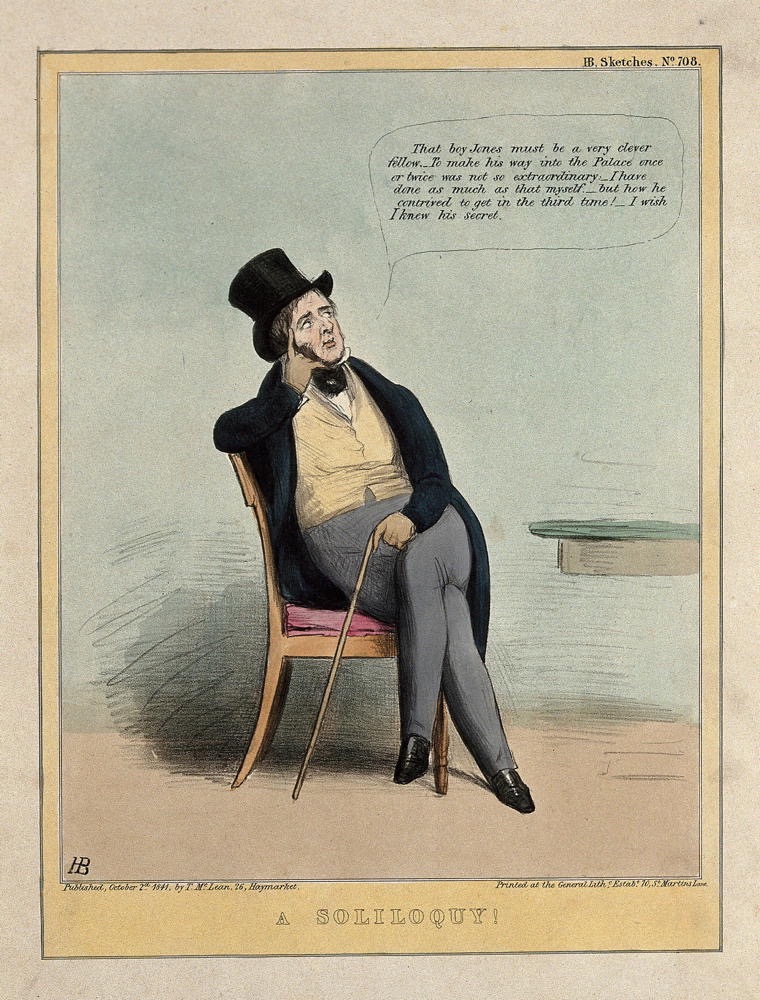
John Doyle (H.B.):
Lord Melbourne speaks his thoughts aloud. Coloured lithograph
(1841)
"…I will never know what is or isn't."
Of all the civil and criminal infractions, Trespass seems the most passive. One need not prove motive to bring charges against a trespasser. Nor does anyone need to prove physical damage, for the very act of presence serves as adequate evidence of the commission. If I “get in your space,” I might violate your subtlest rights, the rights to control your space. The Lord’s Prayer asks for forgiveness for any trespasses committed against us as well as those we might have committed against others, challenging more vengeful notions of jurisprudence, for any decent Comeuppance might well stem from any odd trespass both committed and unforgiven. Comeuppance seems unjustified in those cases where the Trespass was contritely forgiven. “No harm, no foul,” in the popular jargon. This convention suggests that jurisprudence might first demand an absence of forgiveness and, perhaps, at least a little taste for vengeance. Of course, many have characterized this universe as natively dog-eat-dog, with the wronged perhaps perfectly or even imperfectly, but nonetheless justified in pursuing redress to the extent any court might grant it.
I am eventually forced to ask myself if I really intend to encourage this dog-eat-dog nature by actively engaging in it. Our incumbent spends altogether too much of his non-refundable time seeking redress for one or another or, often, a raft of Trespasses, often to little effect. Unsatisfied with one judge’s decision, he quickly appeals, as if another jury might determine guilt or innocence differently depending on venue. Troublingly, his assumption often seems validated. Then his opponent appeals that judgment, and the circular reasoning continues, albeit with ever more frantic earnest, with the trespassed against chasing the trespasser without a sense that forgiveness might intervene to anyone’s benefit. This frantic Comeuppances dance ultimately makes little sense to me, for where does justice lie within such swirling ambiguity? I feel encouraged to acquiesce if only to avoid being cast as a delighted vengeful punisher.
I’d rather not be cast as anybody’s judge, jury, or, especially, executioner, even though I know it has become increasingly popular to go all Cotton Mather on people, especially our incumbent, who, even on his best days lately, seems to so richly deserve even the harsher of the many available Comeuppances. I do not feel like cheering in anticipation of his usurpation, for his very presence seems like a tragic mistake, unredressable by any reasonable means. His final Comeuppance could come in the form of an ultimately successful goad, the final unforgivable insult that drove his opponents to better his worst behaviors with their otherwise completely just punishments. If even the cats of this world get goaded into behaving like dogs, civilization seems more than merely threatened. It’s collapsed.
I carry this Comeuppance business with no small mass of distress. Yes, I almost desperately need redress, for the insults have become something well North of continuous and increasingly humiliating. Yet at the same time, I cannot forget my earliest learnings about the nature of Comeuppances and punishments, how even the guiltiest party in the history of this world—and, believe me, there have been no shortage of genuinely guilty parties—became innocents again after the accusations against them became accepted as just and prudent. Then, when the question of Comeuppance came into play, impossible choices entered into the previously rather mindless calculus. For the longest time, we dreamed of vanquishing, until we found that terrible, if not necessarily all that swift, sword landed in our hands, and we faced the very real possibility that we might become the monster we had convinced ourselves we were previously just prepared to slay to achieve justice.
Forgiving the trespasses committed against us might be the highest justice, but the notion that any genuine monster like our incumbent might somehow get away scot-free more than irks me and most. Lest any of us become the monster by satisfying our most primitive notions of justice, we must consider our punishments terribly carefully; if, indeed, our sentences ultimately mete out anything even vaguely resembling justice or merely vengeance. In many terribly real ways, our incumbent has been punishing himself for decades. To begin to comprehend the depth of his debt to himself, consider the volume of compensation he sincerely feels he’s owed for the chaos and heartbreak he’s so sincerely sown over his life. He seems to firmly believe he’s owed for the non-refundable time he’s spent frantically trespassing against even the least of us, who understandably hold him in reviling contempt. If that, alone, isn’t punishment for everyone involved, I will never know what is or isn’t.
And what of Justice, if any of us ever understood what that was? We must, perhaps, conjure up a fresh understanding to match every emerging infraction. Every fresh Trespass might deserve its own conclusion arrived at after overmuch consideration. Justice might inevitably represent an essentially unresolvable paradox, much better served in theory than it can ever be served in practice, like forgiveness or even understanding, things even the least of us might well be capable of eventually experiencing if not necessarily of dispensing.
©2026 by David A. Schmaltz - all rights reserved

Good For A Goose

Comeuppance (13)
Decency (90)
Decency Unscrolling (1)
EndDays (92)
Exiled (90)
Fambly (93)
FollowingChapters (93)
Grace (92)
Humor (2)
iAlogue (1)
Letters to the Editor (1)
NextWorld (91)
Personal (18)
Prosperity (94)
Steam Festival (4)
Unscrolling (89)
Vaporized (6)
Work (16)
September 2026
August 2026
July 2026
June 2026
May 2026
April 2026
March 2026
February 2026
January 2026
December 2025
November 2025
October 2025
September 2025
August 2025
July 2025
June 2025
May 2025
April 2025
March 2025
February 2025
January 2025
December 2024
November 2024
October 2024
September 2024
August 2024
July 2024
June 2024
May 2024
April 2024
March 2024
November 2006
October 2006
September 2006
August 2006
July 2006
June 2006
May 2006
April 2006
March 2006
February 2006
January 2006