UnSecurity
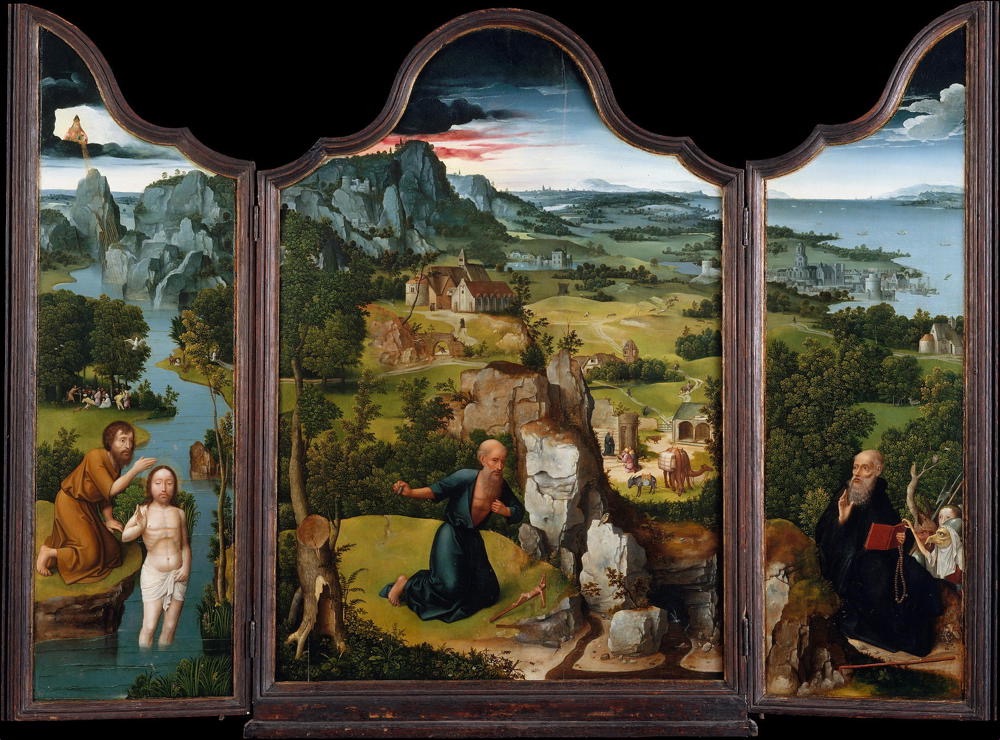
Joachim Patinir
The Penitence of Saint Jerome
(ca. 1515)
"… and they usually cost much more than Prosperity ever bargains for."
Our Prosperity was never really secure. Its security was usually merely presumed, for there could never have been an adequate defense against its many enemies, and it always had its enemies, many of them. It survived, while it survived, as a matter of apparent grace, without coherent explanation. It came, but was always capable of leaving or, more likely perhaps, of being snatched away for no apparent reason. There were always those who insisted upon assaulting any decency, as if their special gift was the superpower to sour others’ experience. They were always trouble, and everyone knew they were or would be real trouble before their story ended. They were often just jealous, envious of others’ apparently better circumstances, angry at themselves for where they landed, but also at least equally angry at others for prospering. It never made sense to assault themselves, though they were capable of severely wounding themselves and would wound themselves on occasion, but continuous self-destruction makes little sense, even to almost complete idiots. Regardless of the defense erected against such forces, Prosperity would often lose, especially on the first round or two, though it would always retain an ability to recover and renew. It mostly made no sense to maintain a robust defense, since it could eventually renew and recover infinitely as it wished. Prosperity was always persistent.
A piece of Prosperity’s perversion insisted that we needed to maintain a more active defense. The public cried out for greater security, especially after the 9/11 experience. The concept of Homeland Security was floated and adopted a little too enthusiastically. Our Prosperity began being frisked at airports and held in suspicion by security professionals who sowed the seeds of institutionalized insecurity that severely hobbled our traditional sense of Prosperity. It became increasingly difficult to maintain a sanguine garden behind the erected battlements, for Prosperity was never designed to be a defensive mechanism. The antagonism grew until Prosperity shrank in response. Then we had perhaps an enviable defense, but without the sense of security that Prosperity naturally provided. We made a trade-off that ultimately left us feeling less secure, even as we became more heavily defended. We began to learn that those who would purchase security with their Prosperity ultimately possess neither security nor Prosperity, an apparent paradox.
Security always seems to make prospective sense. Who wouldn’t want to build a fence against potentially malign forces? My lowly little pickup truck had just such a defense built in, but since I’d bought it aftermarket from a friend, I had no idea it was present. I learned when I couldn’t get it started after topping off the tank. Earlier that day, I’d gone to start it so that I could fetch two fine metal lawn chairs I’d bought, but the battery was dead. It was a new battery, bought just last winter, and while I had left the truck parked for five or six weeks, it had apparently completely discharged. I’d been meaning to buy one of those Jump Boxes that can spark an engine just as well as a more tedious cabled jump, so I found one and quickly started the engine. I finished fetching the chairs, then invited The Muse for a drive while I recharged the inexplicably dead battery. I made an innocent mistake when I turned off the engine after I’d stopped at a gas station to top off the tank. The engine wouldn’t restart after, not even when plugged into that snazzy new Jump Box.
We returned to The Villa via a two-hundred-dollar tow. I figured the starter was broken, but Claude® offered another explanation. It opined that the automatic anti-theft system might have kicked in. It explained that these can get confused when the battery fully discharges. Because I hadn’t unlocked the truck’s door with the key fob because the battery was dead, the automated anti-theft system couldn’t authenticate me as the owner. It ran until I turned it off, but by then it still hadn’t verified my identity, so it denied me the ability to restart the engine. The battery was still discharged. I will have to remove that battery, take it somewhere to recharge it, then reinstall it and follow a strict sequence of moves that might get the pickup to recognize me as the owner and let me start it. My prior sense of Prosperity has already not survived this brush with security. I would rather the truck had been stolen. I was insured against that risk. Being denied entry to my own vehicle was apparently not an insurable condition.
Similar absurdities always accompany security, especially when attempting to defend against any of the many enemies of Prosperity. As I said earlier in my Innogrance story, Prosperity thrives on some mix of innocence and ignorance that no insurance could ever cover against losing, though each always exists at risk of disappearing. There could be no recourse. The losses become stories, perhaps even cautionary ones, though nobody’s ever the wiser for losing their Prosperity, however it occurs. Most such losses will be temporary and largely psychological, but more egregious ones will always remain possible, with no prepared defense ever capable of successfully defending against the worst-case scenarios. Assuming I can recover my pickup Prosperity, I will see if my mechanic can disable its automated anti-theft system, since it apparently never sleeps and slowly eats the battery if I don’t run the truck regularly enough. Security cannot apparently be very easily purchased. Often, where Prosperity’s concerned, only Unsecuritys are regularly available for purchase, and they usually cost much more than Prosperity ever bargains for.
©2026 by David A. Schmaltz - all rights reserved

Good For A Goose

Comeuppance (13)
Decency (90)
Decency Unscrolling (1)
EndDays (92)
Exiled (90)
Fambly (93)
FollowingChapters (93)
Grace (92)
Humor (2)
iAlogue (1)
Letters to the Editor (1)
NextWorld (91)
Personal (18)
Prosperity (94)
Steam Festival (4)
Unscrolling (89)
Vaporized (6)
Work (16)
September 2026
August 2026
July 2026
June 2026
May 2026
April 2026
March 2026
February 2026
January 2026
December 2025
November 2025
October 2025
September 2025
August 2025
July 2025
June 2025
May 2025
April 2025
March 2025
February 2025
January 2025
December 2024
November 2024
October 2024
September 2024
August 2024
July 2024
June 2024
May 2024
April 2024
March 2024
November 2006
October 2006
September 2006
August 2006
July 2006
June 2006
May 2006
April 2006
March 2006
February 2006
January 2006