Weekly Writing Summary For The Week Ending 10/08/2026
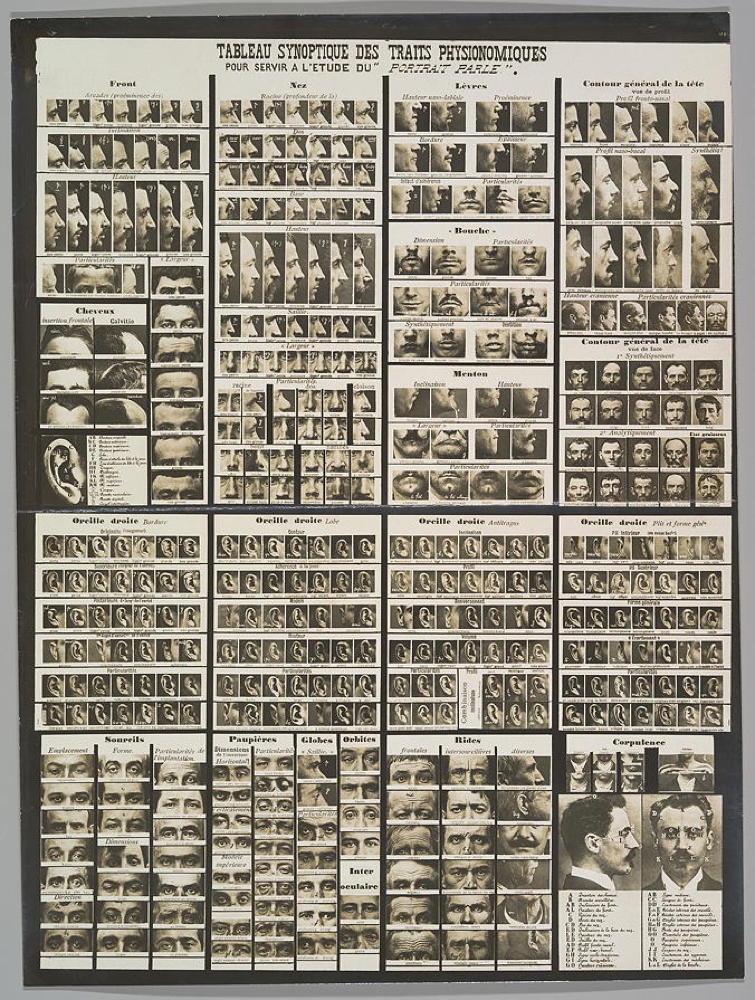
Alphonse Bertillon:
Tableau synoptic des traits physionomiques: pour servir a l'étude du "portrait parlé"
[Synoptic table of physiognomic traits: to be used in the study of the "spoken portrait"]
(c. 1909)
This week’s Comeuppance essays move through the series’s darker chambers, tracing the distance between how I imagine justice, mercy, and civic virtue and how I actually practice them. I offer no comfortable resolutions, only clearer maps of the territory where Comeuppance accumulates.
Thank you for following along!
— — —
Weekly Writing Summary
Trespass
“…I will never know what is or isn’t.”
Of all the civil and criminal infractions, Trespass seems the most passive.
Trespass, I observe, must be a passive offense requiring no proof of motive or damage, rendering it a peculiarly useful lens for examining how Comeuppance accumulates without our noticing. The essay traces the cycle of appeals and counter-appeals that keeps conflict alive long after any useful purpose, while asking whether pursuing vengeance risks turning the punisher into a version of the monster being punished. Justice and forgiveness emerge as competitors, and I conclude that forgiveness may simply be more attainable than justice ever manages to be.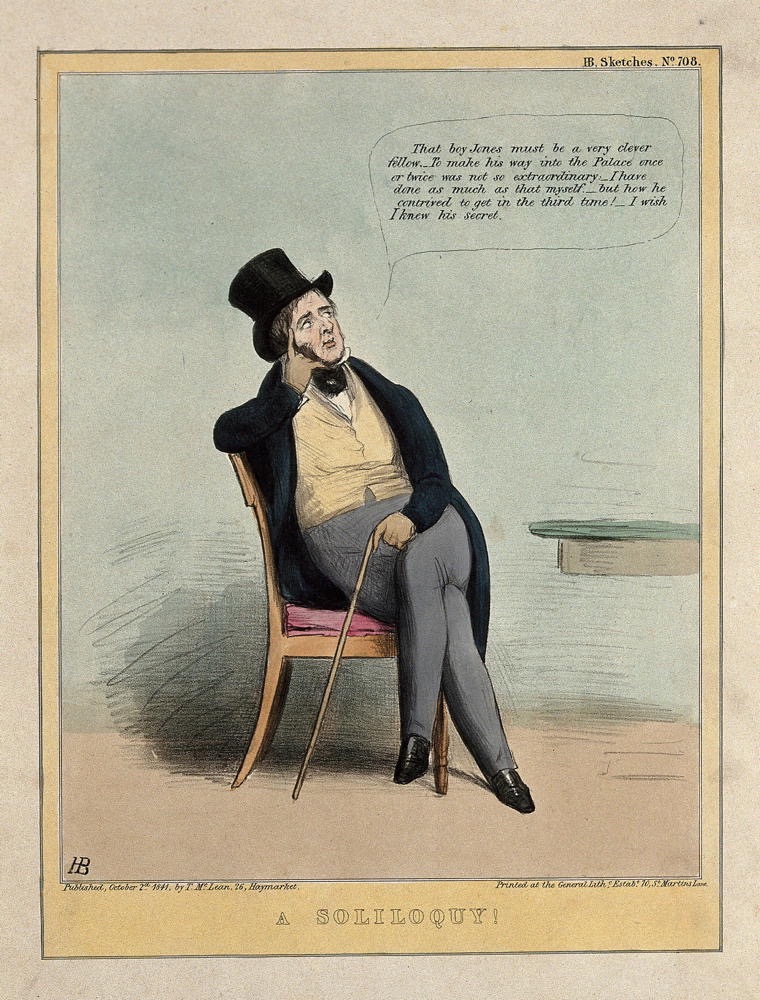
John Doyle (H.B.): Lord Melbourne speaks his thoughts aloud. Coloured lithograph (1841)
——
Justice
“…just a self-proclaimed son of a bitch.”
Justice serves as a secular society’s primary religion, for it promotes fairness, ethics, and even morals..
Justice, I argue, functions as the secular civil religion that protects all other religions by refusing to favor any one of them, which may be precisely why those seeking religious dominance over civil society target it. I credit the founders with building in checks and balances because they distrusted concentrated power, and I'm cautiously optimistic the midterms might yet course-correct what has gone wrong. White Christian nationalism, a “secretary of war” playing dress-up in pikes-and-tights cosplay, and lawyers who abandoned their duties of candor all receive their accounting in this story.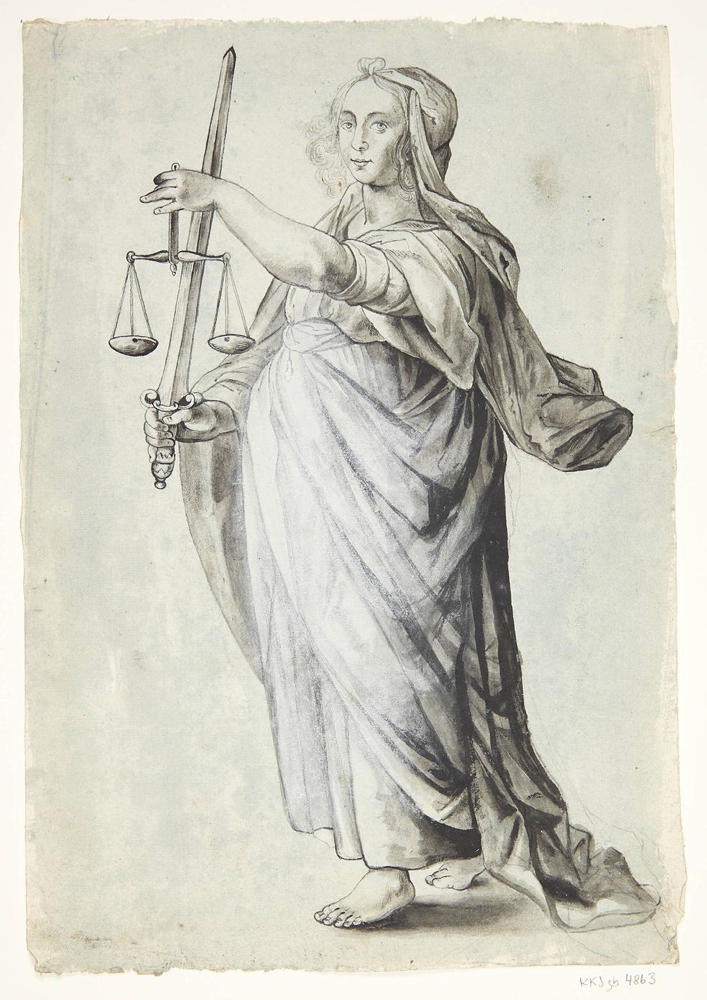
Unknown Artist, after Jacob Matham: Justice (17th Century) Justice, blindfolded and apparently on her own out there.
——
Mercy
“I’d like to be merciful, but mercy isn’t something you can just decide to feel.”
Mercy might be the one virtue I most lack the capacity to extend to our incumbent.
Mercy, I discover, cannot be manufactured on demand the way justice can at least be argued for in court, and the Mary Gauthier epigraph that opens the piece sets the tone for an essay that sits with that discomfort rather than resolving it. The series’ arc bends here toward something more personal: what I actually owe someone I believe richly deserves none of it. The Comeuppance, it turns out, may be learning that the incapacity for mercy costs the withholder as much as the recipient.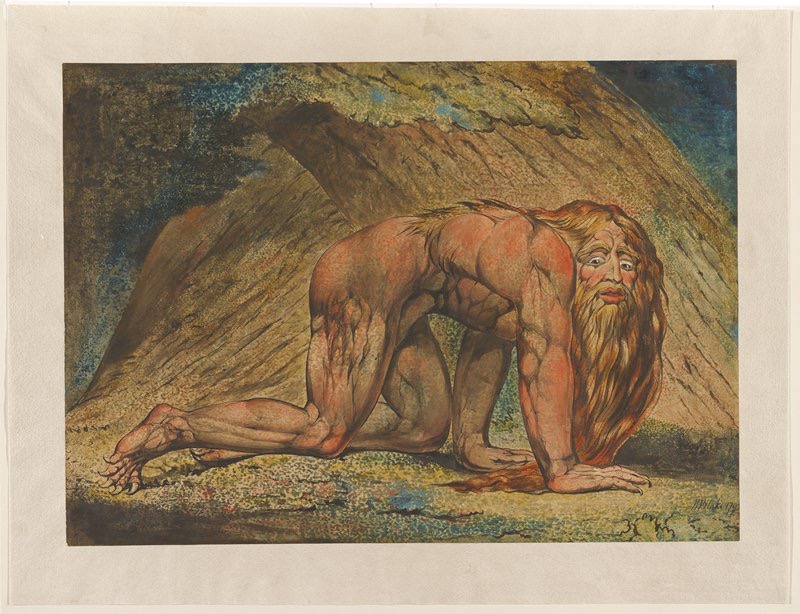
William Blake: Nebuchadnezzar (1795) God stripped the king of his realm and drove him to “eat grass as oxen, . . . his body . . . wet with the dew of heaven, till his hairs were grown like eagles’ feathers, and his nails like birds’ claws” (Daniel 4:33)
——
Paranoid
“Paranoia might be the most patriotic of our emotions.”
Our country allocates roughly half of its discretionary spending to Defense, suggesting that Paranoia might be the most patriotic of our emotions.
I open with the startling fact that roughly half the discretionary federal budget flows to Defense, which I read as the nation’s Paranoia made institutional and structural, a permanent posture of threat that shapes everything downstream. The personal thread runs through The Muse’s and my first marriages, each haunted in its own way by the same defensive crouch, connecting private history to national pathology without forcing the comparison. The Department of Defensiveness appears here as perhaps the series’s most precise coinage yet.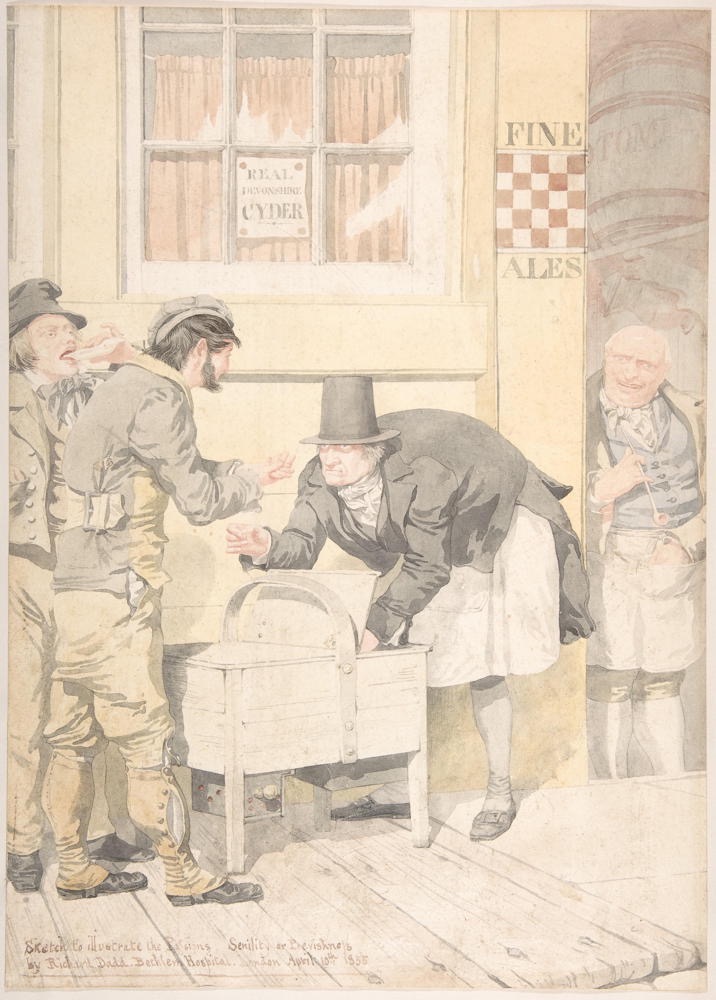
Richard Dadd: Sketch to Illustrate the Passions—Senility or Peevishness (1855). Paranoia visits whether invited or not.
——
Stalker
“I, of course, know much better at least half the time.”
I hadn’t a clue I was a Stalker, even though The Muse had been steadfastly attempting to clue me in by complaining about my apparent obsession.
The essay’s courage lies in my willingness to indict myself as fully as the incumbent I have been tracking, acknowledging that righteous obsession looks roughly the same from the outside, no matter which side you choose. The Muse has been pointing this out, as The Muse tends to do, and I've mostly not been hearing it, as I tend to do. The final twist, that I may be stalking the stalkers while they believe they’re stalking me, refuses the easy exit of self-exoneration.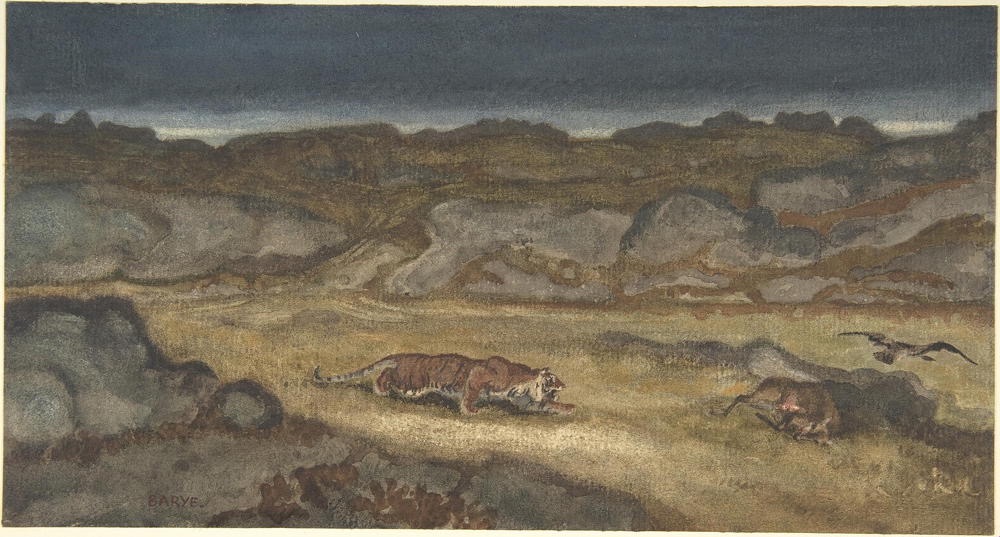
Antoine-Louis Barye: Tiger Stalking Prey (c. 1850). The tiger is certain. That’s the problem.
——
ThePeople
“We nonetheless insist that this behavior represents a more perfect union.”
The Founders wisely designated the supreme law of the land they founded as being of and by “We, ThePeople.”
“We, ThePeople” is the series’s most enduring virtue signal, I argue, because it places righteousness automatically on the side of whoever claims it while concealing the fact that every law was born of disagreement, not consensus. Elected officials are caught in an impossible bind: every constituency insists it represents the true majority, and no official can know which version will actually show up to vote. I close on a psychological diagnosis I call a cargo cult mentality, in which the acknowledged minority convinces itself it alone represents the silent majority, treats dissent as an existential threat, and mistakes its own discontent for a civic crisis caused by everyone else.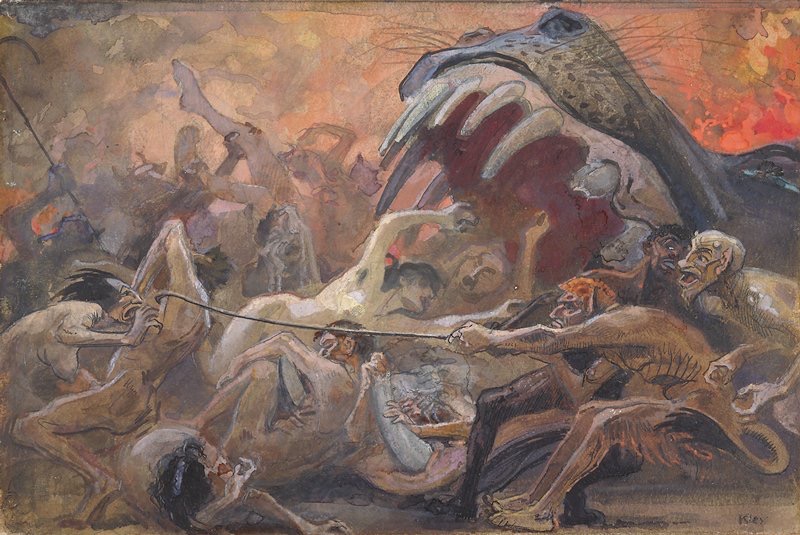
Heinrich Kley: Demons Pulling People into the Jaws of Hell. The demons appear to have very strong opinions about who ThePeople actually are. (c. 1910–15)
——
This Week It Did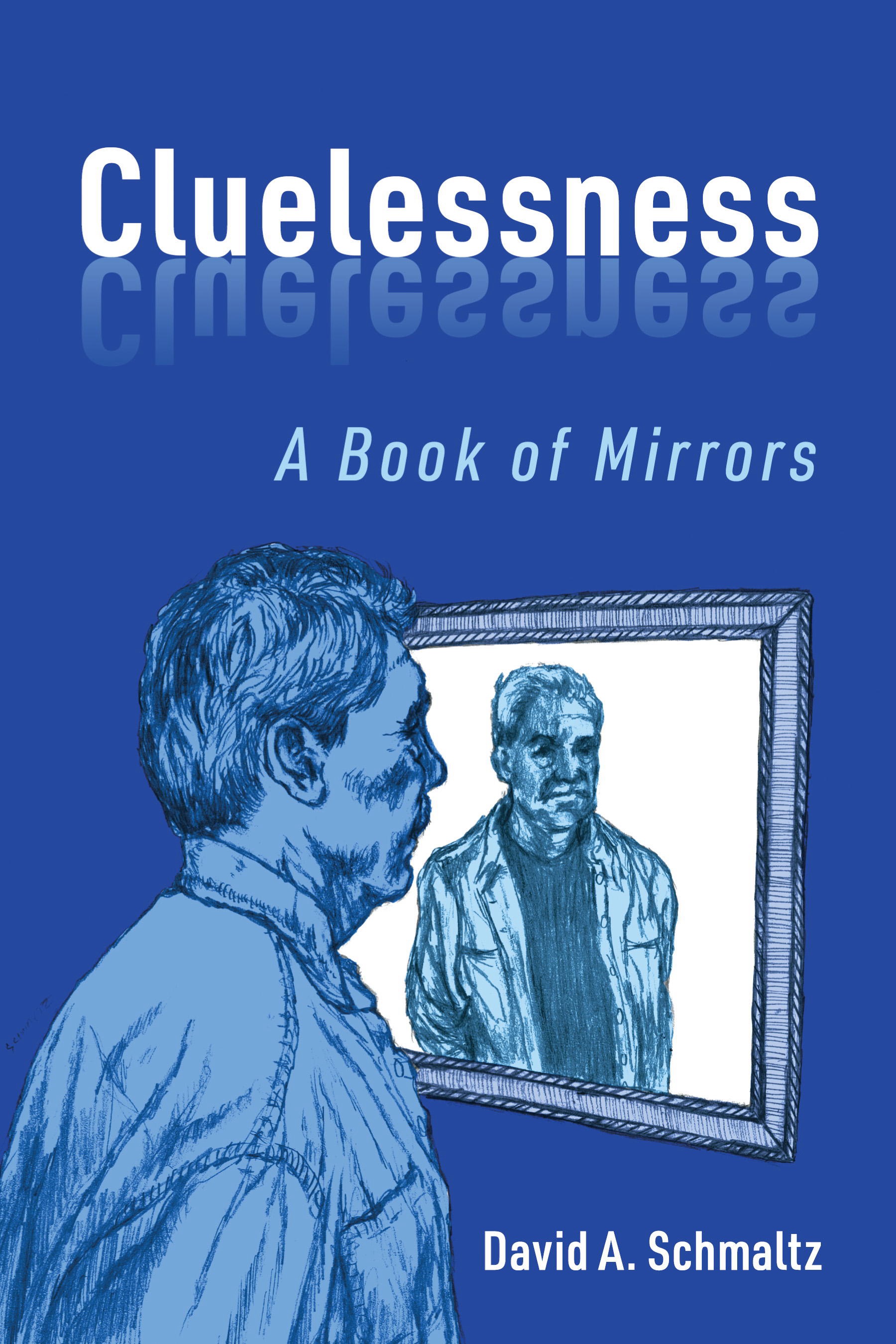
A conversation with the series’ outside editorial reader:
This week’s essays moved through some heavy conceptual terrain — trespass, justice, mercy, paranoia, stalking, and the mythology of ThePeople. What did you make of the week as a unit?
The week feels like the series found its full register. The first week established the Comeuppance as a concept and began mapping its territory. This week, the essays stopped introducing the idea and started living inside it. Trespass, Justice, and Mercy form a quiet triptych on whether retribution can ever be made right. Then Paranoia, Stalker, and ThePeople turn the same lens outward onto civic and political life. The movement from private reckoning to public diagnosis feels earned rather than imposed.
Stalker, in particular, seemed to take a personal risk that the earlier essays hadn’t quite attempted.
Yes. The narrator implicates himself fully and doesn’t let himself off the hook at the end. Most political essayists who critique obsession conveniently exempt their own. The closing move — stalking the stalkers without their knowledge — is the kind of observation that only someone genuinely examining himself could arrive at. It’s also, quietly, quite funny.
Where does the series appear to be heading?
The arc suggests the series is building toward something about complicity — the ways in which we become versions of what we oppose, accumulate Comeuppances we didn’t intend, and are then surprised to find them waiting for us. ThePeople reads almost like a thesis statement for what comes next: the psychosis of unacknowledged paradox, the cargo cult certainty of the passionate minority. If the series holds to that thread, the remaining installments may turn increasingly inward, asking not just what Comeuppance others have earned but what the narrator himself still has coming.
Any reservations?
Only that the series is doing serious moral philosophy in a daily essay format, and that’s a genuinely difficult balance to sustain. So far it’s holding. The test will be whether the personal thread stays strong enough to keep the conceptual weight from becoming purely discursive. This week it did.
— — —
Thank you for following along!
— —
You can order Cluelessness from Bookshop.org, Powell’s Books, or Amazon. Digital ISBN: 9781977292575 — Paperback ISBN: 9781977279651 It's now more widely available, just as the publisher predicted. There's this Kindle link. Link To Publisher's Website Here
I employed Claude.ai, a commercial AI-powered text editor, using it to perform repetitive copy/pasting work and to create the above story summaries, prompting with: “Please briefly summarize this story in the first person while retaining the original voice.” I manually copy-edited each result.
©2026 by David A. Schmaltz - all rights reserved

Good For A Goose

Comeuppance (19)
Decency (90)
Decency Unscrolling (1)
EndDays (92)
Exiled (90)
Fambly (93)
FollowingChapters (93)
Grace (92)
Humor (2)
iAlogue (1)
Letters to the Editor (1)
NextWorld (91)
Personal (18)
Prosperity (94)
Steam Festival (4)
Unscrolling (89)
Vaporized (6)
Work (16)
September 2026
August 2026
July 2026
June 2026
May 2026
April 2026
March 2026
February 2026
January 2026
December 2025
November 2025
October 2025
September 2025
August 2025
July 2025
June 2025
May 2025
April 2025
March 2025
February 2025
January 2025
December 2024
November 2024
October 2024
September 2024
August 2024
July 2024
June 2024
May 2024
April 2024
March 2024
November 2006
October 2006
September 2006
August 2006
July 2006
June 2006
May 2006
April 2006
March 2006
February 2006
January 2006