WealthyWisdom
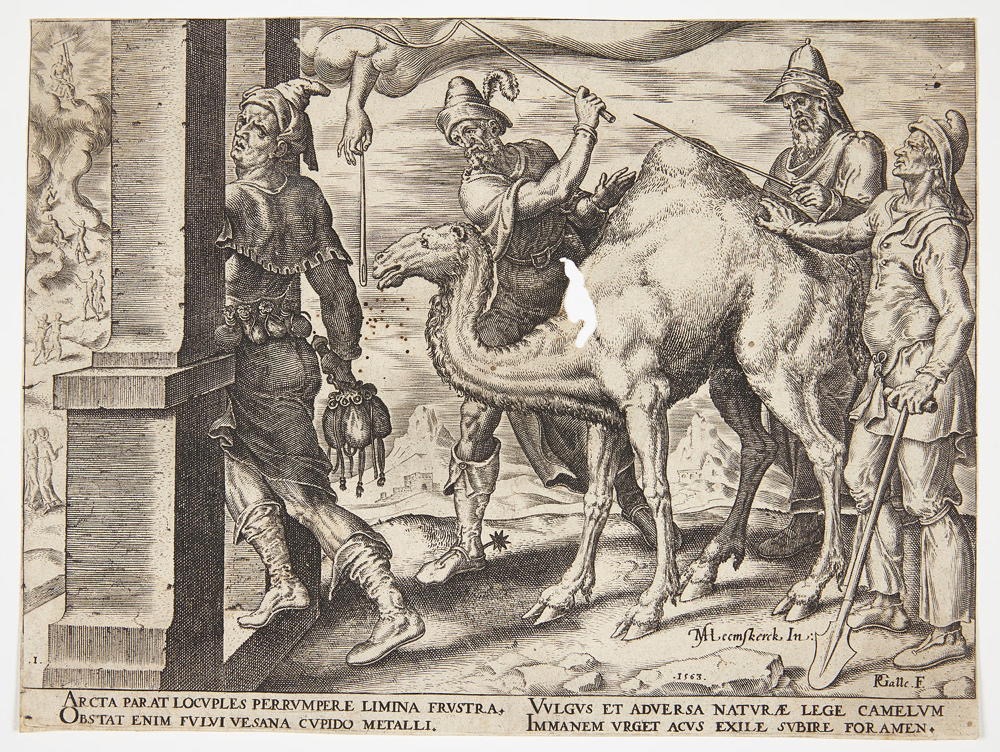
Philip Galle:
It is easier for a camel to pass through the eye of a needle
than for a rich man to enter the Kingdom of God
(1563)
"Maybe the wealthiest man in the world really does belong on Mars."
Nobody mistakes the world’s richest man for the world’s wisest or well-loved. He might be the most reviled person instead, for he exhibits the kind of genius ordinarily reserved exclusively for marsupials rather than humans. Throughout history, the relation between wealth and smarts has shown little correlation, likewise for wealth and health, especially mental. Wisdom tends to travel with other companions and usually leaves the wealthiest to wander through intellectual and emotional wildernesses, rich as Croesus, while literally as poor as most get out. Still, we typically envy the very wealthy as if their assets had rendered them especially protected from experiencing life’s many vagaries, when they seem instead to inherit a raft of their own, in many ways worse than what any so-called regular person ever experiences. Yes, the very wealthy are very different from the rest of us, and not in many ways to envy.
The wealthiest man in the world spent a small king’s ransom on the midterms, almost entirely backing losing candidates. Since the Supreme Court’s narrow 2010 Citizens United v. Federal Election Commission Ruling, which protects political spending as free speech, the wealthiest have spent small kings’ ransoms on almost every race. At first, this tactic seemed to work. It might have been a primary cause of the recent Republican majority in the House and Senate, and given the rules, it seemed an unbeatable ruling. It seemed as though we were destined to continue electing the candidates chosen by the stupidest supporters, rather than anyone who might bring even a glimmer of wisdom into their legislative service. But the destiny of stupidity has always been relatively discernible from the outset, if not clearly present while the kinks worked themselves out. Yes, in those early contests, the best-funded tended to win, but The People eventually caught on that they didn’t need to respond to the noisiest, most frequent advertisements.
A time would come, as it seems to for each and every excess, when reasonable people no longer fall under that thrall. With the near-ubiquitous presence of ads on social media, our natural antibodies against such intrusions started kicking in. I swear that I cannot even see most ads that come across my feeds now. They only spark my sincere inattention. I can patiently wait out their irrelevance, then tap the Leave Ad button without even hearing whatever message it was failing to impart. I might inadvertently tap my way into an actual advertisement, but those fail even more catastrophically, because they leave me pissed off that they rudely disrupted my scrolling trance. Only then might I recognize the intended purpose of the offending advertising and become a permanent enemy of that advertiser, dedicated to never consuming that product or service under any condition. How dare they intrude on my sacred scrolling session! It was inevitable that the Inverse Law of Advertising would eventually take over, introducing the governing paradox of all advertising: FUBOC, Frequency Ultimately Breeds Only Contempt. The more you spend, the worse the advertised product performs.
In the recent midterms, the wealthiest man in this world dropped nearly half a billion dollars, almost all of it on losing candidates. It was as if he had invoked that Inverse Law to guarantee that his candidates would lose. People seemed to choose candidates who hadn’t raised the most money, a clear divorce from the old Reagan Revolution vulture-capitalism school of political engagement, a postmodern version of the once-reliable Midas Touch. Like our incumbent, his chief financier also manifested his superpower: turning whatever he touches into shit. It’s a gift, if not from the Gods, then from the kind of once-common sense that lately seems to be making a comeback. Wealth and wisdom have rarely been traveling companions. The very wealthy seem to lack perspective into how most people live their lives. Great wealth even seems to render the regular people’s aspirations invisible to the wealthy, who seem to possess only very limited perspective. Their wealth seems to keep their attention mostly on themselves. They seem to be barely able to see beyond their nose.
Our incumbent went all in on wealth accumulation, which became the sole discernible purpose of his administration. Not wealth for the good of the nation, of course, but the immeasurably less valuable personal kind, which often came at the price of extending public indebtedness. I understand that the very wealthy consider debt to be an asset, a forever loan that costs little to service after taxes. Further, debt itself isn’t taxable like income, so they can consume like kings without forfeiting meaningful amounts of personal treasure. They live heavily leveraged lives in lieu of living. The rest of us work hard to avoid what the wealthiest wholeheartedly embrace, and thereby actually live very different existences, in different worlds. The wealthiest try to buy their representatives, while the rest of us trust a few to rise above any promise of personal profit and at least try to represent We, The People, for a change. In these midterms, We, The People often spoke louder and clearer than the wealthiest man in the world. That alone seems worthy of celebration. Maybe the wealthiest man in the world really does belong on Mars.
©2026 by David A. Schmaltz - all rights reserved
Good For A Goose

Comeuppance (45)
Decency (90)
Decency Unscrolling (1)
EndDays (92)
Exiled (90)
Fambly (93)
FollowingChapters (93)
Grace (92)
Humor (2)
iAlogue (1)
Letters to the Editor (1)
NextWorld (91)
Personal (18)
Prosperity (94)
Steam Festival (4)
Unscrolling (89)
Vaporized (6)
Work (16)
October 2026
September 2026
August 2026
July 2026
June 2026
May 2026
April 2026
March 2026
February 2026
January 2026
December 2025
November 2025
October 2025
September 2025
August 2025
July 2025
June 2025
May 2025
April 2025
March 2025
February 2025
January 2025
December 2024
November 2024
October 2024
September 2024
August 2024
July 2024
June 2024
May 2024
April 2024
March 2024
November 2006
October 2006
September 2006
August 2006
July 2006
June 2006
May 2006
April 2006
March 2006
February 2006
January 2006